
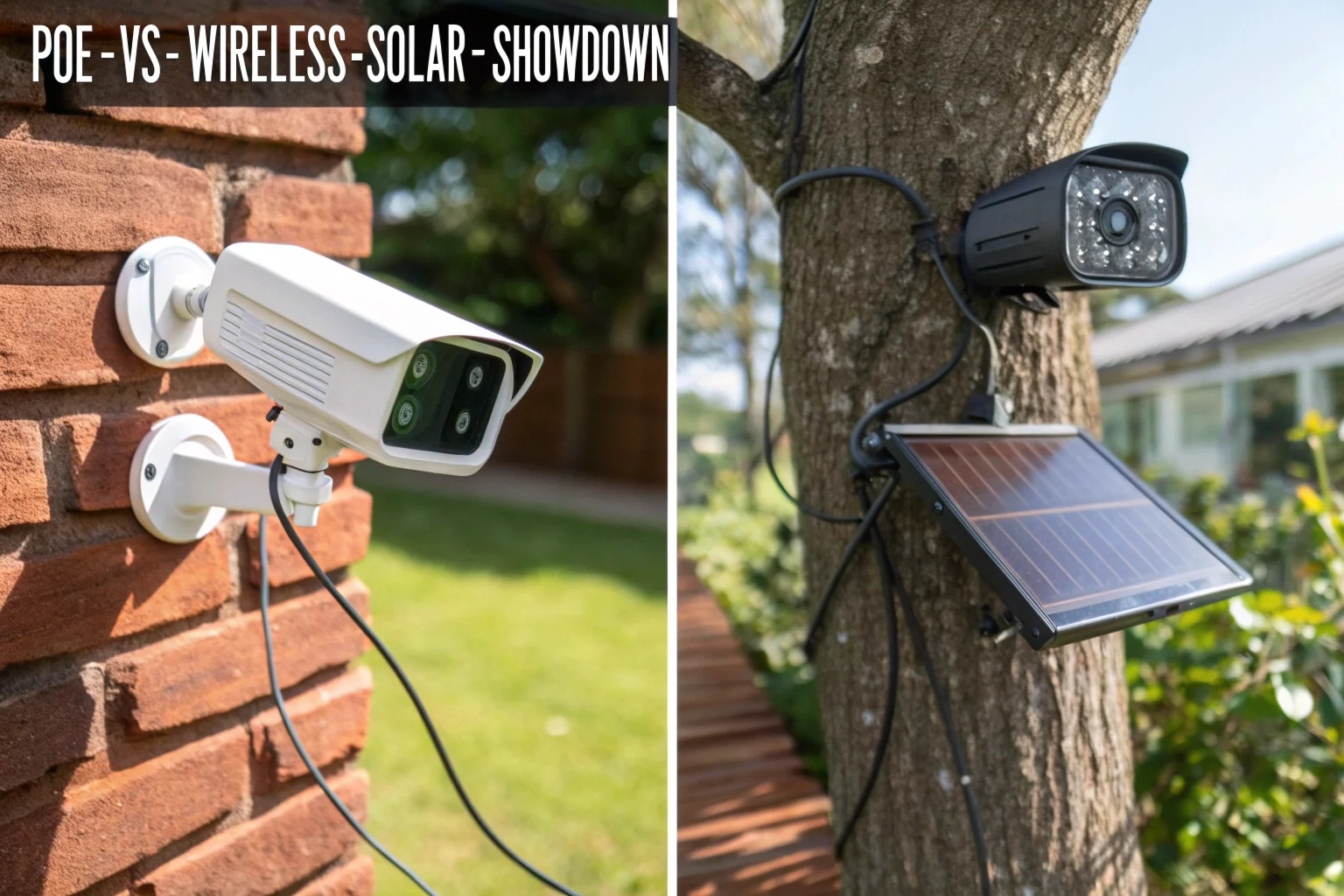
PoE and wireless-solar cameras solve different infrastructure problems. PoE is a power-and-data architecture over Ethernet. Solar describes how a battery camera is recharged. Neither label, by itself, tells you whether a camera records continuously, uses WiFi or 4G, or fits your site's maintenance plan.
For the broader site-selection question, use Solar or Wired Security Cameras: Which Fits the Site?. This page stays focused on the narrower PoE-versus-wireless-solar architecture.
What does PoE actually provide?
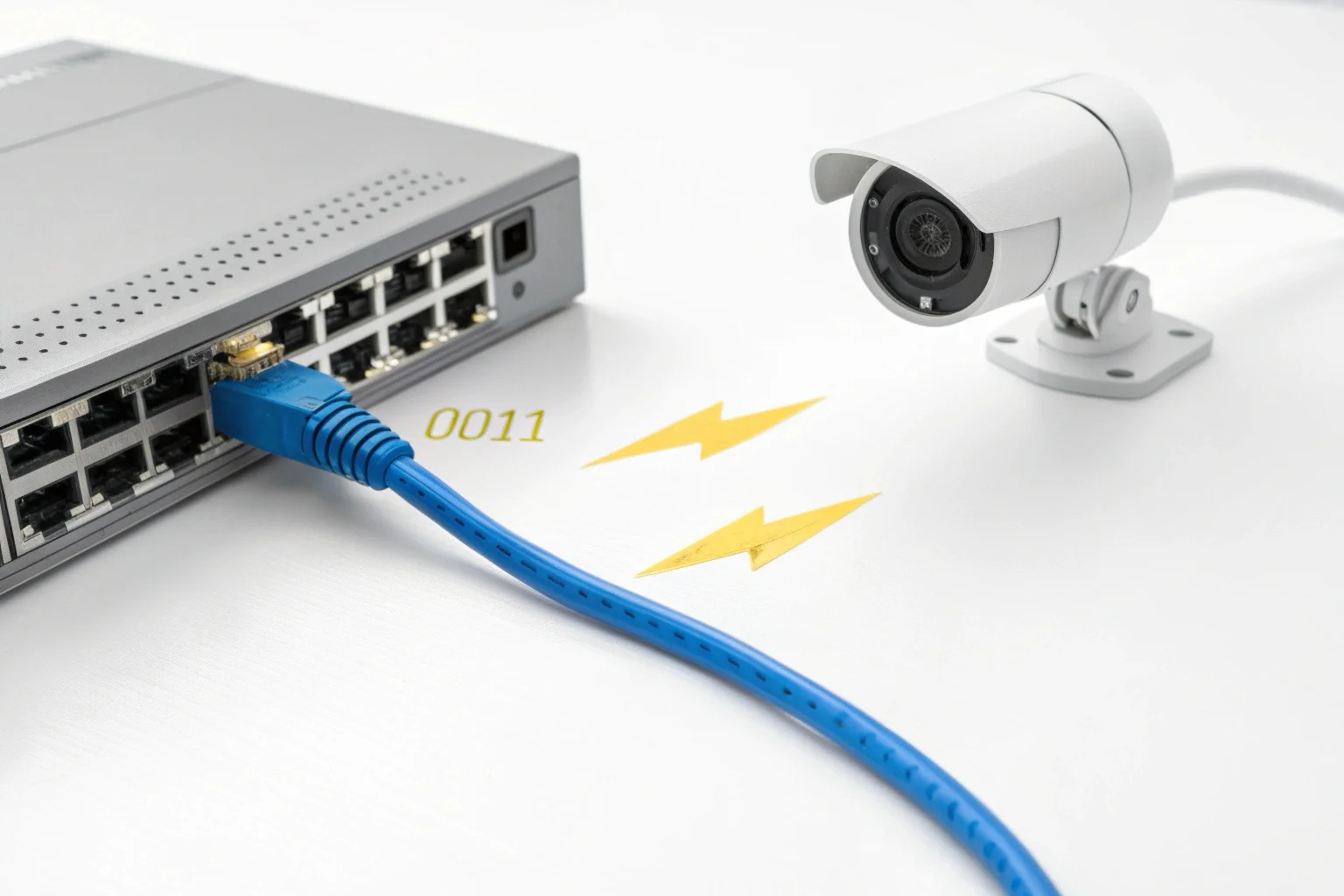
Power over Ethernet delivers DC power to a compatible powered device over copper Ethernet cabling. In a camera installation, that can let one Ethernet cable carry network data and PoE power from a suitable switch or injector.
That is useful because power and network design share the same cable route. But it does not mean:
- every wired camera is PoE;
- every PoE camera supports the same recording mode;
- every PoE installation is immune to outages;
- every camera should be connected to any PoE source without checking its standard and power requirements.
A PoE project still has to verify the camera's hardware support, the power-sourcing equipment, switch/injector capacity, cabling and storage/recording design.
How does PoE power reach the camera?
The PoE source and the powered device have to be compatible. The Ethernet cable is part of both the data path and the power-delivery path.
Do not replace that definition with a generic "wired = PoE" shortcut. A camera can use a separate 12V DC supply and still use WiFi for data. QZT's current C40 is one example: the current page lists 12V DC power plus WiFi and ONVIF, not PoE.
If an installation specifically requires PoE, ask for the exact camera model and PoE standard rather than inferring support from the presence of ONVIF, Ethernet-looking accessories or a power cable.
What does a wireless solar camera change?
A wireless solar camera normally uses a panel to recharge an internal battery. Its data path is separate: depending on the model, that may be WiFi, 4G or another supported connection.
Do not attach a universal range number to "wireless solar." Wireless range depends on the actual radio technology, antennas, site layout, interference and network design. The old 900MHz/600m statement on this page was too broad and has been removed.
Current QZT solar examples use different network paths:
- S7L-SP-4G3 uses a 4G SIM and lists a 9000mAh battery with a 3.3W panel.
- C13L uses 2.4GHz WiFi and lists a 5000mAh battery with a 3W panel.
- C42L uses 2.4GHz WiFi and lists a 7800mAh battery with a 3W panel.
Those hardware values do not create one universal runtime or distance claim.
Does PoE mean 24/7 and solar mean motion-only?
No. Recording support is model- and firmware-specific.
Reolink's current continuous-recording support guide provides a useful example: some battery-powered models do not support continuous recording even when powered or charging, while specific newer battery models do support it.
That is why the old table on this page — "PoE = 24/7 continuous" and "solar = event-based" — was too absolute.
For any camera, verify:
- continuous schedule support;
- event-recording behavior;
- pre-event buffer if required;
- storage destination;
- overwrite behavior;
- restart/reconnect behavior.
The same distinction is covered in Motion-Activated or Continuous Indoor Camera Recording: What Gets Saved?.
Can a solar system power PoE equipment?
It can be engineered, but that is a different project from plugging a small camera solar panel into a PoE camera.
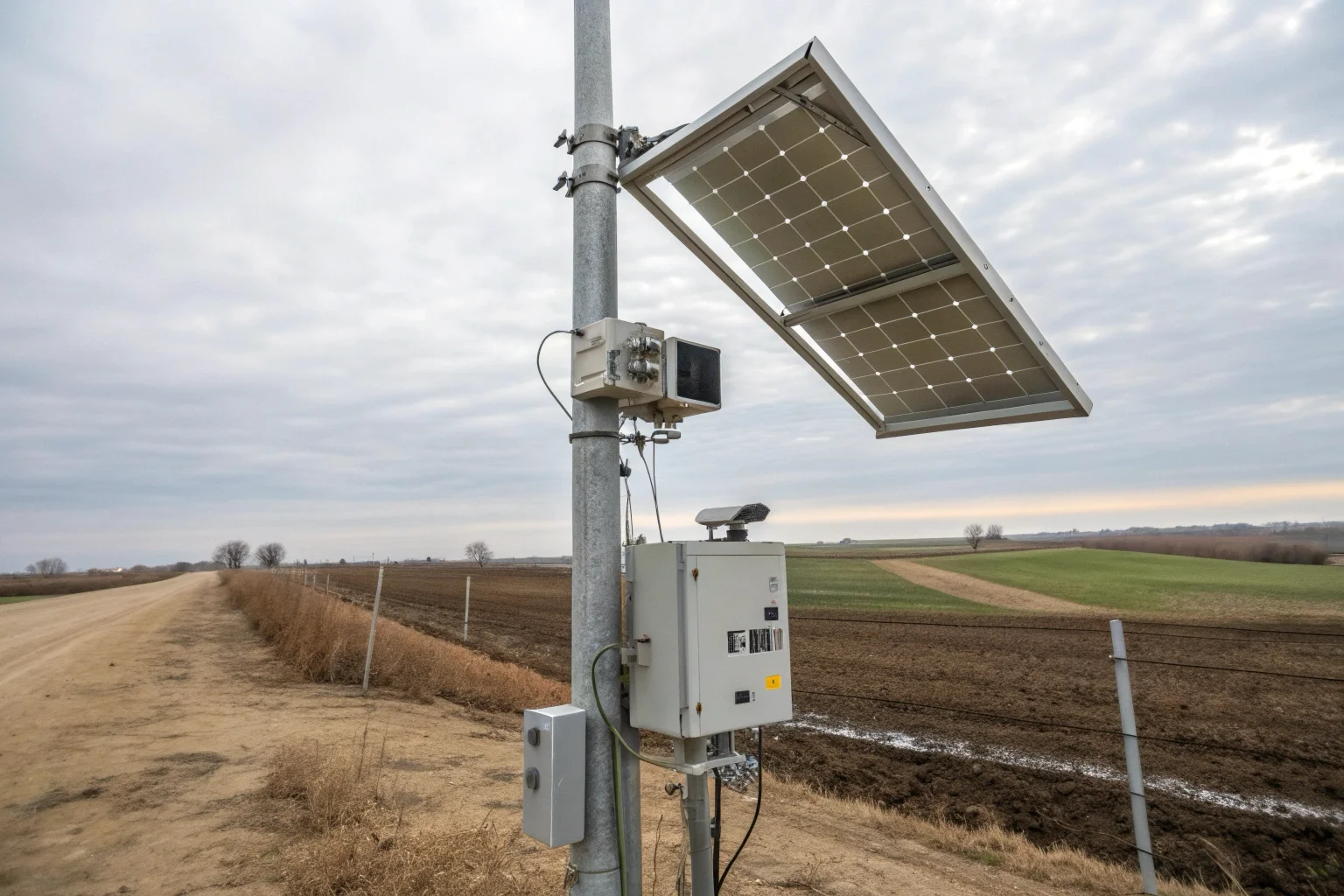
A remote solar-powered PoE installation may require a separate energy system sized for the total load: panel array, battery storage, charge controller, PoE switch/injector, camera load and network backhaul. The power budget has to cover the equipment through the expected low-sun period.
Do not describe that as a universal "solar + PoE camera" feature unless the complete power and network system has been designed and tested.
For most purchasing decisions, compare the real site requirements instead:
- Is grid/DC or PoE power already available?
- Is trenching or cable routing practical?
- Does the site have useful solar exposure?
- Is the required network WiFi, 4G or Ethernet?
- Is recording event-based or continuous?
- What has to keep working during a power or network outage?
- Who will maintain the battery, panel, cables, switch and storage?
The broad comparison belongs to Solar or Wired Security Cameras: Which Fits the Site?. Use this page only to distinguish the PoE and wireless-solar architectures.\n

 English
  Italiano
  Deutsch
  Français
  Español
  Polski