
An outdoor hidden camera can support authorized property monitoring, but the enclosure, network, power source and recording mode must be checked separately. Start with a normal visible outdoor camera when it meets the job. If the project needs a compact or low-profile form factor, verify the exact model instead of relying on the words “weatherproof,” “wireless” or “solar.”
The quickest way to narrow the choice is to answer five questions:
1. What part of the property may the camera lawfully cover?
2. Is stable power available at the mounting point?
3. Will the site use WiFi, 4G or local recording?
4. Does the project need event clips or continuous recording?
5. Which claims can be confirmed on an approved sample?
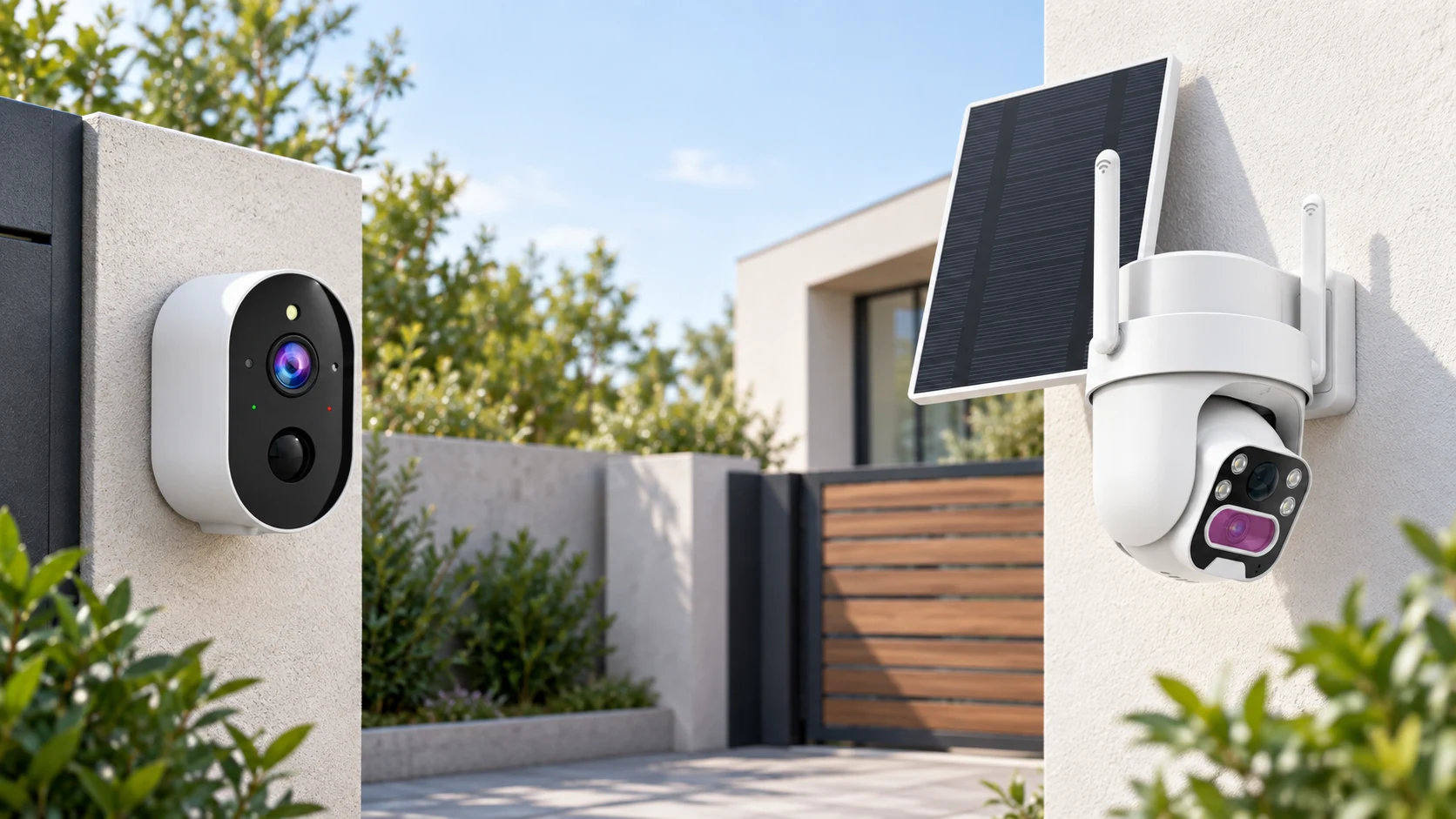
QZT-owned S5L-4G and C45L product references placed in an outdoor property setting. The composite compares form factors; it is not a same-condition performance test.
What should you verify before calling an outdoor camera weatherproof?
An IP number is useful only when it belongs to the exact part being installed. The international IP Code is defined in IEC 60529. A supplier should be able to identify the rating for the camera body, solar panel, cable entry and any exposed connector rather than applying one broad “waterproof” label to the whole kit.
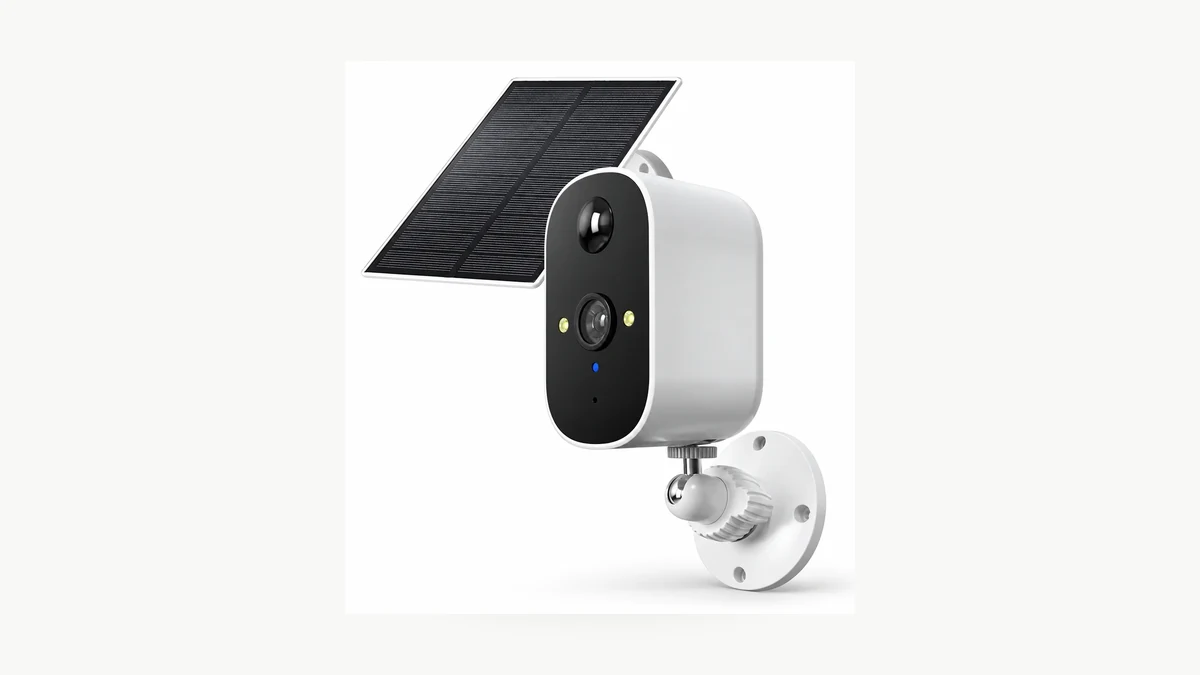
Real QZT C13L source image used to plan placement, exposure and access. A scene image does not prove an enclosure rating.
For example, the current C45L specification lists an IP65 camera housing and an IP66 solar panel. Those are separate ratings. The same source lists a 2 m Type-C cable between the panel and camera and an operating range of -10°C to 45°C. The installation still needs a protected connection, a suitable mounting surface and a drainage path that does not leave a connector sitting in water.
Record these items before approval:
| Buyer check | What to confirm |
|---|---|
| Camera enclosure | Exact model and stated IP rating |
| Solar panel | Its own rating, cable length and connector type |
| Openings and ports | Covers close correctly after the card or reset button is accessed |
| Mounting position | Rain exposure, runoff, shade, glare and service access |
| Temperature | Listed operating range for the ordered version |
| Sample inspection | No water path around seams, doors, glands or cable entry after the agreed test |
Do not turn an IP rating into a promise that any installation can survive flooding, pressure washing or an unprotected open port. The rating, installation method and sample result belong in the same approval record.
Should the site use WiFi, 4G or local recording?
“Wireless” usually describes the data connection, not the power source. A WiFi camera may still need a DC cable, a charged battery or a solar panel. A 4G camera still needs compatible cellular hardware, a working SIM, the correct APN settings and usable coverage at the mounting point.
Real QZT C40 source image. C40 is a powered WiFi camera example; a power cable does not make a camera an Ethernet or PoE model.
Use the network that the site can actually support:
| Site condition | Better starting point | What to test |
|---|---|---|
| Stable router signal reaches the camera | 2.4 GHz WiFi model | Onboarding, signal at the final height, reconnect after router restart |
| No usable local WiFi, but cellular service is stable | 4G model | LTE band version, carrier, SIM, APN, data use and reconnect |
| Remote viewing is not required | Local recording may be enough | Card format, event files, overwrite behavior and retrieval |
| Remote viewing plus local evidence is required | Network connection plus card storage | App access and card recording as two separate tests |
Current QZT examples make the distinction clear. P2A-T and C45L list 2.4 GHz WiFi. S5L-4G and S7L-SP-4G3 use a 4G data connection. These names do not establish coverage in a destination market. For a 4G order, confirm the exact LTE band set, carrier compatibility, SIM status and APN on the approved sample.
Local storage is also not the same as offline operation. A camera may record to a card after setup but still require an app or network for configuration, time synchronization or playback. Test the exact behavior needed by the project with the current firmware and app.
How should you judge solar power and battery claims?
A solar panel charges a battery; it does not guarantee unlimited operation. Daily sunlight, panel angle, shade, temperature, weak network signals, live viewing, event frequency, night lighting and pan-tilt movement can all change the energy balance.
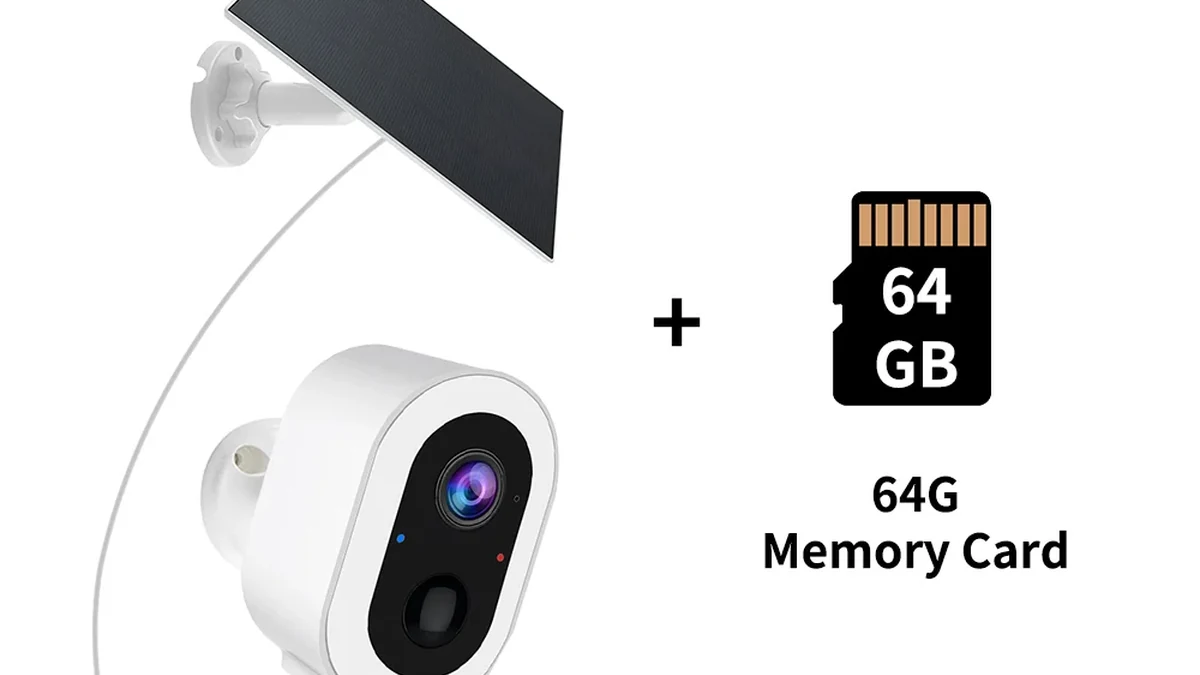
Real QZT S7L-SP-4G3 product source image. The listed 9000 mAh battery and 3.3 W panel do not establish a fixed runtime.
Treat battery capacity and panel wattage as hardware data, not a days-of-use promise. The current S7L-SP-4G3 page lists a 9000 mAh battery and 3.3 W solar panel. C45L lists a 7800 mAh battery and 3 W panel. P2A-T lists a built-in 1.3 W panel, while its battery cell configuration must be confirmed for the order.
Ask for a test plan that matches the deployment:
– event count per day;
– expected live-view minutes;
– night-light use;
– local signal quality;
– panel direction and hours of useful light;
– cold or hot weather conditions;
– low-battery behavior and recovery after charging.
If the project needs continuous recording, begin with that requirement. Many low-power solar models are designed around PIR wake-up and event clips. Do not assume a battery camera can deliver continuous recording because a card slot or solar panel is listed. The broader power decision is covered in Solar or Wired Security Cameras: Which Fits the Site?.
Which current QZT outdoor camera fits each job?
The useful comparison is not “best camera” versus “worst camera.” It is whether the exact network, power and movement configuration fits the site.
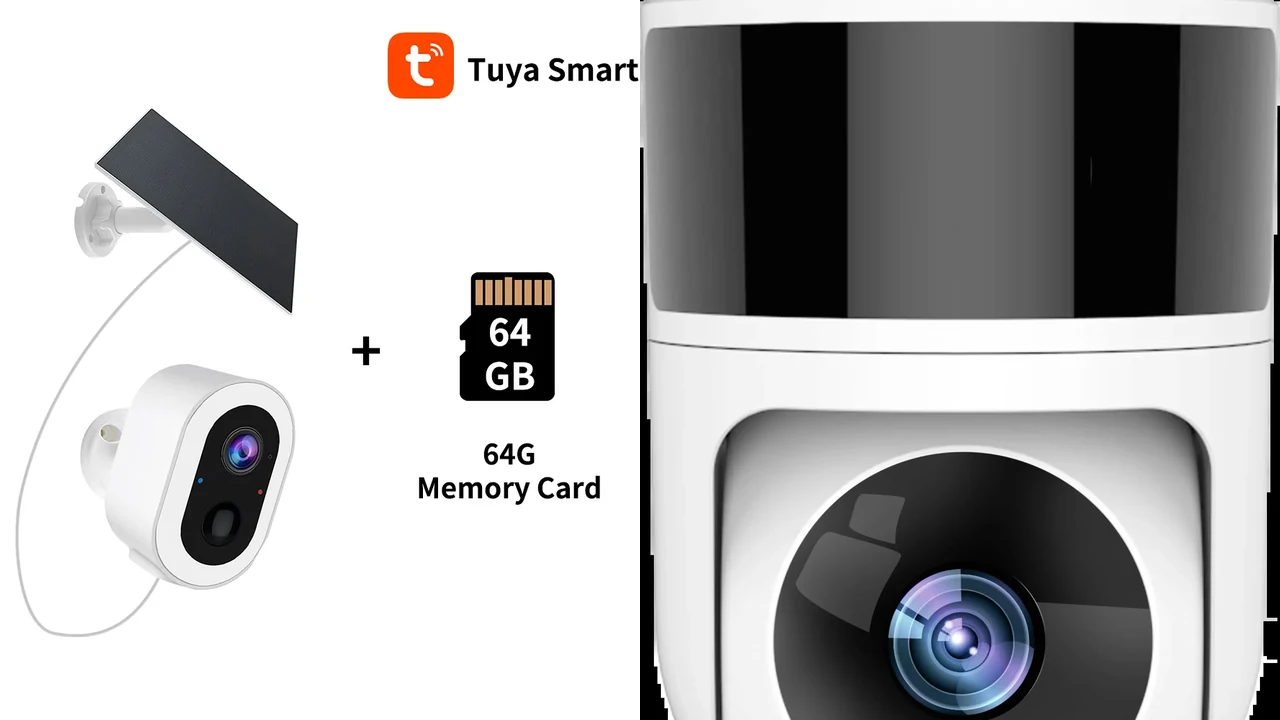
Composite from real QZT outdoor camera source images. It compares power approaches, not tested detection or image performance.
| Current model | Network and power | Verified source data | Best starting point | What to confirm |
|---|---|---|---|---|
| P2A-T | 2.4 GHz WiFi; built-in 1.3 W solar panel | 3 MP, 2304 × 1296 at 15 fps; T-Flash up to 128 GB | Compact solar WiFi monitoring | Battery cell configuration, sunlight and router signal |
| S5L-4G | 4G LTE; rechargeable battery | 3 MP, 2304 × 1296 at 15 fps; T-Flash up to 128 GB | Sites without local WiFi | LTE bands, SIM/APN and whether the order uses the listed 5200 or 9000 mAh configuration |
| S7L-SP-4G3 | 4G SIM; 9000 mAh battery; 3.3 W panel | 3 MP; Tuya Smart; microSD up to 128 GB listed | Solar cellular monitoring | Destination bands, coverage, solar placement and event workload |
| C45L | 2.4 GHz WiFi; 7800 mAh battery; 3 W panel | 4 MP, 2560 × 1440 at 15 fps; 355° pan and 90° tilt; TF card up to 128 GB | Wider adjustable view near reliable WiFi | No 5 GHz, 4G, RJ45, PoE, ONVIF, tracking or patrol is listed |
The table is a shortlist, not a substitute for the current quotation and approved sample. Firmware, battery inclusion, cellular version, packaging and accessories can vary by order configuration. Put those details on the purchase specification instead of leaving them in chat messages.
What do PIR and human detection actually change?
PIR wake-up, human detection, recording and notification are separate steps. A PIR sensor can wake a low-power camera. Software can then analyze the event, save a clip or send an alert according to the model and settings. A successful notification does not prove that the full event was recorded, and a stored clip does not prove that the push alert arrived on time.
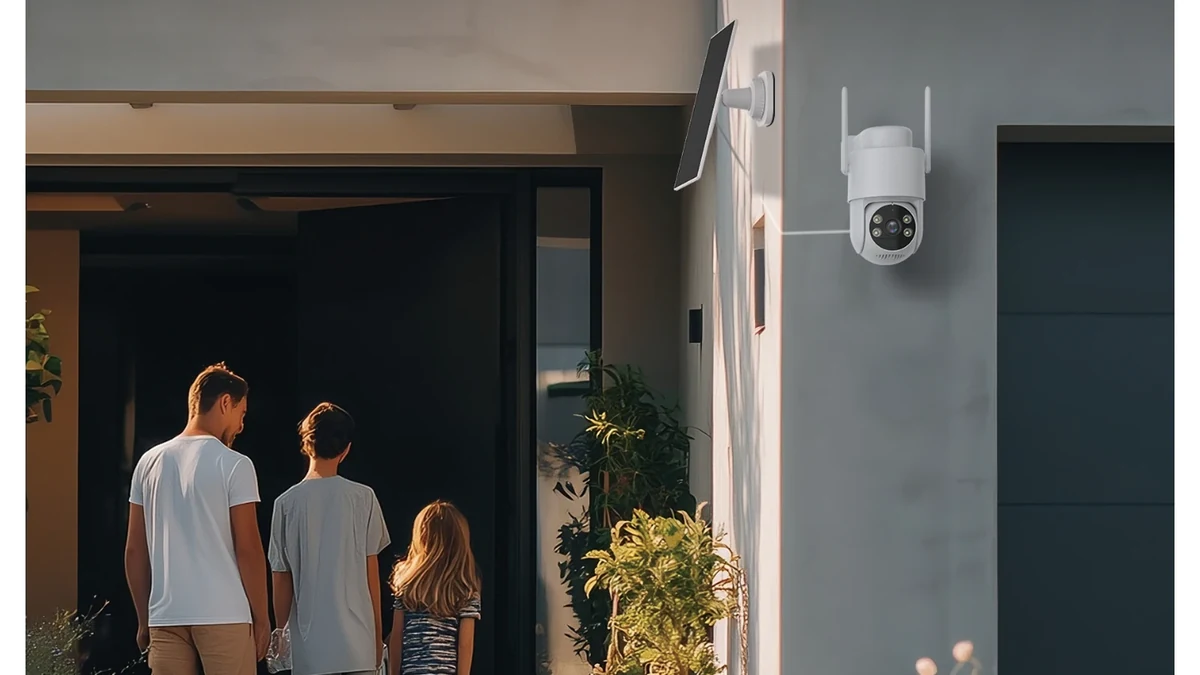
Real QZT C42L source image. Its product data lists PIR alerts and local storage; the image itself does not establish recording duration or detection range.
For C45L, the supplied specification lists PIR detection up to 8 m at 100°. That number belongs to C45L under the stated source conditions; it should not be copied to another model. Final behavior depends on mounting height, approach direction, temperature, sensitivity settings and firmware.
Test the complete chain:
1. Walk into the intended detection zone from more than one direction.
2. Record whether the camera wakes and how quickly the first usable frame appears.
3. Check whether the app alert arrives on each approved phone.
4. Confirm that the clip is stored in the expected location.
5. Review the end of the clip to see whether the event is cut short.
6. Repeat the check at night and after the camera has been idle.
If a buyer needs 24/7 recording, scheduled recording or pre-event footage, write that requirement separately. Do not replace it with a general “motion detection” line.
What should an outdoor camera sample acceptance test record?
A useful sample test produces a short record that purchasing, sales and support can refer to later. It should name the model, hardware version, firmware, app version, network, storage card and test date. Photos of the installed sample and screenshots of key settings are more useful than a pass/fail message without conditions.
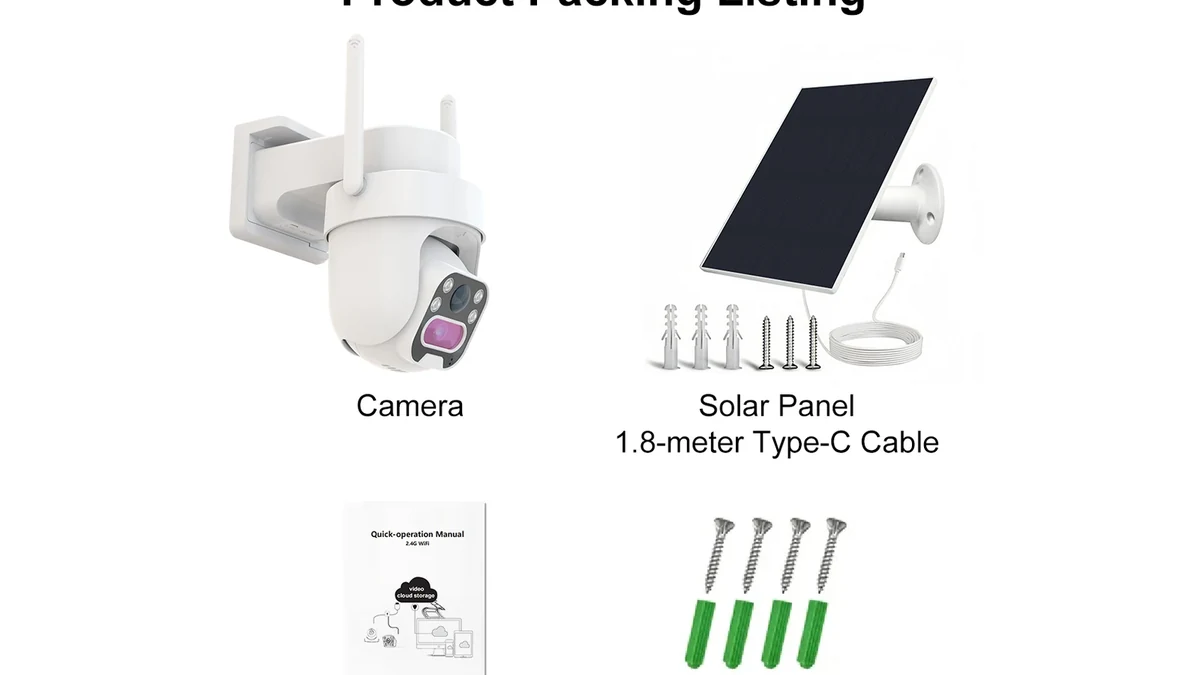
Real QZT C45L package source image. Confirm the final order contents because a power adapter and TF card are not listed as included.
Use the same checks for the approved sample and the first production inspection:
| Test area | Acceptance record |
|---|---|
| Housing and mounting | Model label, enclosure condition, covers, bracket, fasteners and cable entry |
| Network | Router or carrier, signal result, setup path and reconnect after restart |
| Power | Battery configuration, panel or adapter, charging result and low-battery behavior |
| Detection | Mounting height, path of movement, sensitivity, wake-up and false-alert notes |
| Recording | Event or continuous mode, card capacity, file playback, overwrite and time stamp |
| Night viewing | Infrared or white-light behavior, reflections and usable subject distance |
| App and firmware | App name/version, firmware version, account sharing and notification result |
| Privacy | Final field of view, audio setting, access permissions and retention setting |
Outdoor video monitoring should have a defined, lawful purpose and collect no more area than necessary. The European Data Protection Board guidance on video devices explains the data-protection questions for EU deployments. If the view includes a public path, shared space or neighboring property, check the destination rules before installation. Audio recording may have separate restrictions.
Send QZT the site country, available network, power plan, recording requirement, mounting exposure and expected order quantity. That information is enough to narrow the models and define a sample test without inventing a universal runtime or coverage claim.
Frequently Asked Questions
Does an outdoor hidden camera need WiFi?
An outdoor hidden camera does not always need WiFi. Some current QZT outdoor models use 4G LTE, while others use 2.4 GHz WiFi and may also record to a memory card. Confirm the exact connection, app setup, offline behavior and storage path on the ordered model before installation.
Can a solar outdoor hidden camera record continuously?
A solar outdoor hidden camera should not be assumed to record continuously. Many low-power models use PIR wake-up and event recording to reduce battery use. Continuous, scheduled and event recording are different requirements. Confirm the supported mode, card behavior, solar input and expected workload on an approved sample.
Is IP65 enough for an outdoor hidden camera?
IP65 for an outdoor hidden camera is not a complete installation decision. Check whether the rating applies to the camera body, panel or both, then inspect every exposed port, cable and cover. Mounting angle, runoff, temperature and service access also affect whether the chosen model suits the location.
Will a 4G outdoor hidden camera work in any country?
A 4G outdoor hidden camera will not work on every carrier automatically. The hardware must support the destination LTE bands, and the SIM, APN, data plan and local coverage must also work. Approve the exact cellular version with the intended carrier and test it at the real mounting site.
How long will an outdoor hidden camera battery last?
Outdoor hidden camera battery life depends on capacity, event frequency, live viewing, night lighting, signal quality, temperature and solar charging. A mAh figure alone cannot provide a reliable number of days. Record the approved configuration and test it under a workload close to the intended deployment.
Is an outdoor hidden camera legal?
An outdoor hidden camera should only be used for an authorized, lawful purpose. Requirements depend on the country, the area recorded, access to footage, retention and whether audio is enabled. Limit the field of view to the intended property and obtain local advice when public or neighboring areas may be captured.
 English
  Italiano
  Deutsch
  Français
  Español
  Polski