
A technical breakdown of recording durations by form factor, recording mode, and battery chemistry — with real-world data distributors need to answer customer questions accurately.
What Determines How Long a Hidden Camera Can Record?
Every week, distributors face the same question from retail buyers: “How long will this camera actually record?” The honest answer is frustratingly conditional.
A hidden camera’s recording duration ranges from 45 minutes to 180 days depending on battery capacity, recording mode, video resolution, and environmental temperature. No single number applies to all devices.
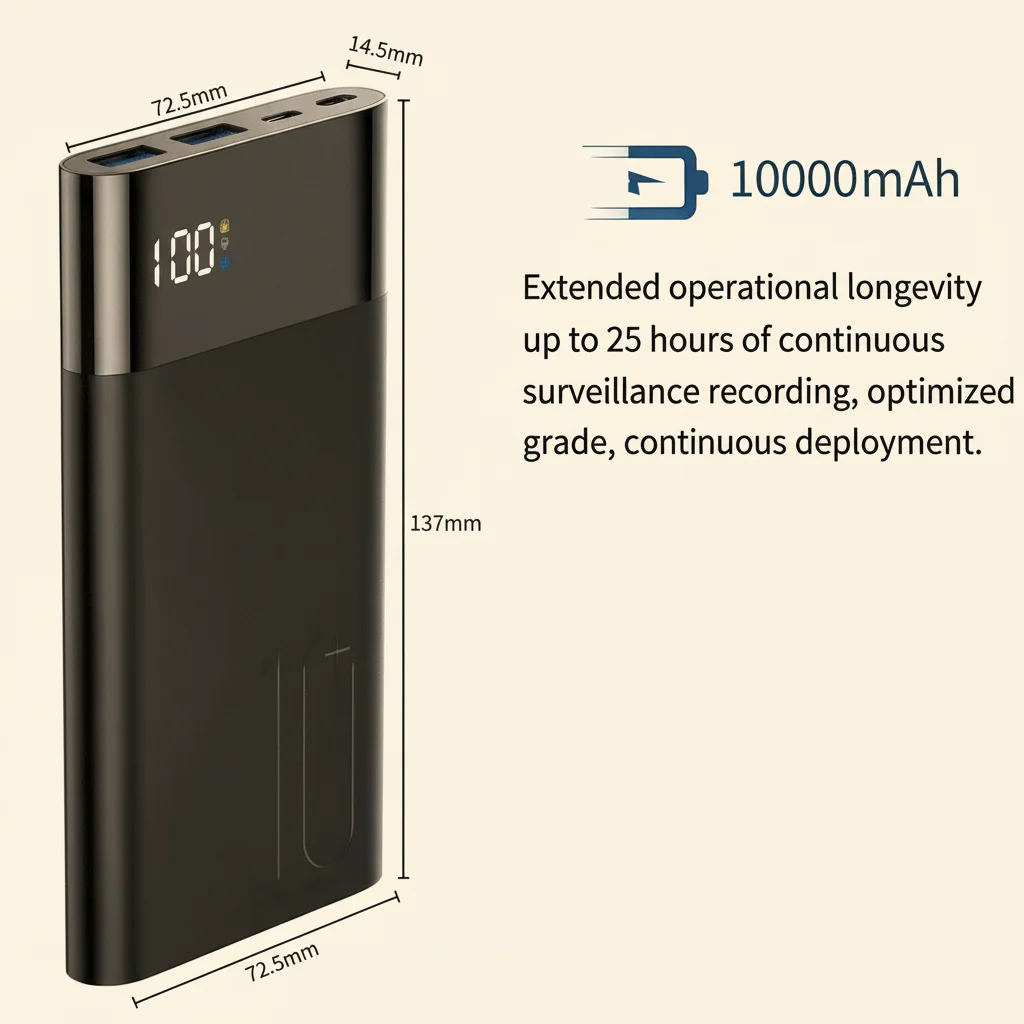
The gap between manufacturer claims and real-world performance is where most distributor-customer conflicts begin. A factory datasheet advertising “12 hours recording” almost certainly refers to the lowest resolution setting (720p at 15fps) in a climate-controlled environment with a brand-new battery. In practice, a customer recording 1080p at 30fps in a warm room may see 4-5 hours from the same device.
The physics are straightforward. A 1080p/30fps H.264 stream consumes approximately 2-3 watts during active recording. A 720p/15fps stream drops to 0.8-1.2 watts. The difference between those two settings is not marginal — it is the difference between a 3-hour runtime and an 8-hour runtime on the same 2,500mAh battery.
Here is what most people get wrong. They assume battery capacity is the only variable. It is not. The image signal processor (ISP), WiFi chipset, IR LED array, and SD card controller all draw power simultaneously during recording. A camera with a 5,000mAh battery but an inefficient WiFi module may record for less time than a camera with a 3,000mAh battery and a modern low-power chipset.
| Factor | Impact on Runtime | Typical Range |
|---|---|---|
| Battery capacity | Direct proportion | 500mAh to 10,000mAh |
| Video resolution | 1080p vs 720p = 2-3x difference | 720p to 4K |
| Frame rate | 30fps vs 15fps = 1.5-2x difference | 15fps to 60fps |
| Recording mode | PIR vs continuous = 50-100x difference | Continuous to PIR standby |
| WiFi streaming | Adds 0.5-1.5W active drain | Off to always-on |
| IR night vision | Adds 0.3-0.8W per LED array | Off to 6-LED array |
| Temperature | High heat reduces capacity 20-40% | -10C to 45C |
Key Takeaway: Battery capacity is necessary but not sufficient — chipset efficiency, recording settings, and environmental conditions collectively determine real-world runtime.
Recording Duration by Form Factor
Different hidden camera designs accommodate different battery sizes. The form factor is the primary constraint on runtime.
Pen cameras average 60-90 minutes of continuous recording. Clock cameras achieve 6-10 hours. Smoke detector and socket cameras run indefinitely on mains power. Power bank cameras deliver 15-30 hours depending on cell capacity.
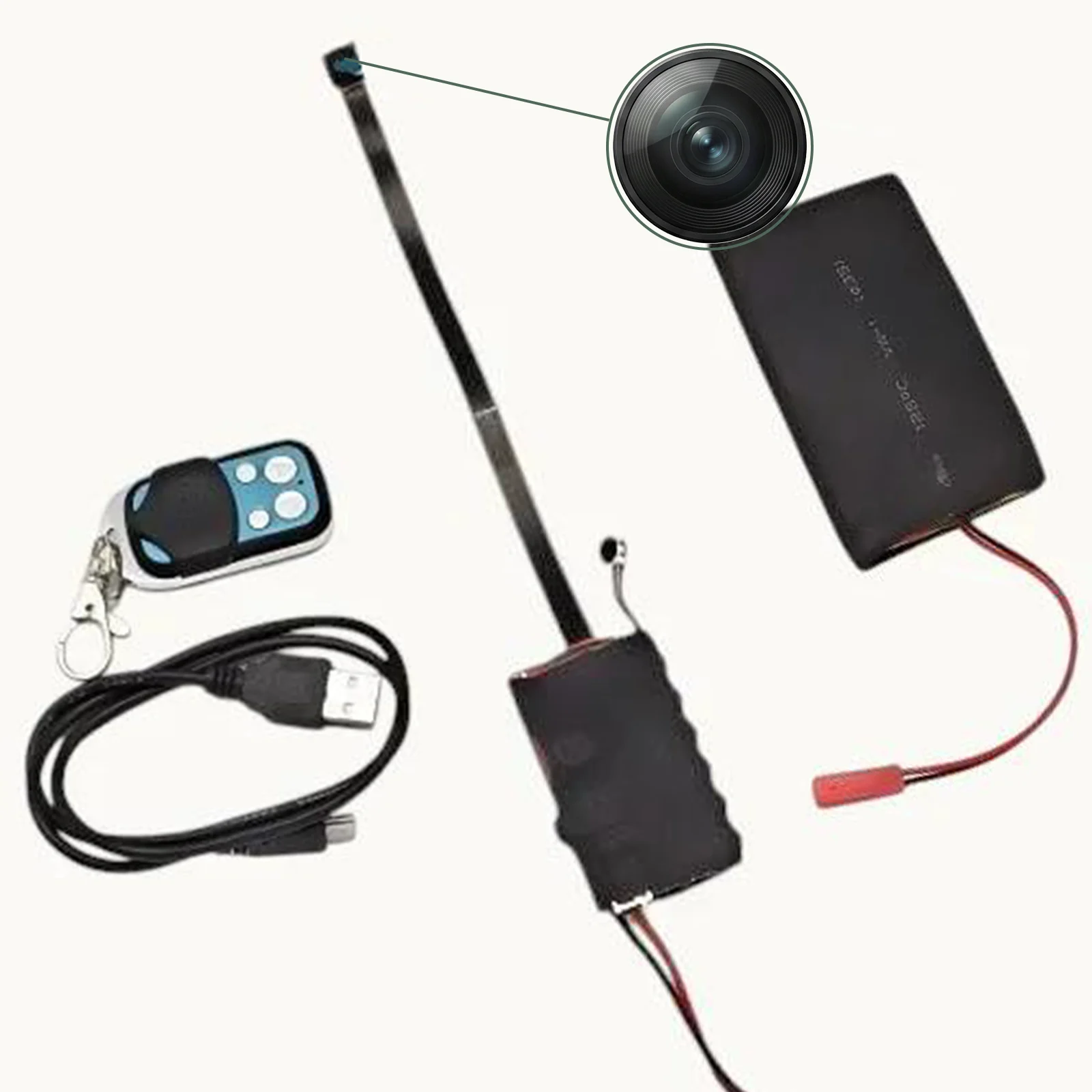
The C10 WiFi camera module — a bare board approximately 35mm x 35mm — typically ships with a 600-800mAh lithium-polymer cell. At 1080p/30fps continuous recording, this yields 1.5-2 hours of runtime. The module is designed for AC-powered installations or external battery packs, not standalone long-duration recording.
Pen cameras face the most severe size constraint. The cylindrical housing must accommodate both writing mechanics and camera electronics within a 10-12mm diameter. The resulting battery is typically 200-350mAh — sufficient for 60-90 minutes at 1080p/30fps. Some manufacturers claim 2-3 hours, but those figures assume 720p/15fps or significant frame dropping.
Clock cameras offer substantially more internal volume. A typical desk clock housing accommodates a 2,000-3,500mAh flat-cell battery. The Z10 clock camera, for example, records 6-8 hours continuously at 1080p/30fps, or up to 30 days in PIR motion-activated standby mode. The clock face itself requires minimal power — less than 50mW for the LED display — so the battery budget is overwhelmingly allocated to the camera module.
Smoke detector cameras and socket cameras bypass the battery question entirely. The S3 socket camera draws power from the wall outlet, enabling 24/7 continuous recording with no runtime limitation. The only constraint is SD card capacity — a 128GB card stores approximately 200 hours of 1080p footage before loop recording overwrites the oldest files.
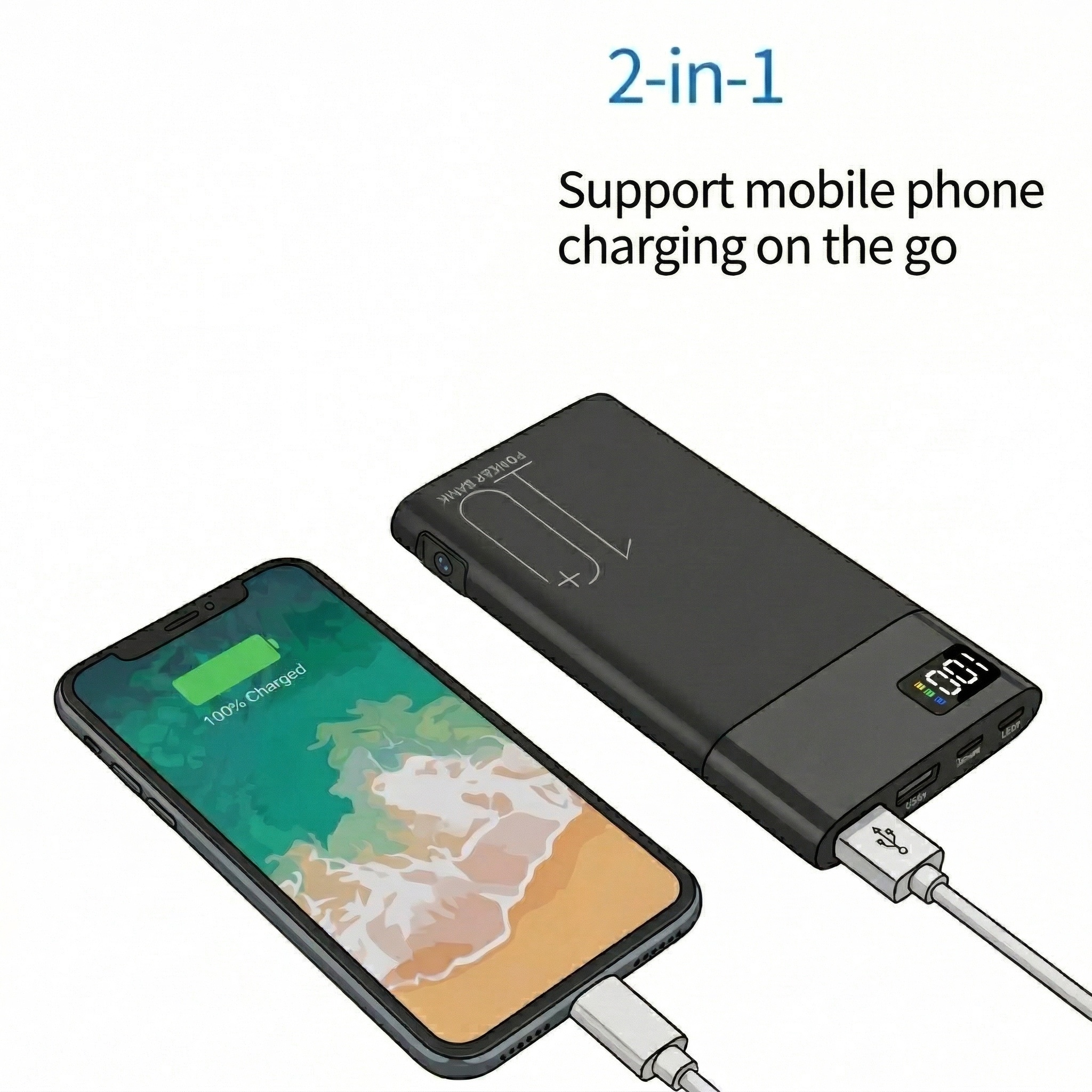
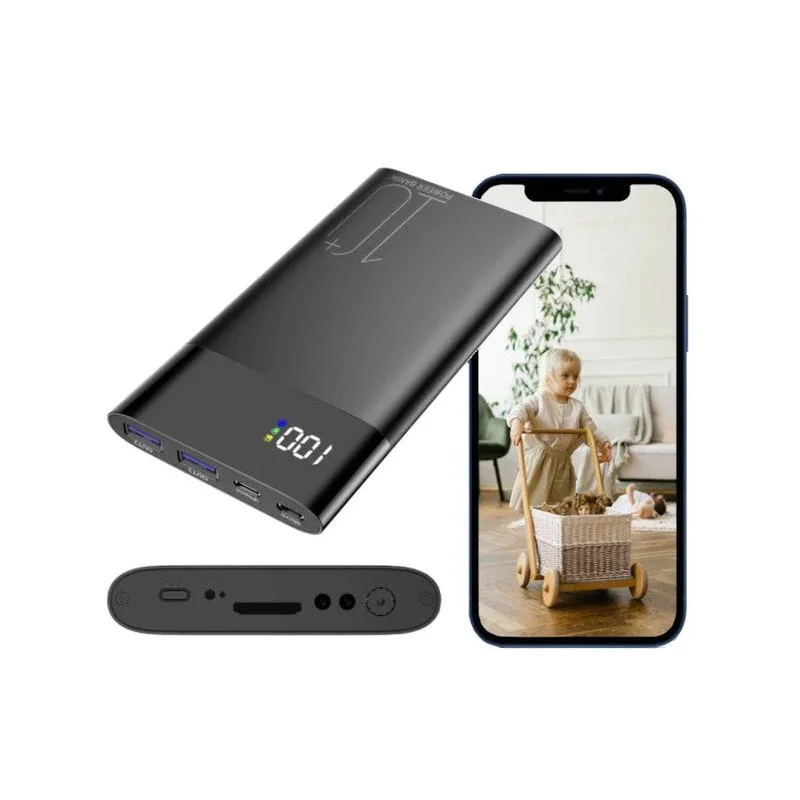
Power bank cameras represent the hybrid approach. The H3 power bank camera integrates a genuine 10,000mAh lithium-ion cell that functions as both camera power source and phone charger. At 1080p/30fps continuous recording, this yields 18-24 hours of runtime. In motion-activated mode, standby extends to 60-90 days between charges.
| Form Factor | Typical Battery | Continuous 1080p/30fps | Motion-Activated Standby |
|---|---|---|---|
| Camera module (C10) | 600-800mAh | 1.5-2 hours | 5-7 days |
| Pen camera (W10) | 200-350mAh | 60-90 minutes | 2-3 days |
| Clock camera (Z10) | 2,000-3,500mAh | 6-8 hours | 25-35 days |
| Smoke detector camera | Mains powered | Unlimited | Unlimited |
| Socket camera (S3) | Mains powered | Unlimited | Unlimited |
| Power bank camera (H3) | 10,000mAh | 18-24 hours | 60-90 days |
| Camera glasses (G3000) | 400-600mAh | 90-120 minutes | N/A (body-worn) |
Key Takeaway: Form factor is the primary runtime determinant — pen cameras are limited by diameter constraints, while socket and smoke detector designs eliminate battery anxiety entirely.
Recording Mode: The Single Biggest Lever
If a customer needs longer recording duration, the most effective adjustment is not buying a bigger battery. It is changing the recording mode.
Motion-activated recording extends battery life by 5-10x compared to continuous recording. PIR (passive infrared) trigger mode extends it by 50-100x. Scheduled recording occupies a middle ground.
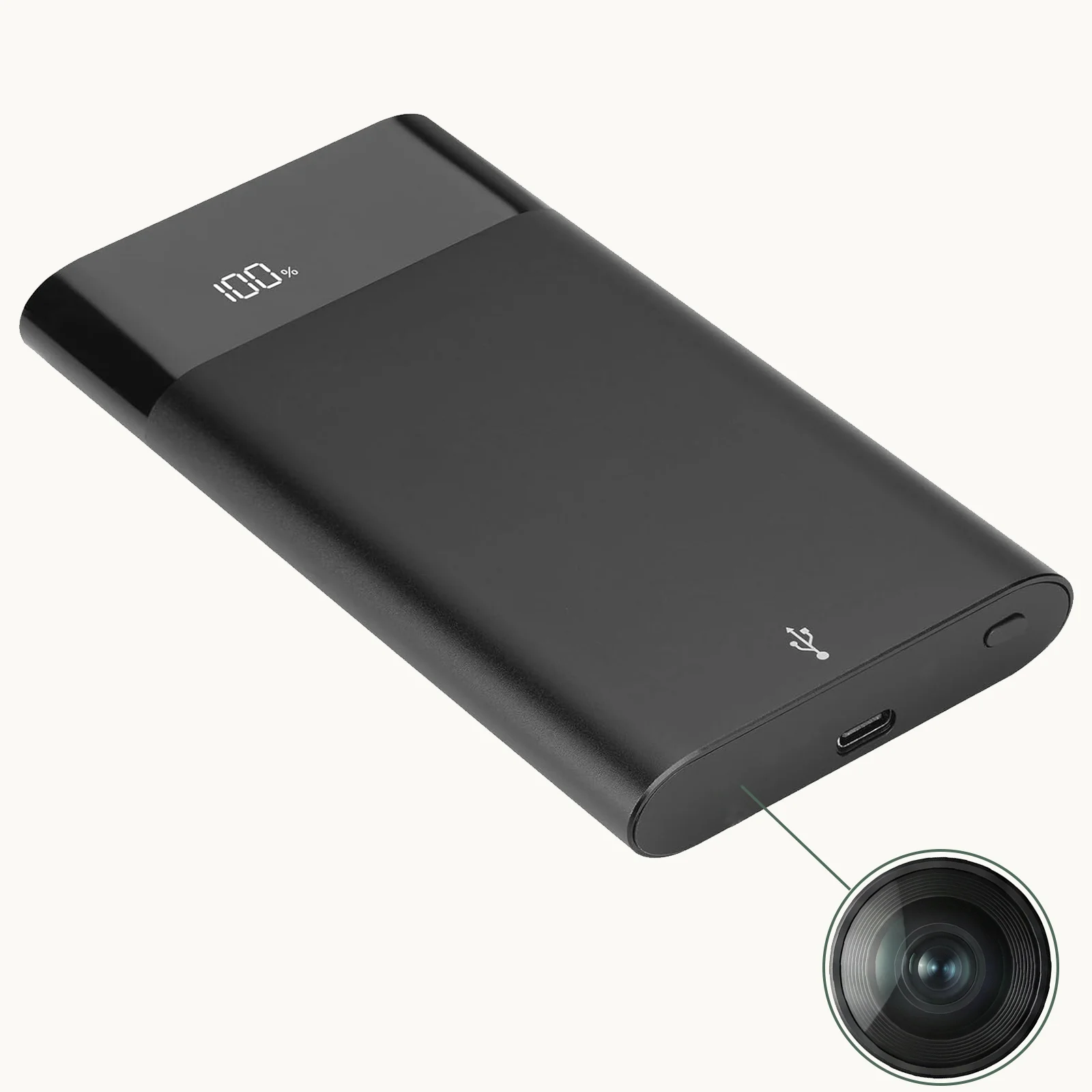
Continuous recording is the default mode most customers assume they need. The camera records every frame, every second, regardless of activity. This is necessary only in specific scenarios — monitoring a cash register, observing a sensitive meeting, or capturing evidence of recurring but unpredictable events. For most applications, continuous recording wastes 80-90% of battery capacity on footage of empty rooms.
Motion-activated recording uses the camera’s image processor to detect pixel changes between frames. When motion exceeds a configurable threshold — typically 5-15% of the frame — the camera begins recording. A 30-second post-motion buffer ensures the triggering event is captured in full. In a typical home or office environment where activity occurs 2-4 hours per day, motion activation extends a 6-hour continuous battery to 2-3 days of effective coverage.
PIR mode represents the ultimate power conservation. Rather than analysing video frames, the camera uses a separate passive infrared sensor to detect heat signatures. Humans emit infrared radiation at approximately 9-10 micrometres wavelength. The PIR sensor detects this radiation and triggers the camera only when a warm body enters the detection zone. Because the video processor remains entirely off until triggered, standby current drops to 50-100 microamps. A 3,000mAh battery in PIR standby mode lasts 90-180 days.
The trade-off is detection range and false positives. PIR sensors typically cover a 90-120 degree cone with a 5-8 metre range. Small animals, HVAC vents, and direct sunlight through windows can trigger false activations. Advanced PIR cameras allow sensitivity adjustment and masking zones to reduce nuisance triggers.
Scheduled recording suits applications with predictable activity windows. A warehouse distributor might schedule recording during business hours only (08:00-18:00), or a retail shop might record during opening hours. This mode eliminates overnight power drain without relying on motion detection accuracy.
| Recording Mode | Power Draw (Active) | Power Draw (Standby) | Typical Extension vs Continuous |
|---|---|---|---|
| Continuous | 2-3W | 2-3W (always active) | 1x (baseline) |
| Motion-activated | 2-3W | 0.3-0.5W | 5-10x |
| PIR-triggered | 2-3W | 0.05-0.1W | 50-100x |
| Scheduled | 2-3W (during hours) | 0.1-0.2W (off-hours) | 2-4x |
| Manual / button | 2-3W | 0.01-0.05W | User-controlled |
Key Takeaway: PIR mode achieves 50-100x battery extension versus continuous recording — the single most effective runtime optimisation available.
Resolution and Frame Rate: The Hidden Power Consumers
Higher resolution does not just consume more storage. It consumes more power.
1080p/30fps recording draws approximately 2.5W. Dropping to 720p/15fps reduces power to 1.0W — extending runtime by 2.5x on the same battery. 4K/30fps pushes consumption to 4-5W, cutting runtime in half compared to 1080p.
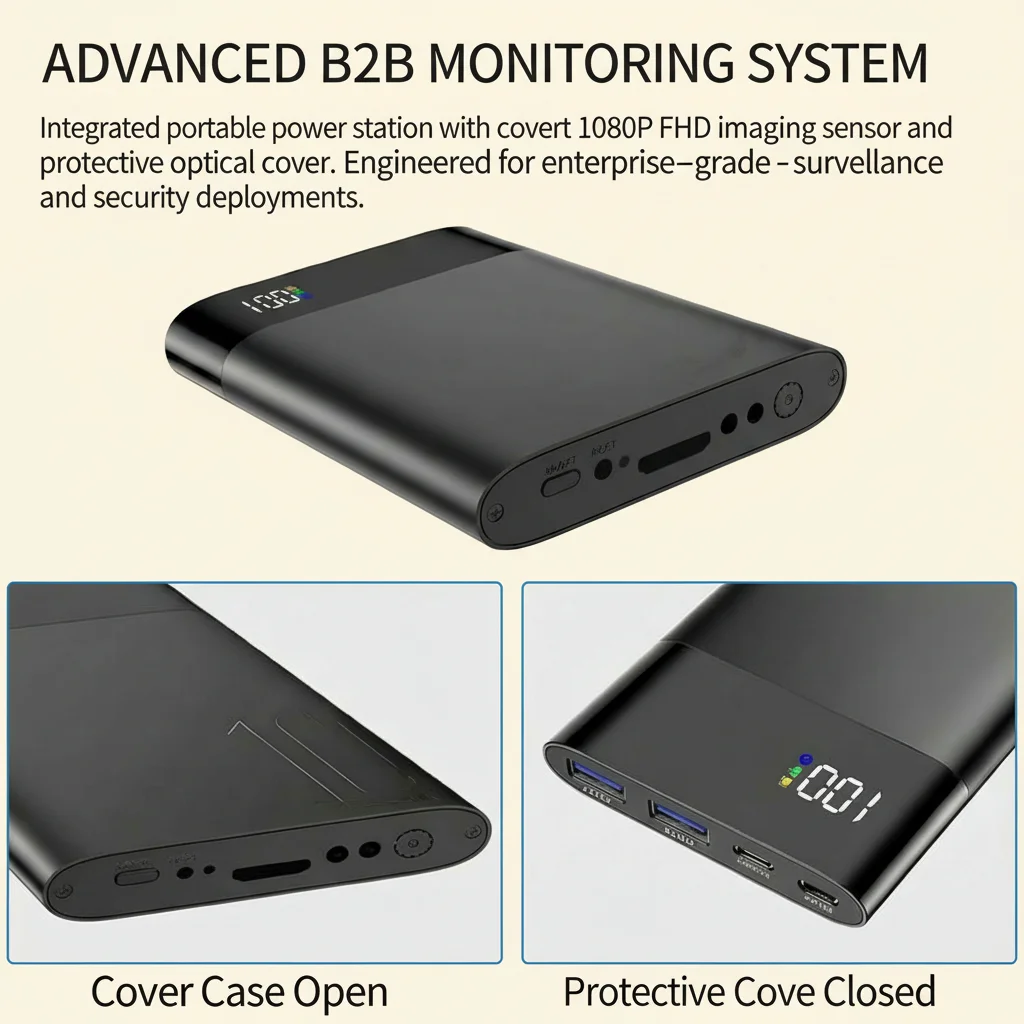
The power consumption breakdown for a typical 1080p hidden camera reveals why resolution matters:
– Image sensor and ISP: 0.8-1.2W
– H.264/H.265 encoder: 0.3-0.5W
– WiFi chipset (when active): 0.5-1.5W
– SD card controller: 0.1-0.2W
– IR LED array (when active): 0.3-0.8W
– System overhead (MCU, regulators): 0.2-0.4W
At 720p resolution, the ISP and encoder each drop by approximately 40%. The sensor itself scales linearly with pixel count — a 2-megapixel sensor draws roughly half the power of an 8-megapixel sensor at the same frame rate. The result is not a small efficiency gain. It is a fundamental runtime extension.
Frame rate operates similarly. 30fps requires the ISP to process twice as many frames as 15fps. The encoder must compress twice as much data. The SD card must write twice as many files. Each of these operations draws power. Dropping from 30fps to 15fps typically extends runtime by 40-60%.
For distributors, the practical advice is specific. When a customer asks “how long will this record?” the first clarification question should be: “At what resolution and frame rate?” A pen camera advertised at 90 minutes may deliver 150 minutes at 720p/15fps — or collapse to 45 minutes at 1080p/30fps with WiFi streaming active.
| Resolution | Frame Rate | Typical Power | Runtime on 2,500mAh |
|---|---|---|---|
| 720p | 15fps | 0.9-1.2W | 7.5-9 hours |
| 720p | 30fps | 1.3-1.6W | 5.5-6.5 hours |
| 1080p | 15fps | 1.6-2.0W | 4.5-5.5 hours |
| 1080p | 30fps | 2.2-2.8W | 3-4 hours |
| 4K | 15fps | 3.0-3.8W | 2-2.5 hours |
| 4K | 30fps | 4.2-5.5W | 1.2-1.8 hours |
Key Takeaway: Resolution and frame rate are multiplicative power consumers — 720p/15fps typically yields 2.5x the runtime of 1080p/30fps from the same battery.
Battery Chemistry: Li-Ion vs Li-Polymer in Hidden Cameras
The battery chemistry inside a hidden camera determines not just capacity but safety, temperature tolerance, and lifecycle.
Lithium-polymer (Li-Po) batteries dominate compact hidden cameras due to their flexible form factors. Lithium-ion (Li-Ion) cylindrical cells power larger devices like power bank cameras. Li-Po offers 15-20% higher energy density but degrades faster in high-temperature environments.
Li-Polymer cells use a gel electrolyte in a foil pouch, allowing them to be manufactured in flat rectangular shapes that fit neatly inside clock housings, pen barrels, and glasses frames. A typical 3,000mAh Li-Po cell measures approximately 60mm x 40mm x 6mm — thin enough to slide behind a clock face or into a pen casing.
Li-Ion cylindrical cells (18650 or 21700 format) are used in power bank cameras where space is less constrained. An 18650 cell stores 2,600-3,500mAh at 3.7V. A 21700 cell extends this to 4,000-5,000mAh. These cells are more thermally stable than Li-Po and tolerate higher discharge currents, but their rigid cylindrical shape limits design flexibility.
Temperature performance is a critical differentiator. Li-Po capacity degrades by 20-30% at 40C and by 40-50% at 50C. A clock camera in a south-facing window in summer may experience internal temperatures of 45-55C, reducing its effective capacity by half. Li-Ion cylindrical cells handle heat better, degrading only 10-15% at 40C.
Cold temperatures affect both chemistries similarly. At 0C, Li-Po delivers approximately 70% of rated capacity. At -10C, this drops to 50%. For outdoor applications — vehicle monitoring, construction sites, or winter sports — this temperature derating must be factored into runtime calculations.
Battery lifecycle is the final consideration. Both chemistries degrade to 80% of original capacity after 300-500 full charge cycles. For a motion-activated camera recharged monthly, this represents 25-40 years of service life — effectively indefinite. For a continuously recording camera recharged daily, capacity degrades to 80% within 12-18 months.
| Chemistry | Form Factor | Energy Density | Temp Tolerance | Best For |
|---|---|---|---|---|
| Li-Polymer | Flat pouch | 150-200 Wh/kg | Moderate (degrades at >40C) | Pen cameras, clock cameras, glasses |
| Li-Ion (18650) | Cylindrical | 200-260 Wh/kg | Good (stable to 60C) | Power bank cameras, modules |
| Li-Ion (21700) | Cylindrical | 250-300 Wh/kg | Good (stable to 60C) | High-capacity power banks |
Key Takeaway: Li-Po fits compact form factors but suffers in heat. Li-Ion cylindrical cells suit power bank designs with better thermal stability and higher cycle life.
What Distributors Should Tell Customers About Runtime
Customer expectations are shaped by smartphone advertising — “all-day battery life” on devices with 4,000-5,000mAh cells. Hidden cameras operate under fundamentally different constraints.
Distributors should advise customers to expect 60-90 minutes from pen cameras, 6-10 hours from clock cameras, and indefinite runtime from mains-powered devices. Any claim exceeding these benchmarks should be treated with scepticism unless verified at the customer’s intended resolution and frame rate.
The most common customer complaint is not that the camera fails to work. It is that the camera works for less time than the customer expected. This expectation gap is avoidable with clear pre-sale communication.
A practical distributor script:
– “This pen camera records 75 minutes continuously at 1080p/30fps. If you switch to 720p/15fps, that extends to approximately 2 hours. For longer coverage, consider motion-activated mode, which typically lasts 2-3 days on a full charge in a normal office environment.”
– “This clock camera records 8 hours continuously. In motion-activated mode, most customers see 3-4 weeks between charges. In PIR mode, you can expect 2-3 months.”
– “This socket camera has no battery limitation — it records as long as it is plugged in. The only constraint is SD card capacity. A 128GB card stores about 200 hours of 1080p footage before loop recording begins.”
For B2B buyers reselling to end-users, the documentation should include a runtime matrix showing continuous, motion-activated, and PIR durations for each resolution and frame rate combination. This transparency reduces return rates and improves customer satisfaction.
| Customer Question | Accurate Answer | Common Misconception |
|---|---|---|
| “How long will this pen camera record?” | 60-90 minutes at 1080p/30fps | “2-3 hours” (based on 720p/15fps claims) |
| “Can I record all night?” | Only with mains-powered devices or external battery packs | “Yes, on battery” (untrue for most form factors) |
| “Does motion detection really save battery?” | Yes, 5-10x extension vs continuous | “Only a little bit” (underestimates the gain) |
| “Will cold weather affect runtime?” | Yes, 30-50% reduction below freezing | “Batteries work fine in cold” (untrue for Li-Po) |
| “Can I stream live and record simultaneously?” | Yes, but WiFi streaming adds 0.5-1.5W drain | “Streaming does not affect battery” (false) |
Key Takeaway: Transparent runtime communication reduces returns more effectively than optimistic marketing claims.
Frequently Asked Questions
Can I extend a hidden camera’s battery life with an external power bank?
Yes. Most hidden cameras with USB charging ports can accept external power banks. A 10,000mAh power bank typically extends a pen camera from 90 minutes to 8-10 hours, or a clock camera from 8 hours to 30+ hours. The limitation is physical — the external battery must remain connected, which compromises concealment.
Why does my camera record for less time than the factory claims?
Factory claims are typically measured at optimal conditions: 720p/15fps, room temperature (23C), new battery, no WiFi streaming, and no IR activation. Real-world use at 1080p/30fps with occasional night vision and WiFi check-ins typically achieves 40-60% of the claimed duration.
Do solar chargers work with hidden cameras?
Small solar panels (5-10W) can trickle-charge some hidden cameras during daylight hours. However, most hidden cameras lack the physical space for solar integration. Solar charging is practical only for outdoor-mounted devices like trail cameras, not for indoor concealed form factors.
How do I know when the battery is running low?
Most hidden cameras include a low-battery LED indicator or mobile app notification. The threshold is typically 10-15% remaining capacity. At this level, most cameras automatically stop recording and enter a deep-sleep mode to preserve the battery from over-discharge damage.
Is it safe to leave a hidden camera charging continuously?
Yes, if the device uses a proper battery management system (BMS). Modern lithium batteries include overcharge protection circuits that stop charging at 4.2V. However, continuous charging at 100% state-of-charge accelerates calendar ageing. For mains-powered applications, socket cameras (which bypass the battery entirely) are preferable to battery cameras on permanent charge.
Ready to Stock Hidden Cameras with Accurate Runtime Data?
Battery life is the most common source of customer dissatisfaction in the hidden camera market. Distributors who provide honest, detailed runtime information — broken down by resolution, frame rate, and recording mode — earn trust and reduce returns.
QZT Security manufactures hidden cameras across all major form factors, from compact pen cameras to mains-powered socket cameras. Every product ships with a runtime matrix tested at multiple resolution and frame rate combinations, not a single optimistic headline figure.
Contact us today for volume pricing, sample units for your own runtime testing, and distributor documentation that answers customer questions before they ask them.

 English
  Italiano
  Deutsch
  Français
  Español
  Polski