
Are Spy Pen Cameras Any Good? Cost, Quality & Legal Guide
You’re sitting in a meeting, and your manager denies ever approving the budget you both discussed last Tuesday. You know what was said — but you have no way to prove it. A spy pen camera in your shirt pocket would have captured every word. But are these devices actually reliable? Do they record clear enough footage to matter? And — critically — are you even allowed to use one?
Yes, spy pen cameras work — when you buy the right model. The gap between a $25 pen that produces pixelated 720p mush and a properly engineered 1080p unit with audio sync and loop recording is enormous. This guide cuts through the marketing noise to answer the four questions every buyer asks: whether spy pens are any good, which model is best, what they cost, and where they’re legal to use. B2B buyers will also find wholesale sourcing and QC verification frameworks below.
How Do Spy Pen Cameras Actually Work?
Most people assume a spy pen is just a tiny webcam jammed into a plastic pen shell. That assumption leads to bad purchases.
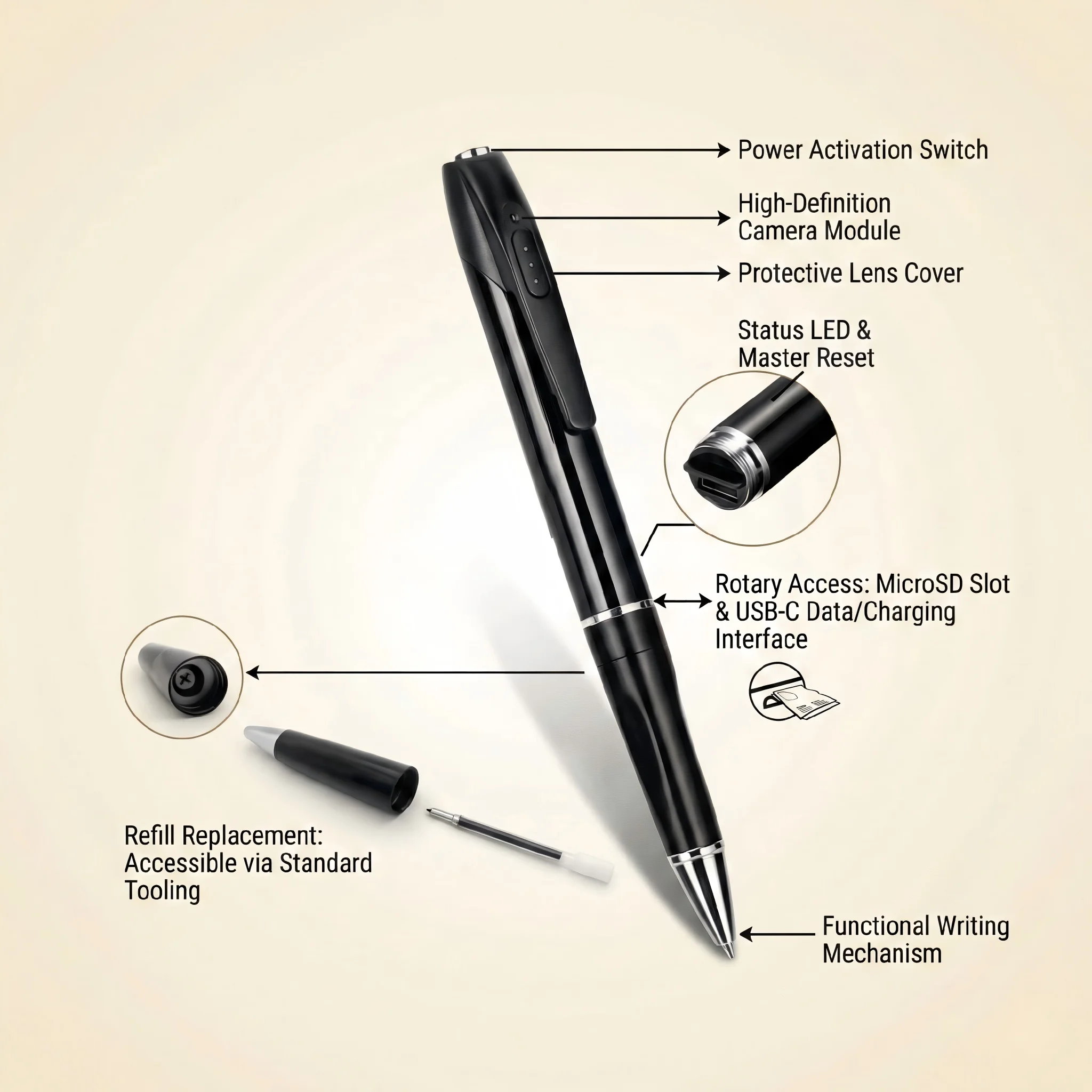
A spy pen camera packs three core components into a writing-pen form factor: a pinhole CMOS sensor (typically 1/4″ or 1/3″), a MEMS microphone, and a battery-power-management circuit connected to either internal flash memory or a microSD slot. The lens sits behind a pinhead-sized hole near the pen clip or tip — invisible unless you know exactly where to look.
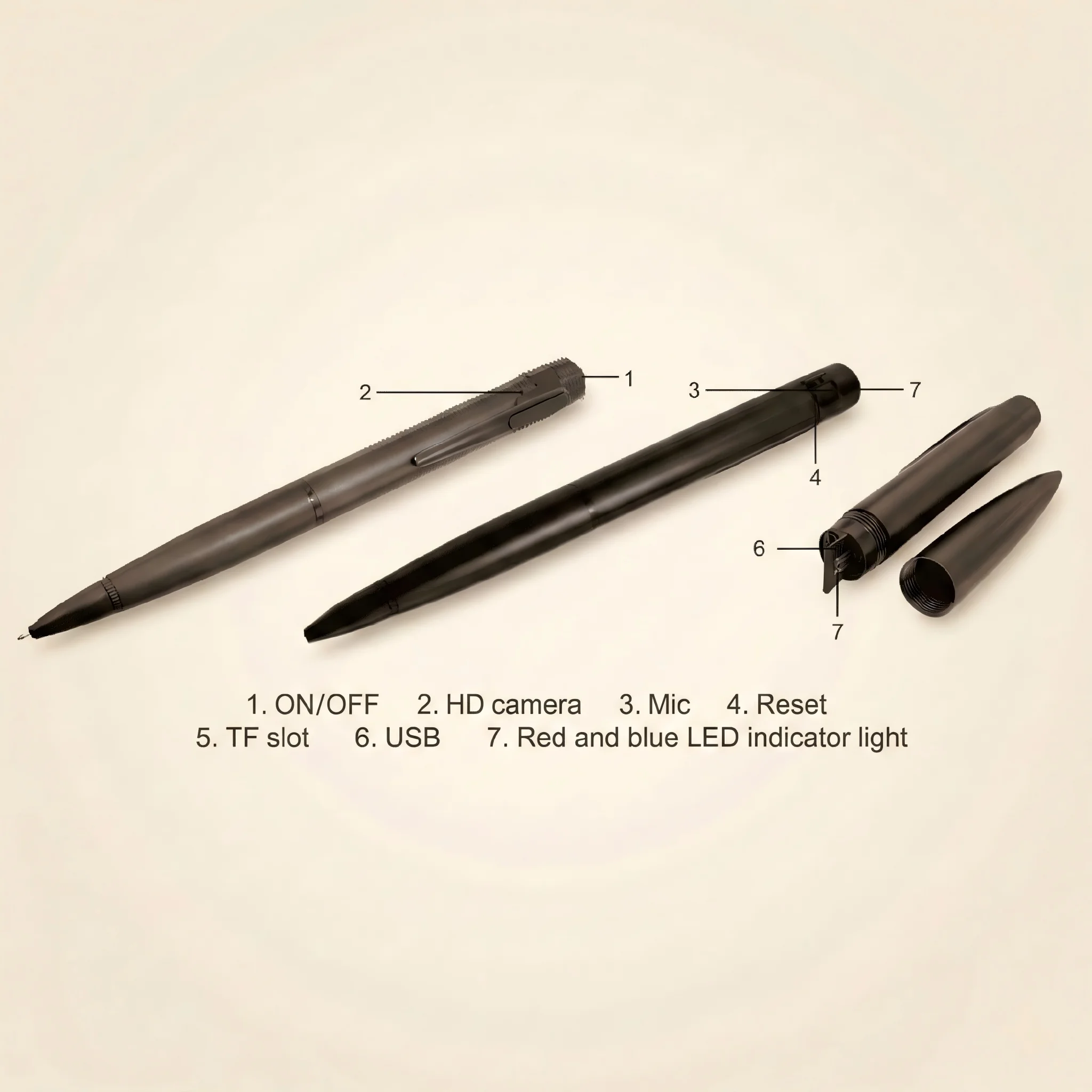
Here’s what makes the engineering tricky. The lens aperture is roughly 1.5mm across. At that size, every photon matters. The sensor has to push gain levels high in anything but bright office lighting — which introduces noise. The cheap units (sub-$30 retail) use recycled smartphone sensors from 2016-era feature phones. They claim “1080p” but actually record at interpolated 720×480 with upscaling. The file metadata will say 1920×1080; the actual pixel-level detail will be closer to VGA.
But here’s the thing: well-engineered models like our 1080P Hidden Spy Pen Camera W9 use native 1920×1080 CMOS sensors paired with glass optics — not plastic. The difference shows up immediately in edge sharpness and low-light noise floor. The microphone is a Knowles-type MEMS chip that captures usable audio at 6–8 feet in a quiet room. Recordings save as .MOV or .MP4 files with embedded timestamps, and the entire unit draws about 280–350mA during recording — giving 60–90 minutes of runtime from the tiny 180–240mAh lithium cell inside.
| Component | Budget Spy Pen (Sub-$30 Retail) | Quality Spy Pen (W9/W10 Class) |
|---|---|---|
| Sensor | Interpolated 720p, plastic lens | Native 1080p CMOS, glass optics |
| Microphone | Basic electret, 3ft usable range | MEMS Knowles-type, 6–8ft range |
| Battery | 120–150mAh, ~45min recording | 180–240mAh, 60–90min recording |
| Storage | Fixed 8–16GB internal, no expansion | microSD up to 128GB, hot-swappable |
| Build | Hollow-feel plastic, non-functional ink | Weighted metal barrel, writes with real ink |
Key Takeaway: A spy pen is a tightly engineered imaging pipeline, not a toy — buy accordingly.
Are Spy Pen Cameras Any Good for Real-World Recording?
This is the question that sends people to Amazon reviews, Reddit threads, and eventually to specialist B2B suppliers. The honest answer: mid-range and above spy pens (the $60–$120 wholesale tier) are genuinely useful. The bottom-tier ones aren’t.
What “good” means depends on your use case. A private investigator documenting insurance fraud from 15 feet away needs different performance than a businessperson recording a conference-room negotiation from 2 feet. The critical metrics are: resolvable detail distance, audio intelligibility range, and recording reliability (does it actually save the file when the battery dies?).
In testing documented by multiple specialist retailers, quality units like the W10 30MP spy pen capture readable text on a whiteboard at 8–10 feet in office lighting. Facial features are distinguishable at 6–8 feet. Audio picks up normal conversation clearly at 6 feet with HVAC background noise — the DSP noise reduction chip actually works on these units, unlike the $25 versions where “noise reduction” means cranking the gain until everything clips.
The recording reliability factor is something most reviews miss. Quality pens use a supercapacitor-backed write buffer: if the battery dies mid-recording, the last 30 seconds still get flushed to the SD card before power loss. Cheap pens corrupt the entire file. If you’re recording evidence for a legal matter or a critical business negotiation, that single feature is worth the price difference.
| Recording Scenario | Budget Pen Performance | W9/W10 Class Performance |
|---|---|---|
| Office meeting, 6ft from speaker | Grainy, audio muffled below 3ft | Clear faces, intelligible speech |
| Whiteboard text at 8ft | Unreadable smear | Legible characters |
| Low light (evening office) | Near-black, unusable | Grainy but identifiable |
| Battery-die file recovery | Corrupted file, total loss | Supercapacitor saves last 30s |
| Timestamp accuracy | Resets to 2016 on power loss | Battery-backed RTC, correct |
Key Takeaway: Good spy pens deliver courtroom-usable evidence; cheap ones deliver regret.
What Is the Best Spy Pen Camera for Different Needs?
There is no single “best” spy pen — only the best one for your specific recording scenario, budget, and legal jurisdiction. The market splits into three tiers that map to actual component quality, not marketing claims.
The budget tier ($15–$35 wholesale) uses Allwinner or Generalplus chipsets from 2018-era dashcam designs. Video is interpolated 720p at best. Audio sounds like a phone call from 2005. But — and this matters for certain B2B buyers — they work for close-range documentation where detail isn’t critical. A security guard documenting a stationary scene 3 feet away? Fine. A lawyer trying to capture a witness deposition across a table? Not fine.
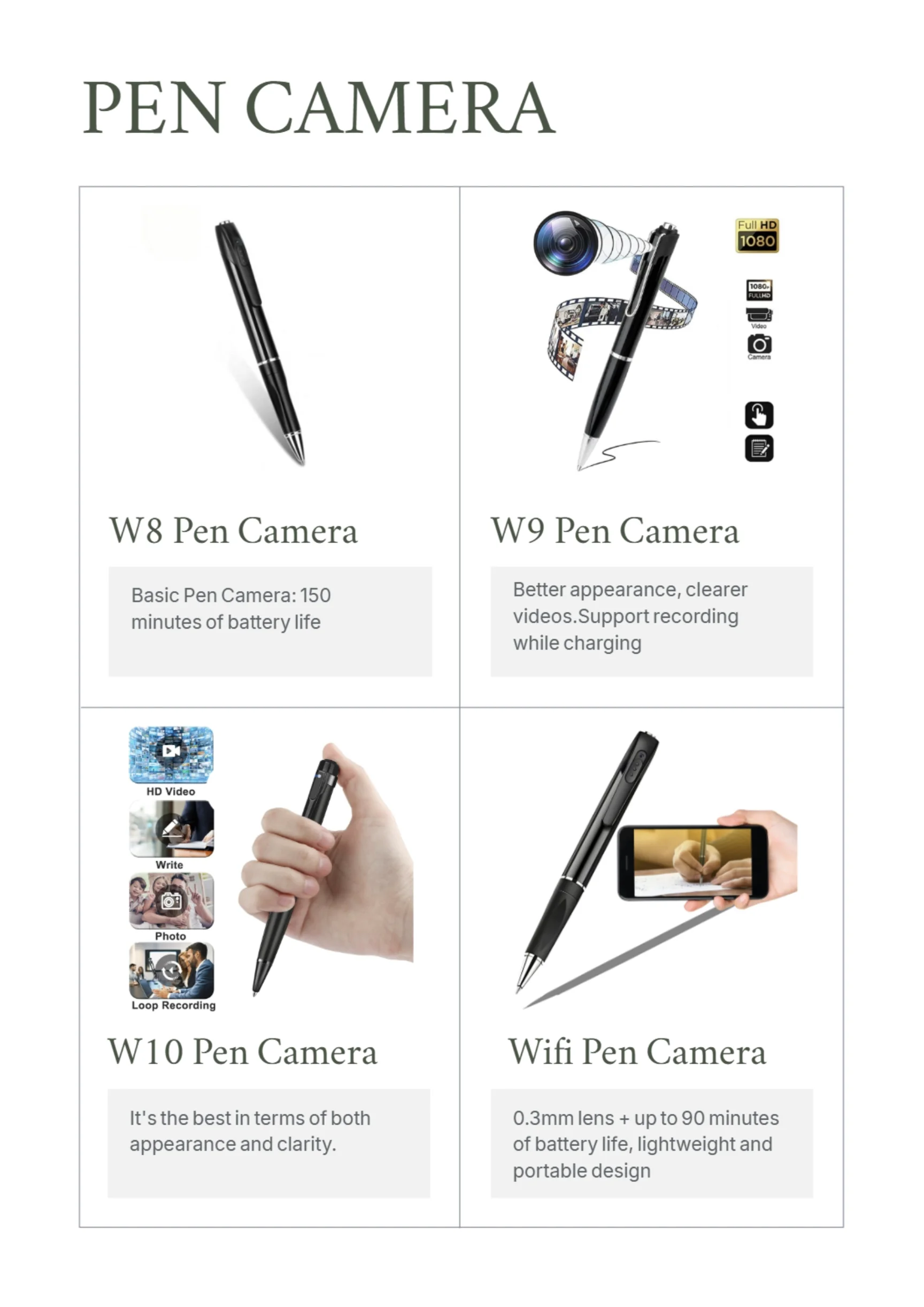
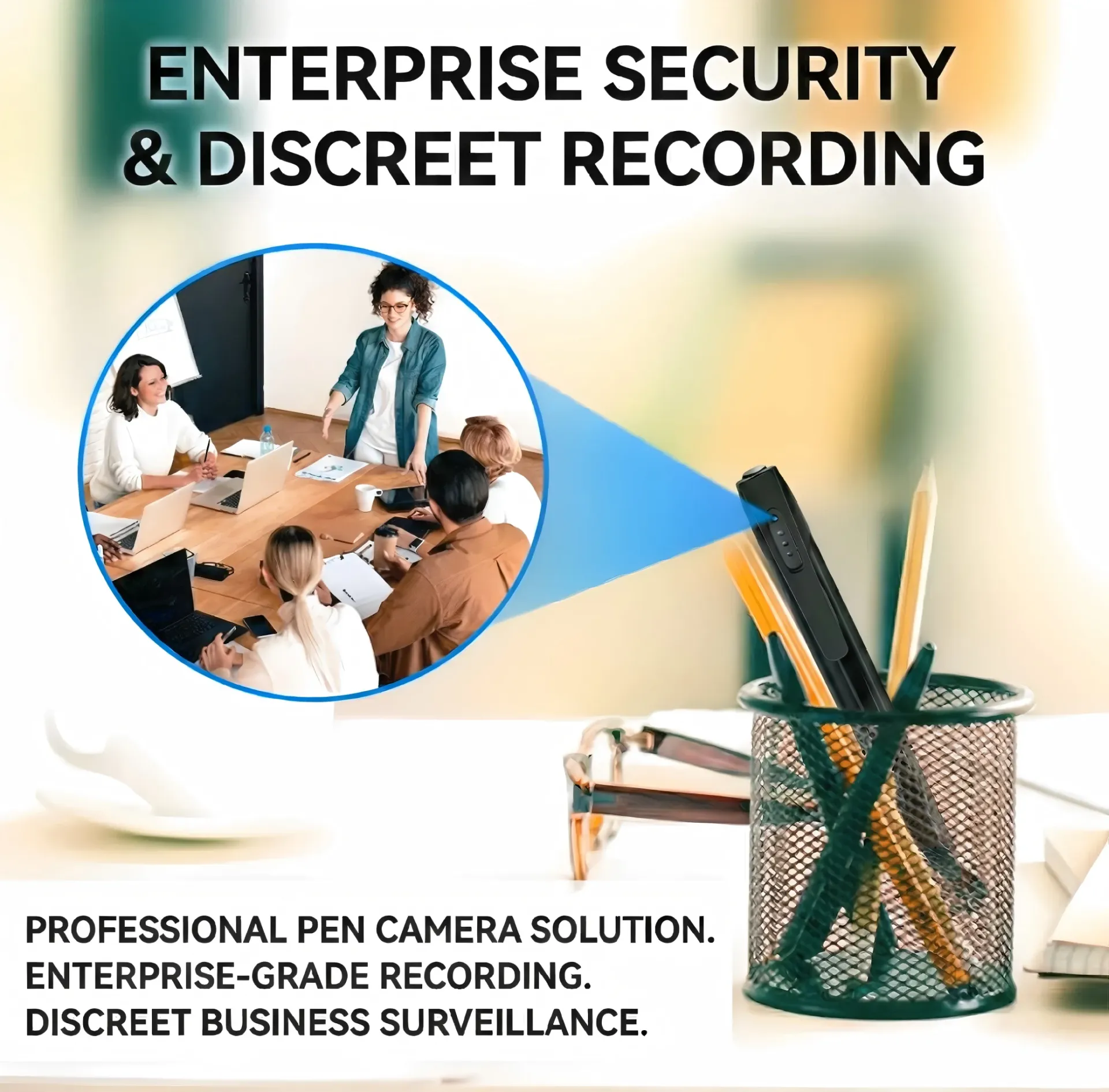
The mid-range tier ($40–$75 wholesale) — where the W9 12MP model sits — uses native 1080p sensors with glass lens assemblies, proper MEMS mics, and battery-backed real-time clocks. This is the sweet spot for 90% of B2B buyers: private investigators, corporate security teams, journalists, and wholesale distributors serving those markets. Video is sharp enough for evidence. Audio is clear enough for transcription.
The premium tier ($80–$150 wholesale) adds WiFi connectivity — but here’s what most people get wrong. The WiFi spy pen camera does NOT stream real-time like a security camera. It creates a local WiFi hotspot; your phone connects and views footage with 1–4 seconds of latency. Useful for confirming camera angle during setup, not for live monitoring. The W10 adds a 30MP photo mode and 128GB microSD support for all-day conference recording.
| Use Case | Recommended Tier | Why |
|---|---|---|
| Personal meeting notes | Budget ($15–$35) | Close-range audio, don’t need detail |
| Corporate evidence gathering | Mid-range W9 ($40–$55) | Native 1080p, reliable file saves |
| Private investigation | Mid-range W9/W10 | Sharp enough for court, audio clarity |
| All-day conference/lecture | Premium W10 ($65–$85) | 128GB = 12+ hours continuous |
| Remote angle checking via phone | WiFi Pen ($80–$150) | Live preview, not live monitoring |
Key Takeaway: Match the tier to the stakes — higher stakes demand native 1080p and file reliability.
What Is the Price of a Spy Pen Camera in 2026?
Spy pen camera pricing follows a predictable curve from disposable to professional — but the retail numbers you see on Amazon are 2–4× the wholesale cost. Understanding this spread is essential whether you’re buying one unit or 500.
Retail pricing (end-user, single unit):
– Budget 720p pens: $18–$35
– Native 1080p pens (W9 class): $55–$95
– WiFi-enabled 1080p pens: $90–$160
– Premium 30MP + 128GB (W10 class): $110–$180
Wholesale pricing (B2B, MOQ 10–50 units):
– Budget 720p: $8–$15 per unit
– Native 1080p W9 class: $25–$45 per unit
– WiFi pens: $45–$80 per unit
– W10 class: $40–$70 per unit
The pricing gap between retail and wholesale creates margin for distributors — even at 50% below Amazon retail, a B2B buyer moving W9-class pens at £65–£75 in the UK or €70–€85 in Germany still clears healthy profit. But here’s where B2B buyers from the EU need to pay attention: the wholesale price MUST include CE marking and RoHS compliance documentation. If a supplier quotes $18 for a “1080p pen camera” without providing CE certificates, you’re buying e-waste that customs can seize at the port.
Shipping and duties add 12–18% for DDP air freight to UK/EU addresses. Factor that into your landed cost calculation. A $35 wholesale unit becomes roughly £33–£36 landed — still sellable at £69–£79 with room for warranty reserves.
| Price Tier | Wholesale (10–50 units) | Retail Markup | Margin Potential |
|---|---|---|---|
| Budget 720p | $8–$15 | 2–3× | Narrow — compete on volume |
| Mid 1080p (W9) | $25–$45 | 2–2.5× | Healthy — value-add through bundling |
| WiFi 1080p | $45–$80 | 2–2.5× | Strong — higher ticket, fewer competitors |
| Premium W10 | $40–$70 | 2–2.5× | Good — position as “professional grade” |
Key Takeaway: Wholesale is 40–60% below retail — but only with proper CE/RoHS documentation.
What Specs Actually Matter When Choosing a Spy Pen?
Product listings throw numbers at you — 1080p! 30MP! 128GB! — and hope you won’t ask which ones are real. Here’s a spec-by-spec reality check based on teardowns and actual testing.
Resolution: Ignore “4K” claims entirely. No spy pen camera in 2026 records native 4K video. The sensor would need to be 8MP minimum with pixel-binning at a size that doesn’t fit in a pen barrel. Any listing claiming 4K video is interpolating — the sensor captures 720p or 1080p, and software upscales. Check for “native” or “optical” resolution in the spec sheet. If the listing won’t say it, assume it’s interpolated.
Battery: Runtime is 60–70% of claimed. A pen advertised as “120 minutes recording” typically delivers 70–85 minutes of actual 1080p recording. Here’s why: the rated runtime is tested at 720p with screen off — not 1080p continuous. The CMOS sensor draws more current at higher resolution, and the DSP chip works harder encoding more pixels. Subtract another 15–20% after six months of use as lithium cells degrade. For B2B buyers, this matters: your customers will test the battery and complain if it falls short. Under-promise in your own listings.
Storage: microSD beats internal memory every time. Fixed internal storage means when the memory fails, the entire device is bricked. A microSD slot lets users swap cards between sessions, upgrade capacity, and recover files by pulling the card even if the pen’s USB port fails. The W10 pen camera supports up to 128GB — roughly 24–36 hours of 1080p footage before overwriting.
| Spec | What Marketing Says | What It Actually Means |
|---|---|---|
| “4K Video” | Ultra HD recording | Interpolated 720p/1080p — ignore |
| “120 min battery” | All-day recording | 70–85 min 1080p real-world, less after 6 months |
| “Night vision” | See in the dark | Digital gain boost — noisy, no IR LEDs in pen format |
| “HD audio” | Crystal clear sound | Tests at 3ft in silence; real range is 6ft with noise |
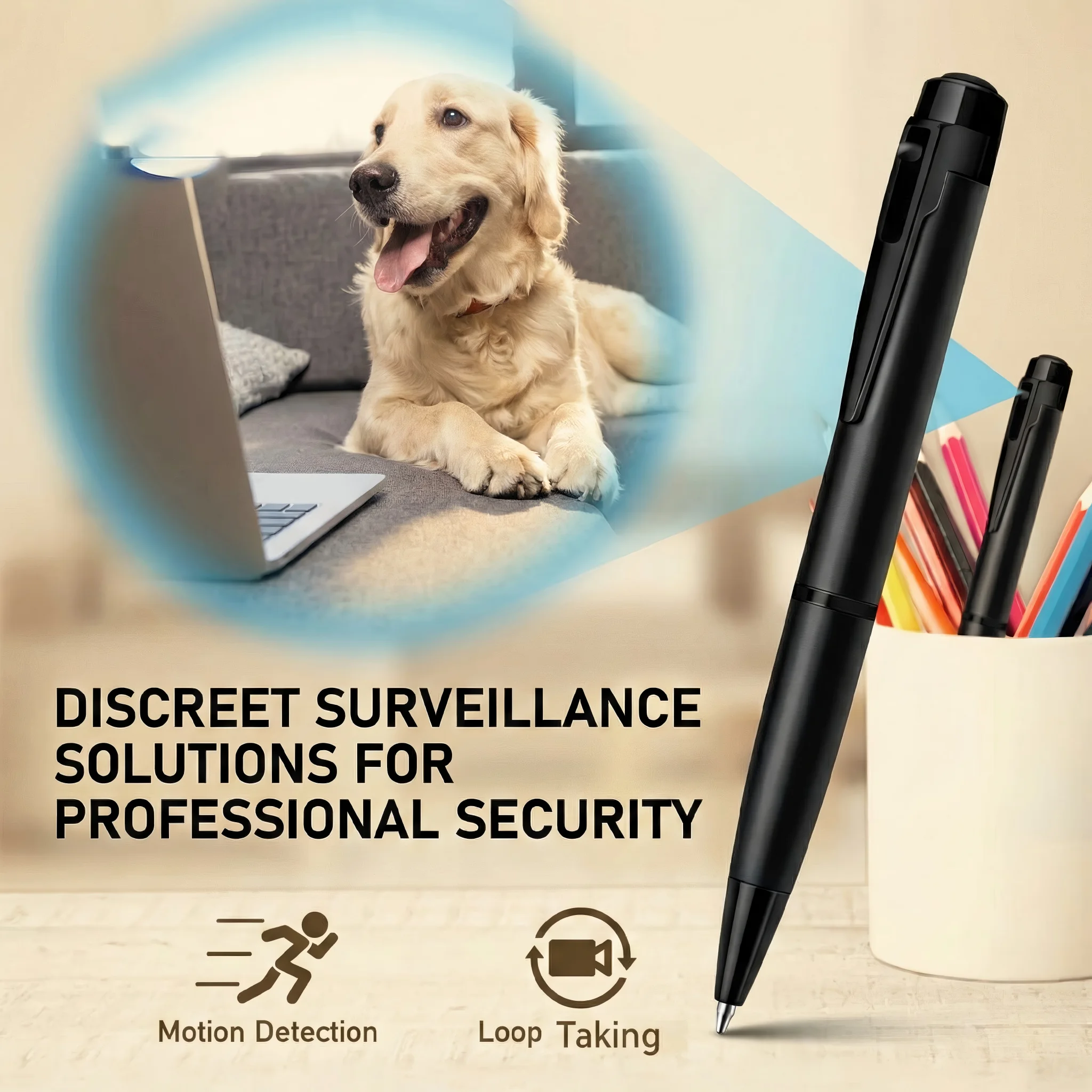
| “Motion detection” | Smart recording | Basic pixel-change trigger, 2–3 sec activation delay |
Key Takeaway: Native 1080p, microSD slot, and USB-C charging are the three non-negotiable specs.
Are Camera Pens Legal to Use in the UK and EU?
Legal compliance is where most spy pen buyers — and far too many B2B sellers — go dangerously wrong. In the UK and EU, the law doesn’t care that your device is shaped like a pen. It cares about what data you collect, where you collect it, and whether people had a reasonable expectation of privacy.
UK law is governed by the Data Protection Act 2018 (the UK’s post-Brexit GDPR implementation) and the Regulation of Investigatory Powers Act 2000 (RIPA). For personal or business use, covert recording is treated as processing personal data. You need a lawful basis under Article 6 — typically “legitimate interests,” but this requires a Legitimate Interests Assessment (LIA) documenting why recording is necessary and proportionate. The Information Commissioner’s Office (ICO) has been clear: recording employees without their knowledge is presumptively unfair unless you can demonstrate a specific suspicion of serious wrongdoing.
EU law under GDPR is even stricter. Germany’s Bundesdatenschutzgesetz (BDSG) requires employee consent for workplace recording in almost all circumstances — and consent must be freely given, which is nearly impossible in an employer-employee relationship. France’s CNIL has fined companies for covert workplace surveillance. Across the EU, the principle is consistent: if someone has a reasonable expectation of privacy (their office, a meeting room, a vehicle they’re driving), covert recording is presumptively illegal unless you have a documented, specific, and proportional justification.
Audio recording adds another layer. The UK is a one-party consent jurisdiction — you can record conversations you participate in. Germany is a two-party consent jurisdiction — all participants must agree. Recording a conversation in Germany without consent is a criminal offense under §201 StGB, punishable by up to three years in prison.
| Jurisdiction | Video Recording | Audio Recording | Workplace Covert |
|---|---|---|---|
| UK | Legal in public/no-privacy areas | One-party consent | Requires LIA + specific suspicion |
| Germany | Strict — consent required in private | Two-party consent (§201 StGB) | Nearly always illegal without consent |
| France | CNIL-regulated, consent-heavy | Two-party consent | Requires CNIL notification |
| EU General | GDPR Article 6 — lawful basis required | Varies by member state | Must be necessary + proportionate |
Key Takeaway: Covert recording in the UK/EU needs a documented lawful basis — not just a product manual disclaimer.
Are Camera Pens Legal to Use in the United States?
US spy pen laws are a patchwork of federal statutes and 50 state rulebooks. The single most important distinction for any spy pen user: video recording rules are different from audio recording rules — and audio is the one that gets people prosecuted.
Federal law (18 U.S.C. § 2511) permits audio recording as long as one party to the conversation consents — and that party can be you. If you’re participating in the conversation, you can legally record it under federal law. Video recording in public places where there’s no reasonable expectation of privacy is broadly legal under the First Amendment and federal statutes.
State laws split into two camps. Thirty-eight states are one-party consent (aligned with federal law). Twelve states — California, Florida, Illinois, Maryland, Massachusetts, Michigan, Montana, Nevada, New Hampshire, Pennsylvania, Vermont, and Washington — are all-party consent states. In these states, everyone being recorded must consent. Recording a conversation in California without informing all participants is a felony under Penal Code §632, carrying up to three years in prison and a $2,500 fine per violation.
Where you can NEVER record: bathrooms, locker rooms, changing rooms, bedrooms, hotel rooms, and medical examination rooms — anywhere a reasonable person expects privacy. This is universal across all 50 states and isn’t a gray area. Placing a spy pen in a bathroom is a felony in every state.
| Legal Factor | One-Party States (38) | All-Party States (12) |
|---|---|---|
| Audio recording rule | You consent = legal | Everyone must consent |
| Video in public | Generally legal | Generally legal |
| Video in private workplace | Gray zone — consult attorney | Gray zone — consult attorney |
| Penalty for violation | Misdemeanor to felony, varies | Felony-level in CA, FL, PA |
| Best practice | Disclose when possible | Always disclose or don’t record |
Key Takeaway: Audio consent laws, not video laws, trigger the prosecutions — know your state.
What Spy Pen Camera Features Do B2B Buyers Care About?
Retail customers care about price and “does it work.” B2B buyers — distributors, corporate security procurement teams, private investigation firms — care about margin, reliability, documentation, and after-sales support. The feature checklist is completely different.
CE/FCC certification and RoHS compliance is not optional for B2B. A customs officer in Rotterdam or Felixstowe can seize an uncertified shipment at the port — and they do, regularly. European distributors need the full technical file: CE declaration of conformity, RoHS test reports, EMC test reports, and the manufacturer’s ISO 9001 certificate if available. Without these, the product is uninsurable and unsellable in the EU.
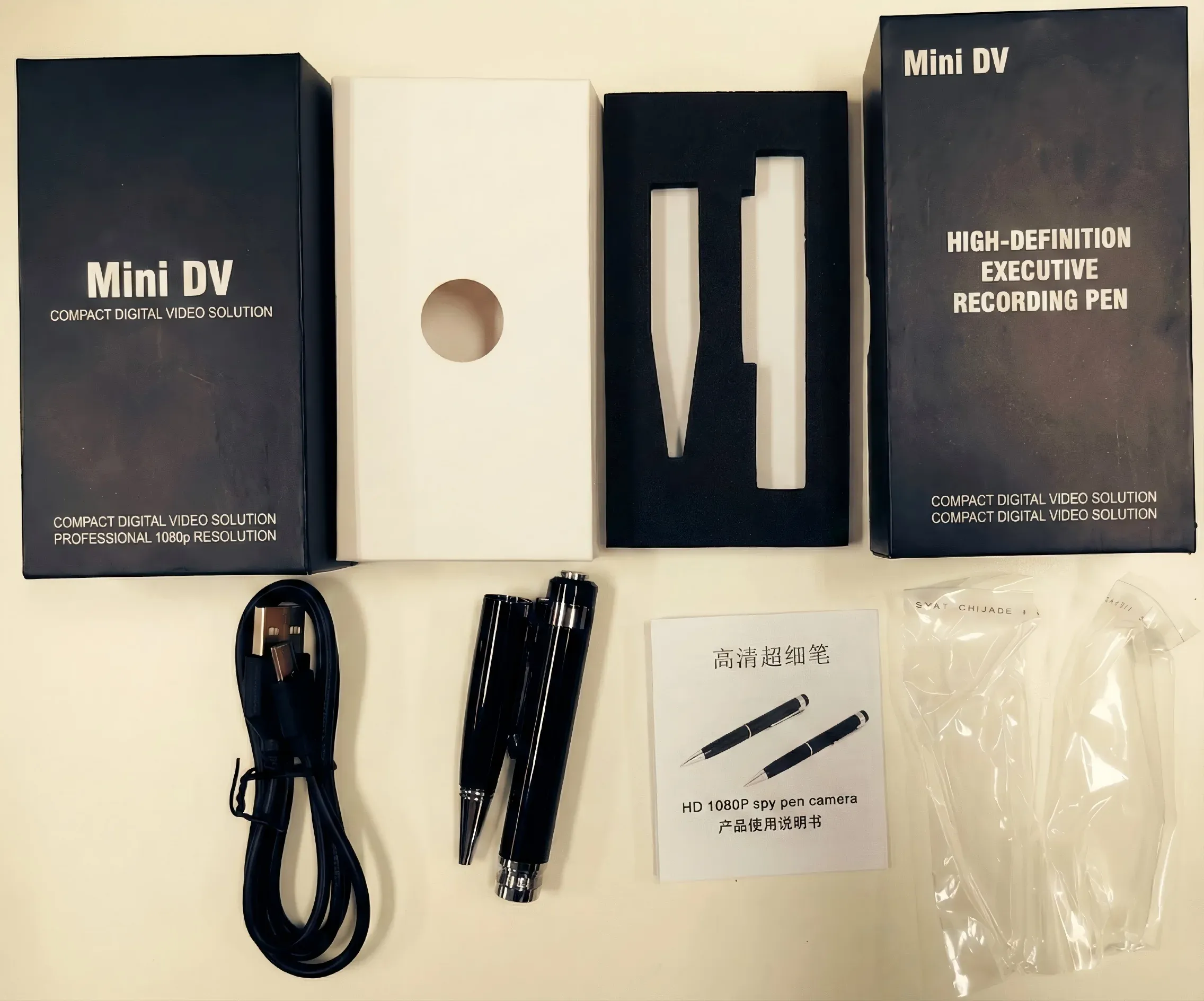
MOQ flexibility matters more than unit price. A distributor testing a new market wants to order 10–20 units, not 500. A supplier who offers sample orders with the same unit documentation as bulk orders is worth paying 10–15% more for. Our W9 pen cameras ship from 10-unit MOQ with full CE documentation — the same paperwork you’d get at 500 units.
White-label and OEM options separate commodity traders from manufacturing partners. Can the supplier print your logo on the pen barrel? Customize the packaging? Pre-load your firmware with your brand’s splash screen? If you’re building a brand in Germany’s security electronics market or France’s surveillance sector, these matter more than shaving $2 off the unit cost.
| B2B Requirement | Why It Matters | Red Flag |
|---|---|---|
| CE/RoHS documentation | Customs clearance, EU legality | “We’ll send it later” — never arrives |
| Low MOQ (10–50) | Market testing, cash flow | 500-unit minimum on first order |
| Sample unit with full docs | Verify before committing | Sample ships without paperwork |
| Consistent batch quality | Returns destroy margin | Different lens tint batch-to-batch |
| White-label capability | Brand building in local market | “No customization” — you’re a reseller, not a brand |
Key Takeaway: Documentation and MOQ flexibility beat rock-bottom unit pricing for B2B buyers.
How Do You Verify Spy Pen Camera Quality Before Bulk Ordering?
Ordering 200 spy pens that turn out to have focus drift, dead pixels, or battery failure at 40 minutes isn’t just a bad review — it’s a margin-destroying return wave. Pre-bulk QC verification isn’t optional; it’s the cheapest insurance you’ll ever buy.
Step 1: Order 3–5 sample units — not 1. A single sample can be a “golden unit” hand-picked from the production line. Three to five units from different production batches reveal batch-to-batch variance. Pay full price including shipping. Free samples are almost always cherry-picked.
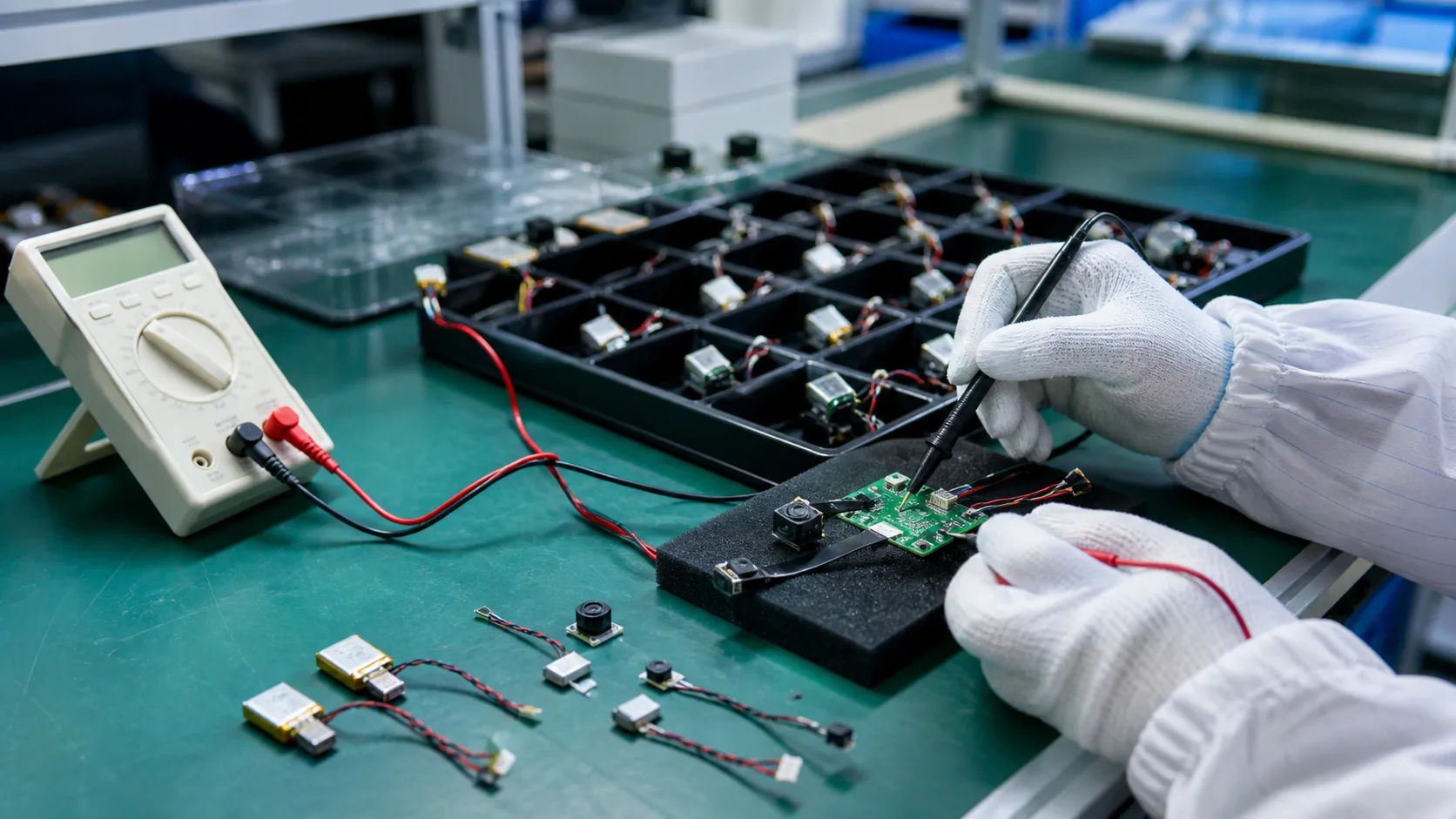
Step 2: Run the same test on every unit, in the same conditions. Set up a test card (print a Snellen eye chart or even a newspaper page) at 6 feet. Record 60 seconds on each pen under the same office lighting. Compare frame-by-frame. If one unit is noticeably softer than the others, the lens wasn’t properly focused at assembly — a batch-wide issue, not a one-off.
Step 3: Battery validation. Fully charge each unit. Start recording continuously with a timestamp visible in-frame. Note exactly when each unit powers off. Three units should be within 10% of each other. If one dies at 45 minutes and another at 75, the battery supplier is inconsistent and you’ll see 10–15% early-failure returns.
Step 4: Audio cross-check. Record the same sentence from 6 feet on all units. Open the files in Audacity (free audio tool). Check waveform amplitude and noise floor. If one unit is significantly quieter or noisier, the microphone solder joint or MEMS element is faulty.
| QC Test | Pass Threshold | Fail = Reject Shipment |
|---|---|---|
| Video sharpness at 6ft | Newspaper text readable on all units | Any unit blurrier than peers |
| Battery runtime consistency | Within 10% of each other | >15% variance across samples |
| Audio level at 6ft | Waveform peaks within 3dB | >6dB difference between units |
| Timestamp persistence | Survives power-off for 24hr | Resets to factory default |
| File integrity on battery death | Last clip playable, not corrupted | Corrupted .MOV — walk away |
Key Takeaway: Three sample units, same test protocol, reject if variance exceeds 10–15%.
Spy Pen Camera vs Other Hidden Cameras: Which Should You Stock?
A spy pen isn’t always the right tool — and for B2B buyers stocking inventory, diversifying across form factors protects against shifts in demand. Here’s how pen cameras compare against their main covert competitors.
Spy pen vs glasses camera: Pens are better for stationary, close-range recording (meetings, interviews, desk work). Glasses like our covert HD camera glasses excel at mobile, first-person recording — following someone through a space, documenting an interaction while moving. Glasses have shorter battery life (40–60 minutes) because the battery is tiny. Pens win on recording duration; glasses win on point-of-view mobility.
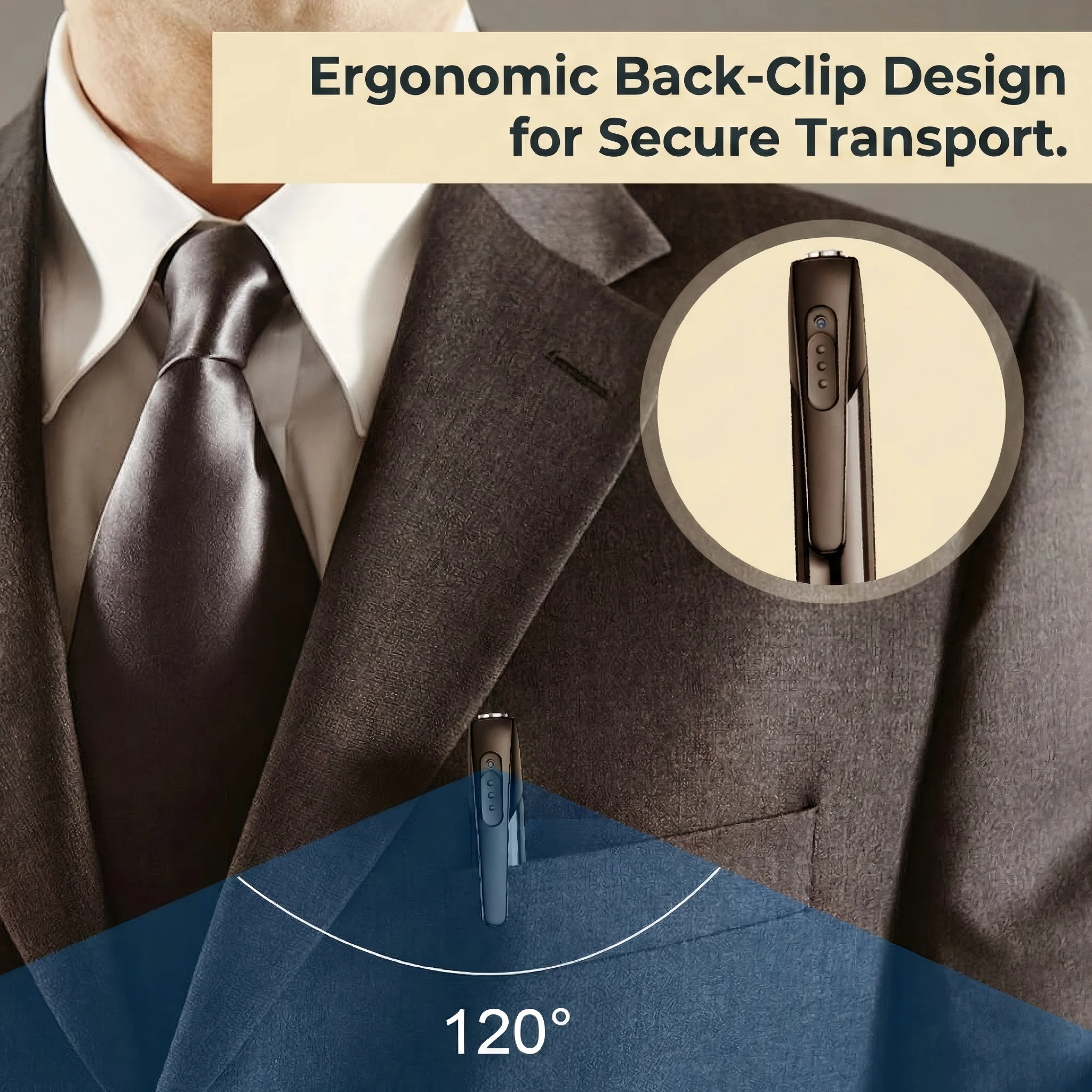
Spy pen vs clock camera: Clock cameras like our Z10 WiFi spy clock are stationary room monitors — plug them in and they record 24/7. Pens are mobile and personal. If you’re documenting your own interactions throughout a day, a pen is the right tool. If you’re monitoring a fixed space (office, hotel room, warehouse corner), a clock camera or smoke detector camera makes more sense. B2B buyers should stock both: pens for personal/documentation use, stationary hidden cameras for fixed surveillance.
Spy pen vs USB charger camera: The WiFi USB charger camera is plugged into a wall — continuous power, continuous recording, no battery anxiety. But zero mobility. Pens are the opposite: portable, battery-limited, discreet in motion. Complimentary product categories, not competing ones.
| Feature | Spy Pen | Spy Glasses | Clock Camera | USB Charger Cam |
|---|---|---|---|---|
| Best use | Meetings, interviews | Mobile POV recording | Fixed room monitoring | Fixed 24/7 surveillance |
| Battery life | 60–90 min | 40–60 min | Plugged in (unlimited) | Plugged in (unlimited) |
| Mobility | Pocket-portable | Worn, hands-free | Stationary | Stationary |
| Discreetness | Very high (looks like pen) | Moderate (camera visible close-up) | High (functional clock) | High (functional charger) |
| Wholesale cost | $25–$80 | $30–$70 | $35–$90 | $20–$55 |
Key Takeaway: Stock pens for personal recording, stationary cameras for fixed surveillance — they serve different buyers.
Frequently Asked Questions
Can I use a spy pen camera to record my boss giving me contradictory instructions?
Yes — in one-party consent jurisdictions. If you’re in a conversation with your boss, you are a participant and can legally record under federal law and in 38 US states. But in all-party states (California, Florida, etc.) or in Germany, recording without disclosure is illegal and could result in criminal charges. For UK users, one-party consent applies but workplace recording policies may impose additional restrictions. Always check: if the recording would violate your employment contract, the legal right to record doesn’t protect you from being fired.
What’s the best spy pen camera for recording lectures and conferences?
The W10 model with 30MP photo mode and 128GB microSD support is the best choice for all-day academic recording. Its larger storage capacity means 12+ hours of continuous 1080p footage without swapping cards. The higher-resolution photo mode also lets you capture whiteboard or projection screen snapshots during lectures. Just remember: many universities in the UK and EU require consent from the lecturer before recording — check your institution’s policy first.
How do I know if a spy pen camera listing is lying about 1080p?
Three red flags: (1) the listing says “4K” — no spy pen records native 4K, period. (2) The file format is .AVI instead of .MOV or .MP4 — .AVI is common on old chipsets that capture at 720p and upscale. (3) The listing doesn’t mention “native” or “optical” resolution — if they won’t say it, it’s interpolated. When you receive the unit, open a test clip in VLC Media Player, press Ctrl+J for codec information, and check the displayed resolution against “Buffer Dimensions.” If they don’t match, it’s upscaled.
Are spy pen cameras detectable by anti-spy camera detectors?
Yes — all camera lenses, including pinhole lenses in spy pens, reflect light. Professional-grade camera detectors use laser illumination to identify the retro-reflection from CMOS sensors. A spy pen’s lens is harder to spot than a full-size camera, but it’s not invisible to detection equipment. This is actually a good thing: if you’re using the pen for legitimate purposes and someone asks whether they’re being recorded, you can demonstrate transparency. If you need something truly undetectable for a sanctioned law enforcement operation, you need different equipment — not a consumer spy pen.
Can I bring a spy pen camera through airport security in Europe?
Yes — it’s a pen with electronics inside, not a prohibited item. But there are two caveats. First, lithium batteries in checked luggage are restricted; keep the pen in your carry-on. Second, using the pen to record inside an airport security area or on an aircraft without permission may violate local laws and airline policies. In Germany’s airports, recording in security screening areas is explicitly prohibited. In the UK, airport bylaws restrict photography and recording in certain zones. Power the pen off and keep it in your bag through security — don’t give security personnel a reason to ask questions.
Ready to Stock or Source Spy Pen Cameras?
Whether you’re a distributor building a surveillance product line in the UK, a corporate security manager in Germany sourcing evidence-gathering tools, or a private investigator in France upgrading your kit — the right spy pen camera starts with verified specs, documented compliance, and a supplier who ships what they promise.
Our spy pen camera collection includes the W9 12MP, W10 30MP/128GB, and WiFi models — all with native 1080p sensors, CE/RoHS documentation, and sample-order MOQs starting at 10 units. Contact us today to request spec sheets, compliance documents, or sample pricing.

 English
  Italiano
  Deutsch
  Français
  Español
  Polski