
The four requirements the Reddit r/SecurityCamera community asks about most — discreet form factor, audio and video recording, local storage, and uninterrupted live streaming — don’t all conflict with each other, but they do create trade-offs that most product pages ignore. Getting all four right requires understanding how each feature actually works in a wireless mini spy camera, not just whether a spec sheet claims it.
This guide explains exactly what to check before buying a wireless mini spy camera with audio and video recording, and which hardware decisions determine whether the camera will actually do what you need.
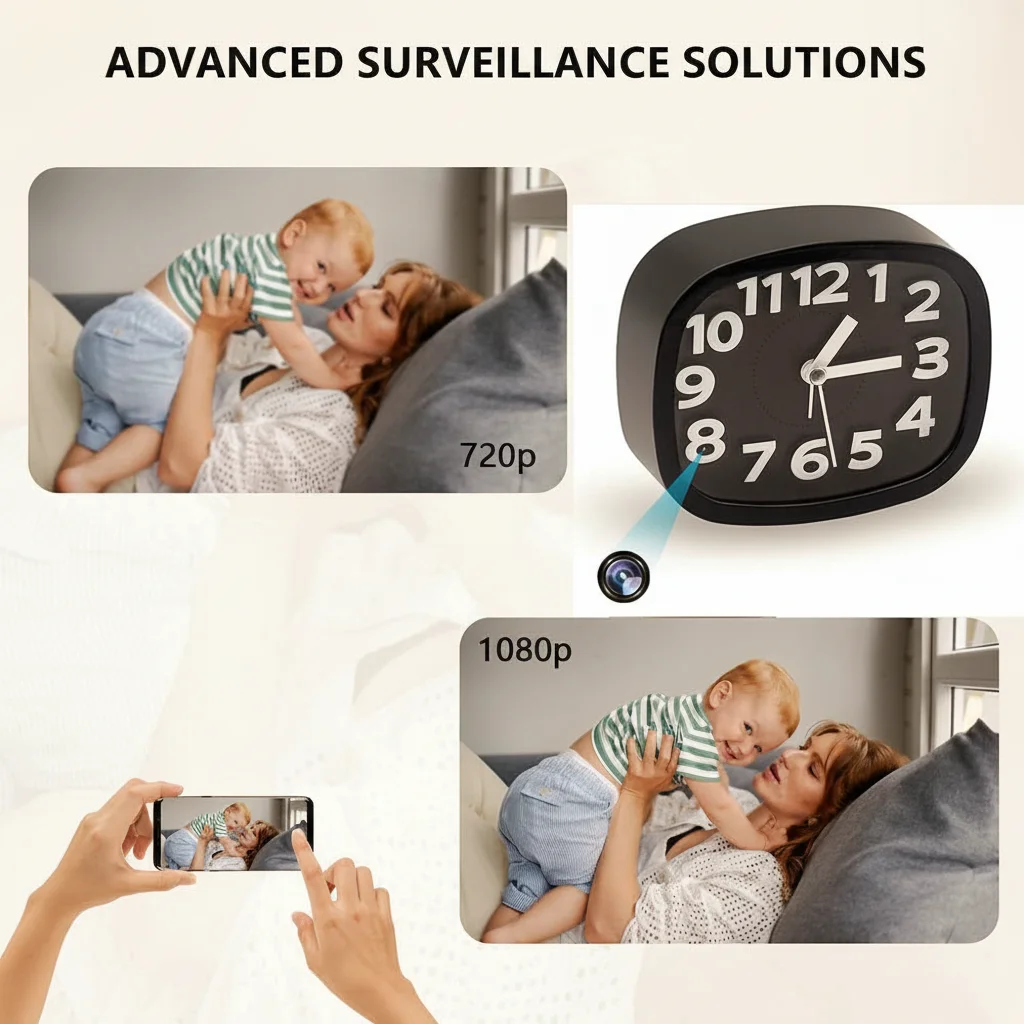
Can a wireless camera record audio and video at the same time without cutting out?
Yes — but only if the camera architecture separates audio capture from video compression. Lower-cost wireless spy cameras process audio and video on the same low-power SoC (system-on-chip). When the chip is under load — for example, streaming 1080p while simultaneously writing to a MicroSD card — the audio channel is the first thing that drops frames or cuts entirely.
Cameras based on higher-grade SoC platforms, including those using the Hisilicon Hi3518 or Novatek chipsets, handle simultaneous audio and video processing reliably. To verify this before purchasing:
- Ask the supplier for a sample recording clip that includes audio captured while the WiFi live stream was active simultaneously
- Check whether the spec confirms AAC or PCM audio encoding — cameras that skip encoding and send raw audio are prone to sync drift
- Confirm the microphone is an omnidirectional condenser mic with a frequency response above 3kHz for usable voice capture
What is the difference between WiFi live streaming and local recording — and can you do both at once?
These are two independent data paths, and whether they can run simultaneously depends on the camera’s network chipset and available bandwidth:
- Local recording to MicroSD writes a compressed H.264 or H.265 video file to the card directly from the video processor. No network connection is required.
- WiFi live streaming opens a separate RTSP or P2P stream to your phone via the app. This uses 2.4GHz bandwidth and adds approximately 50–100ms of latency.
The issue arises when both paths share the same data bus on the SoC. In this case, enabling live streaming reduces the bitrate available for local recording, causing dropped frames or lower-quality saved footage. Better-designed cameras use dual data paths — the local recording runs at full bitrate regardless of streaming status.
Ask the supplier specifically: does MicroSD recording quality change when the app is actively streaming? If they can’t answer, assume the camera uses a single data bus.
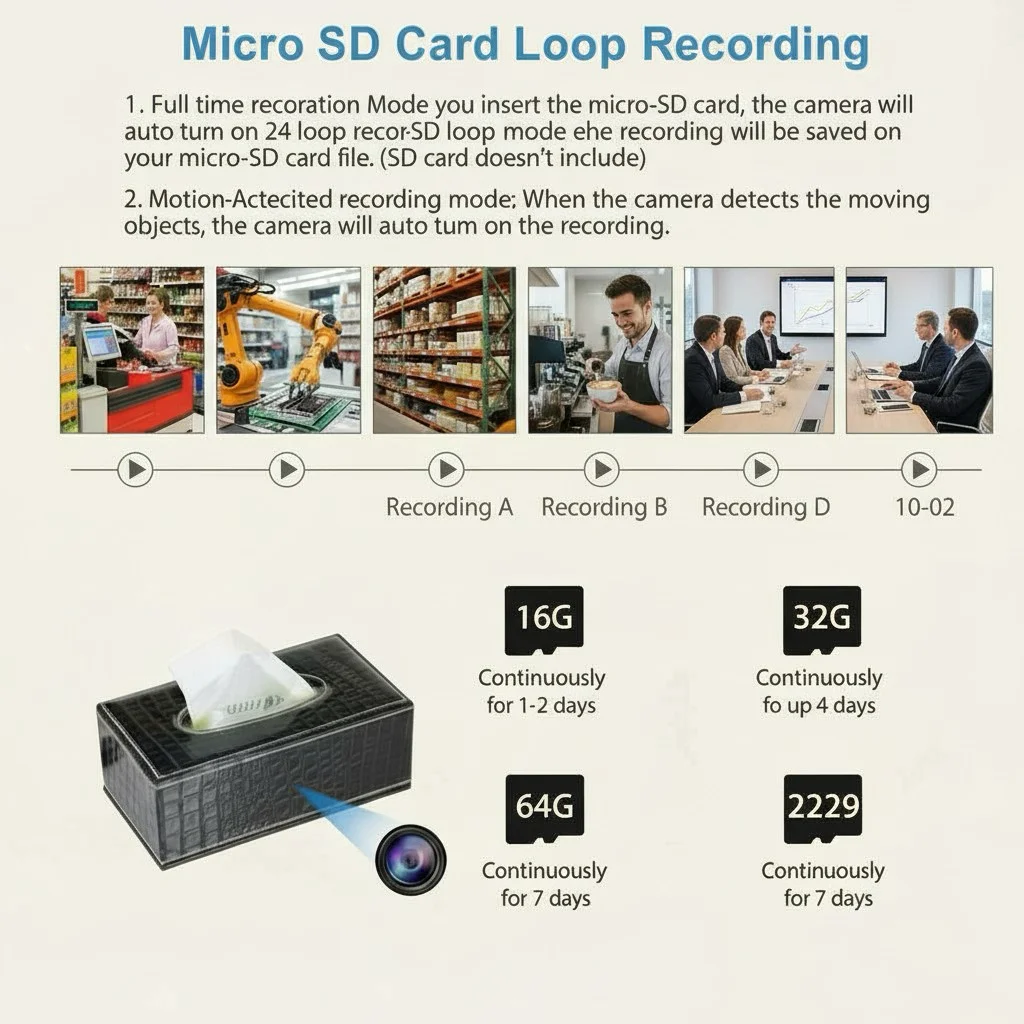
How much storage do you actually need, and how does loop recording work?
Most wireless mini spy cameras support loop recording — when the MicroSD card fills up, the oldest files are overwritten automatically. This is ideal for continuous unattended recording without manual management.
| Card size | Recording hours at 1080p/8Mbps | Recording hours at 720p/4Mbps |
|---|---|---|
| 32GB | ~8–9 hours | ~17–18 hours |
| 64GB | ~17–18 hours | ~35–36 hours |
| 128GB | ~35–36 hours | ~72 hours |
Before inserting a card, confirm the camera supports your card size and requires FAT32 format. Many cameras sold as supporting 128GB actually cap out at 64GB due to firmware limits. Use a Class 10 or UHS-I rated card — slower cards cause dropped frames in continuous recording mode.
Cameras that support motion-activated recording significantly extend effective storage time. In a typical indoor setting where movement happens 2–4 hours per day, a 32GB card on motion-activation can last 3–5 days before loop recording begins overwriting.
What makes a wireless spy camera actually discreet?
Discretion comes from two separate factors: physical form factor and operational silence. Most buyers focus on the first and overlook the second.
Form factor: A camera that blends into its environment is less likely to be noticed. Cameras built into functional objects — clocks, socket outlets, USB chargers, or smoke detectors — are significantly harder to identify as cameras than a standalone black cube sitting on a shelf.
- Z10 WiFi clock cameras sit on a desk or shelf as a working digital clock while recording continuously
- EU socket cameras plug into the wall outlet and are invisible to anyone not looking for a camera
- USB charger cameras function as real phone chargers while recording to a MicroSD card
- Power bank cameras offer portability with battery-based operation for locations without nearby outlets
Operational silence: A camera that blinks an LED or makes a faint mechanical noise when recording defeats its own purpose. Before using any wireless spy camera, verify: no indicator LEDs during recording (or confirm they can be disabled in the app), no WiFi connection noise when the camera sends motion alerts, and no audible click or mechanical sound from an internal shutter mechanism.

How does the live-streaming connection actually work — and what interrupts it?
Most consumer wireless spy cameras use one of two live-streaming architectures:
- P2P relay: The camera and your phone both connect to the manufacturer’s cloud server, which bridges the connection. This works from anywhere with an internet connection but depends on the server staying online. If the manufacturer shuts the service down, remote viewing stops working.
- Direct LAN / RTSP: The camera streams directly to your phone over your local WiFi network. This does not require any external server and works even without internet. However, it typically only works when you are on the same WiFi network, not remotely.
Cameras using the Tuya or Hikam app infrastructure use P2P relay but offer significantly better server reliability than smaller brands. For critical monitoring that must not depend on a third-party server, an RTSP-capable camera that streams directly to an NVR or local viewer is more reliable.
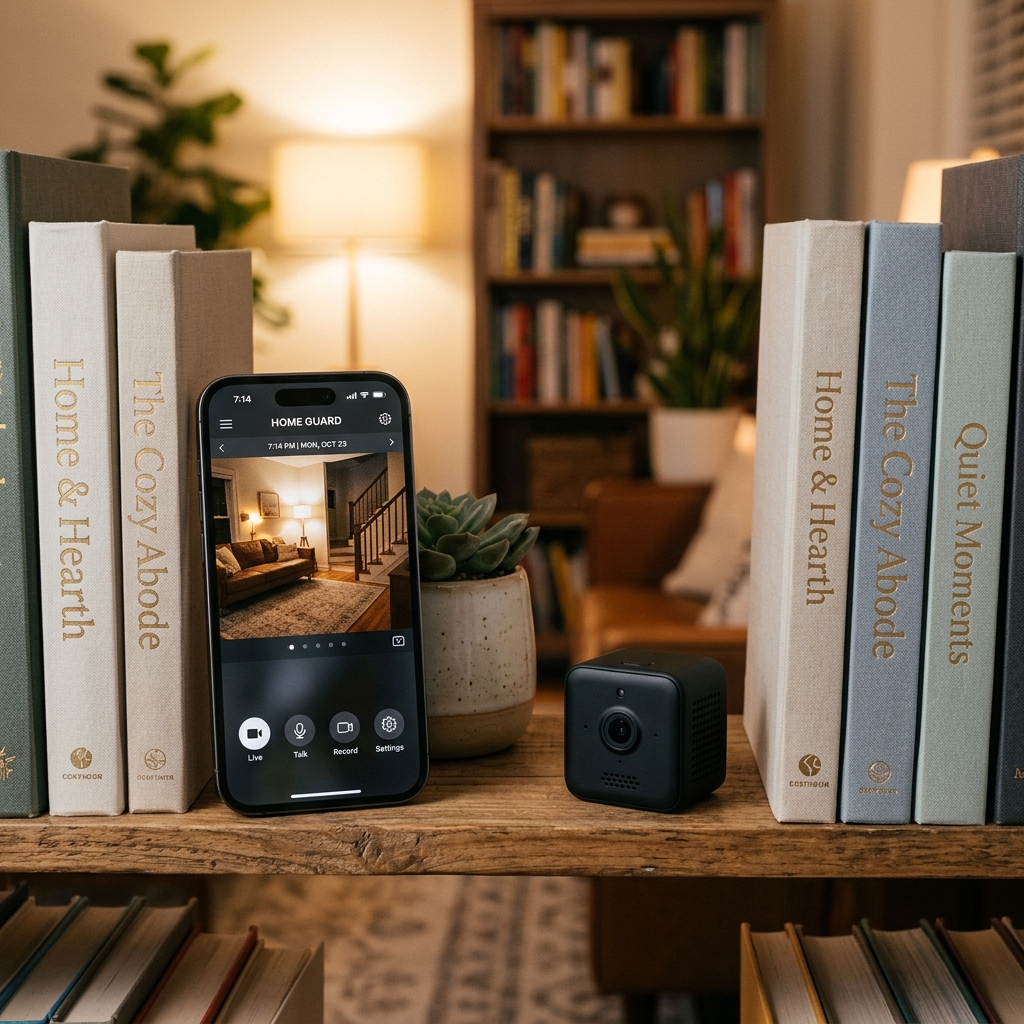
What is the minimum setup that covers all four requirements simultaneously?
Based on the actual hardware specs that matter for simultaneous audio recording, video recording, local storage, and live streaming without interruption:
| Requirement | Minimum spec to confirm | Why it matters |
|---|---|---|
| Audio + video simultaneously | Dual-channel SoC or dedicated audio DSP | Single-channel SoCs drop audio under load |
| Local recording while streaming | Dual data path architecture confirmed by supplier | Single data path degrades local recording quality |
| Continuous recording without gaps | Loop recording + Class 10 MicroSD support | Slower cards cause dropped frames |
| Discreet appearance | Integrated into functional everyday object | Standalone cube cameras are identifiable |
| Reliable live streaming | Tuya/established P2P platform or direct RTSP | Unknown P2P servers may go offline |
FAQ
Can a wireless mini spy camera record audio without being plugged in?
Yes, if the camera has an internal battery and a built-in microphone. Battery-powered cameras with audio recording capability typically run 60–120 minutes on continuous recording with WiFi streaming active. For extended unattended operation, choose a camera with direct AC power — socket cameras and clock cameras are the most practical options for continuous audio and video recording without battery management.
Why does my wireless spy camera stop live streaming after a few minutes?
The most common cause is a WiFi timeout built into the app to conserve battery. Check the app settings for a “continuous live view” or “streaming timeout” option. If the camera itself is battery-powered, WiFi streaming may cut after a set period to preserve battery life. A camera connected to permanent power does not have this limitation. The second common cause is a weak 2.4GHz signal — move the camera closer to the router or add a WiFi extender to the coverage area.
Does recording to MicroSD and live streaming to the phone work at the same time?
This depends on the specific camera hardware. On dual-path cameras, yes — both run simultaneously at full quality. On single-path cameras, enabling live streaming can reduce local recording bitrate or temporarily pause writing to the card. Confirm this with the supplier before purchasing if simultaneous operation is a firm requirement.
What happens to the recording if the WiFi goes down?
On cameras with MicroSD recording, local storage continues working without WiFi — the camera writes footage to the card regardless of network status. Push notifications and remote viewing stop working until the connection is restored, but the recording itself is not interrupted. This is why local MicroSD storage is essential for any setup where network reliability cannot be guaranteed.
For wireless mini spy cameras with verified audio recording, MicroSD storage, and Tuya app live streaming, visit the QZT Security product range or contact the team for specific requirements.

 English
  Italiano
  Deutsch
  Français
  Español
  Polski