
Do Hidden Cameras Record Audio? UK and EU Audio Recording Laws Explained
Every week, someone buys a hidden camera expecting it to capture conversations, places it exactly where they need it, retrieves the footage — and finds that the audio is silent. Or worse: they use the footage in a workplace dispute only to discover that the audio recording creates a legal complication they did not anticipate.
The question “do hidden cameras record audio” is simple. The answer is not, because it depends entirely on which product you buy and where you are planning to use it.
This guide covers the three things you need to know before buying: which QZT hidden cameras include audio recording, what the law says about recording audio in the UK and EU, and how to use audio recordings legally and effectively.
Which QZT Hidden Cameras Record Audio?
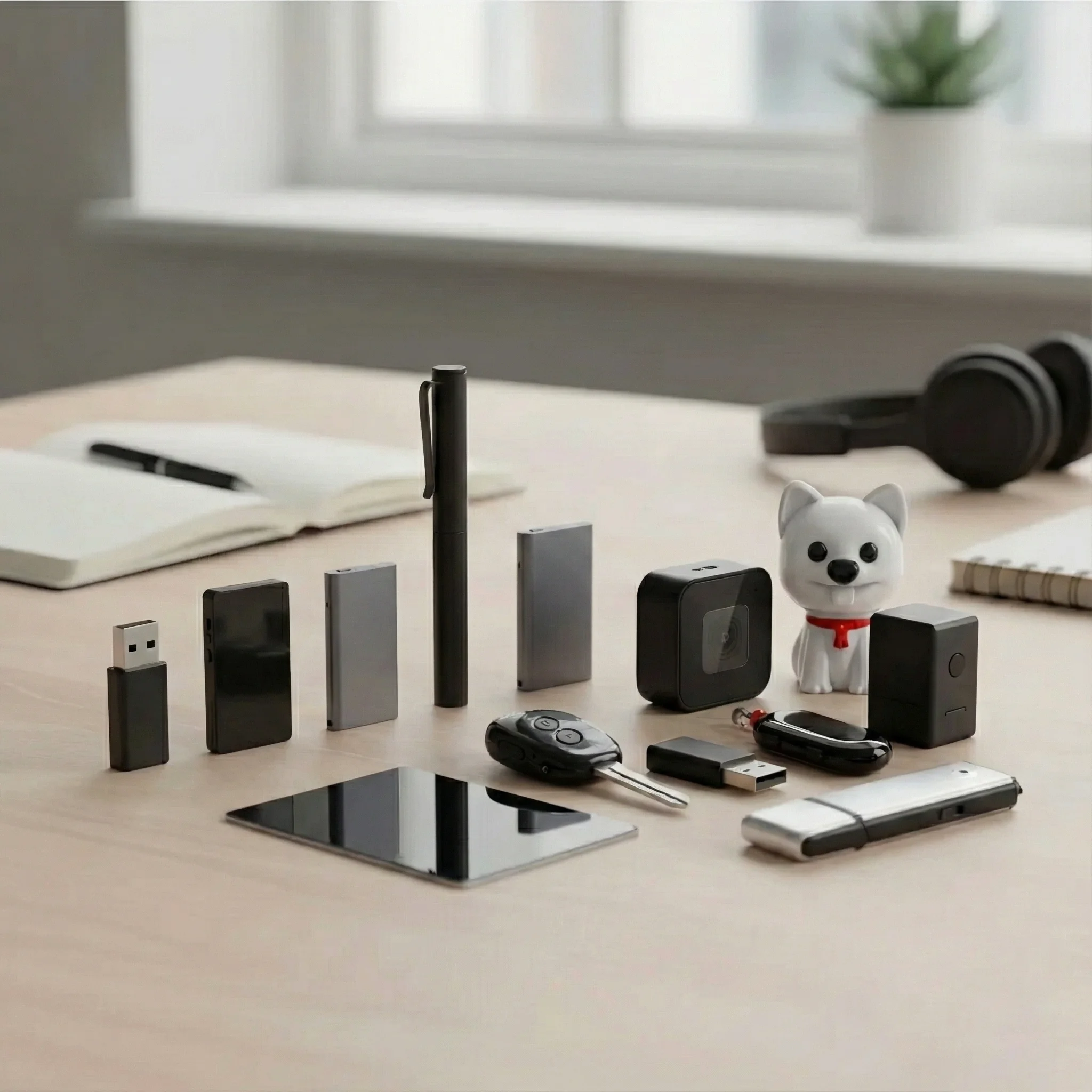
Not all hidden cameras record audio. This is the most common source of confusion, and the answer is product-specific.
Cameras that record video with audio:
– QZT WiFi Spy Pen Camera — built-in microphone, captures both video and audio in meetings or interviews
– QZT W9 Spy Pen Camera — audio recording enabled, standard on this model
– QZT W10 Spy Pen Camera — audio recording enabled, long recording time supports extended meetings
– QZT WiFi Power Bank Camera — microphone integrated into the body
– QZT Power Bank Camera — audio recording enabled
– QZT USB Flash Drive Spy Camera — audio recording standard
– QZT WiFi Spy Camera USB Charger — built-in microphone
– QZT WiFi Smoke Detector Camera — audio recording enabled
– QZT WiFi Clock Camera — audio recording standard
– QZT WiFi Socket Camera — audio recording enabled
Cameras that record video without audio:
– QZT Covert HD Camera Glasses — primarily first-person video, no audio recording on this model
Dedicated audio-only devices:
– QZT Hidden Spy Voice Recorder
– QZT Small Voice Activated Recorder — voice-activated, ideal for meeting documentation
– QZT Q97 Professional Voice Recorder — Type-C, high bitrate audio
– QZT Magnetic Spy Voice Recorder 500H — extended battery, VOR mode for long deployments
If capturing audio is essential to your use case — and for most evidence, legal, and business purposes it is — verify that your chosen model includes audio before purchasing.
UK Audio Recording Law: What You Need to Know
The United Kingdom operates under a one-party consent rule for audio recording. This means that as long as you are a participant in the conversation, or you have reasonable authority to record it, you do not need the consent of the other party.
This is governed by several overlapping legal frameworks:
Regulation of Investigatory Powers Act 2000 (RIPA) sets out the rules for covert surveillance by public bodies. For private individuals and businesses, RIPA does not apply — but it establishes the legal context that distinguishes lawful from unlawful recording.
Data Protection Act 2018 and GDPR classify audio recordings of identifiable individuals as personal data processing. The relevant lawful basis for most private-use scenarios is Article 6(1)(f) — legitimate interests — which applies when you are recording for the prevention of crime, protection of property, or other legitimate purposes. The Information Commissioner’s Office (ICO) has published specific guidance on surveillance cameras that applies to audio recording by businesses.
Employment tribunal practice is particularly relevant for workplace disputes. Acas guidance and tribunal precedent confirm that covert audio recordings made by employees of their own workplace discussions are generally admissible in employment tribunal proceedings. The recordings must be of genuine relevance to the dispute — they cannot be used as a general fishing exercise.
Here is what one-party consent means in practice: if you are the manager conducting an investigation, you can record a conversation you are part of without telling the other party. If you are an employee documenting what your manager says to you, you can do the same. If you plant a microphone in a room to record conversations you are not participating in, you are moving into legally ambiguous territory that requires careful consideration.
The key boundary under UK law is the reasonable expectation of privacy. A manager’s office, a changing room, or a private bathroom are spaces where people have a reasonable expectation of privacy. Recording in those spaces — even by the property owner — can breach the Protection from Harassment Act 1997 and the Data Protection Act. A living room, shop floor, or office reception does not carry the same expectation of privacy, which is why hidden cameras are commonly deployed in those spaces.
EU and GDPR Audio Recording Rules
The European Union’s approach to audio recording sits within the broader GDPR framework. Audio recordings of identifiable individuals are personal data under Article 4(2) GDPR. Processing (including recording) must have a lawful basis under Article 6.
For private individuals and businesses in EU member states, Article 6(1)(f) — legitimate interests — is the most commonly applicable basis. It allows recording when:
– You have a legitimate interest (e.g., protecting your property, preventing theft, documenting agreements)
– The recording is necessary for that purpose
– Your interests are not overridden by the fundamental rights of the recorded individuals
The one-party consent rule applies across most EU member states for personal data processing purposes. Germany, France, Italy, Spain, and the majority of EU countries recognise that one party to a conversation may record it without informing the others, provided the recording is for a legitimate purpose.
However, EU law does add requirements that UK law does not:
Data minimisation (Article 5(1)(c) GDPR) requires that you do not collect more data than is necessary. For audio recording, this means recording only when needed, not continuously for hours when you only need to capture a specific interaction.
Purpose limitation (Article 5(1)(b)) means you cannot record for one purpose and then use the footage for an unrelated purpose without a new lawful basis.
Information obligations (Articles 13 and 14) require that individuals are informed about recording in most circumstances. This is a grey area for private covert recording — the ICO’s guidance and ECtHR case law suggest that covert recording for legitimate crime-prevention purposes can proceed without prior notification — but for businesses deploying audio monitoring systems openly, signage and policy documentation are required.
In Germany specifically, the Bundesarbeitsgericht (Federal Labour Court) has set a high bar for covert workplace audio recording: it is generally only permitted where there is a concrete suspicion of a criminal offence and no less intrusive means of investigation are available. Distributors targeting the German market should advise their B2B customers accordingly.
Practical Audio Recording Guidance for Evidence and Documentation
Understanding the law is necessary. Using audio recordings effectively is a separate skill.
Audio quality depends on placement. The microphone on a hidden camera is typically omnidirectional and positioned inside the device casing. This means audio quality varies significantly by product form factor. A pen camera held close to a conversation captures clear audio. A smoke detector camera mounted on a ceiling 3 metres away captures muffled conversation and ambient noise. For important meetings or interviews, a dedicated voice recorder like the QZT Q97 Professional Voice Recorder placed within 1–2 metres of the conversation produces significantly better audio than a ceiling-mounted camera.
Environmental noise matters. Recording in a noisy environment — a busy street, a factory floor, a restaurant — significantly reduces the utility of audio recordings. The microphone picks up the ambient noise and the conversation gets lost in it. For evidence in noisy environments, consider a directional lavalier microphone clipped near the speaker, or a dedicated voice recorder in the pocket of the person being recorded.
VOR (Voice Operated Recording) mode on the QZT Small Voice Activated Recorder solves the storage problem for long recordings. Instead of recording 8 hours of silence followed by 10 minutes of conversation, the recorder wakes up when sound exceeds a threshold, captures the relevant audio, and goes back to standby. The QZT Magnetic Voice Recorder 500H extends this concept to multi-day deployments with up to 500 hours of battery life in VOR mode.
File format affects usability. Most QZT cameras record audio as part of an AVI or MOV video file. Dedicated voice recorders typically produce WAV (uncompressed, highest quality) or MP3 (compressed, more storage-efficient) files. For evidence purposes, WAV is preferred because it is the industry standard for forensic audio analysis. If a recording might be used in serious legal proceedings, convert the file to WAV before submitting it.
Key Takeaway: Audio Is Powerful but Requires More Care

Audio recordings often carry more immediate evidentiary weight than video alone. A video that shows someone entering a room is circumstantial. An audio recording that captures that person making a verbal admission is direct evidence. For workplace disputes, theft investigations, and personal safety documentation, audio matters.
But audio is also more legally sensitive than video. The practical rules are straightforward:
– Only record audio where you have the legal right to do so (your own property, a conversation you are part of, or with specific legal authority).
– Choose the right tool for the recording environment — a dedicated voice recorder for close conversations, a camera with audio for wider coverage.
– Understand the specific rules of your jurisdiction, particularly if you are operating in Germany or other EU member states with stricter workplace surveillance laws.
– For businesses in the UK and EU deploying audio monitoring openly, document your lawful basis, post appropriate notices, and establish a clear data retention policy.
For distributors, this is an area where providing clear guidance to B2B customers reduces returns and liability. A customer who buys a QZT Spy Pen Camera expecting it to capture audio from across a room and finds it does not is a preventable complaint. Setting the right expectation during purchase is part of good customer service.
Frequently Asked Questions
Can I record a conversation without the other person knowing in the UK?
Yes, if you are a party to the conversation or have legitimate authority to record it. The one-party consent rule in the UK permits this for private purposes. For workplace investigations, courts have confirmed that covert recordings by employees can be admissible in tribunal proceedings. The key restriction is that you cannot record in spaces where people have a reasonable expectation of privacy (bathrooms, changing rooms) or record conversations you are not party to through bugging devices placed in the environment.
Do I need to tell employees if I install audio recording in my business?
In the UK, yes — if you are deploying audio monitoring openly, you must inform employees under the Data Protection Act 2018 and the ICO’s Employment Practices Code. Failure to inform is a data protection breach. Covert recording for the investigation of a specific suspected offence is exempt from this requirement, but requires careful legal compliance management.
Is audio more sensitive than video under GDPR?
Yes, generally. The Article 29 Working Party (now the European Data Protection Board) has consistently stated that audio data can reveal more sensitive information than video — emotional state, health indicators, opinions, beliefs. This means audio recordings are subject to greater scrutiny and require stronger justification. Where video alone is sufficient for your purpose, consider disabling audio recording on your camera to reduce your data protection obligations.
Which QZT product has the best audio quality for meetings?
The QZT Q97 Professional Voice Recorder produces WAV-quality audio at up to 192kbps — the highest fidelity of any QZT device — making it the best choice for meeting documentation where audio clarity is paramount. For covert audio recording during interviews or personal safety situations, the QZT Hidden Spy Voice Recorder in voice-activated mode captures clean audio for extended periods.
Can I use a hidden camera’s audio recording in an employment tribunal in the UK?
Generally yes, if the recording is directly relevant to the dispute and was made in a location where the employee had no reasonable expectation of privacy. Tribunals have accepted covert audio recordings in cases involving discrimination, harassment, and misconduct. You should seek legal advice before submitting any recording as evidence, particularly if there are questions about how or where it was obtained.
What about GDPR compliance when recording audio in the EU?
The recorder (whether a business or individual) becomes a data controller under GDPR Article 4(7) and must have a lawful basis for processing. For private crime-prevention purposes, Article 6(1)(f) — legitimate interests — is typically sufficient. For businesses, a documented legitimate interests assessment (LIA) is recommended. Keep recordings only as long as necessary, do not share them without a valid reason, and implement reasonable security measures to protect the files.
For guidance on GDPR-compliant surveillance solutions or help selecting a camera with audio recording for your specific jurisdiction, contact QZT Security.

 English
  Italiano
  Deutsch
  Français
  Español
  Polski