
Spy Pen Cameras: The Growing Tool for UK and European Business Professionals in 2026
There is a specific kind of frustration that every professional eventually encounters: a meeting where promises were made, an interview where details mattered, a property inspection where verbal agreements were reached — and no record exists of what was actually said. The person on the other side may remember it differently six months later. You have no proof.
This is the problem that spy pen cameras solve. And across the UK and Europe in 2026, a growing number of professionals — lawyers, journalists, property managers, freelancers, investigators, and field workers — are discovering that the humble recording pen is one of the most practical tools in their professional kit.
The global surveillance camera market is projected to reach USD 75.63 billion by 2031, with the spy camera segment growing at 8.6% annually. Within that market, spy pen cameras occupy a distinct niche: they are not for securing your home or monitoring a property. They are for capturing what happens when you are physically present and need an accurate, tamper-evident record of events.
This article examines why spy pen cameras are becoming essential business tools in 2026, who benefits most from them, what features matter for professional use, and how to stay on the right side of UK and EU recording laws.
Why a Recording Pen, Not a Phone
Most professionals already carry a smartphone with a capable camera and voice recorder. So why would anyone choose a dedicated pen camera instead?
The answer is about psychology, reliability, and evidence.
When you open your phone to record a meeting, everyone in the room notices. The dynamic shifts. People speak more carefully, self-censor, or explicitly refuse to participate in a recorded conversation. The act of recording becomes the event — distracting from the substance of the meeting and potentially souring the relationship.
A pen camera changes this entirely. It sits in your hand, on the table, or in your pocket. It records audio and video without announcing itself. The conversation proceeds naturally. You get an accurate record of what was actually said, not a performance for the camera.
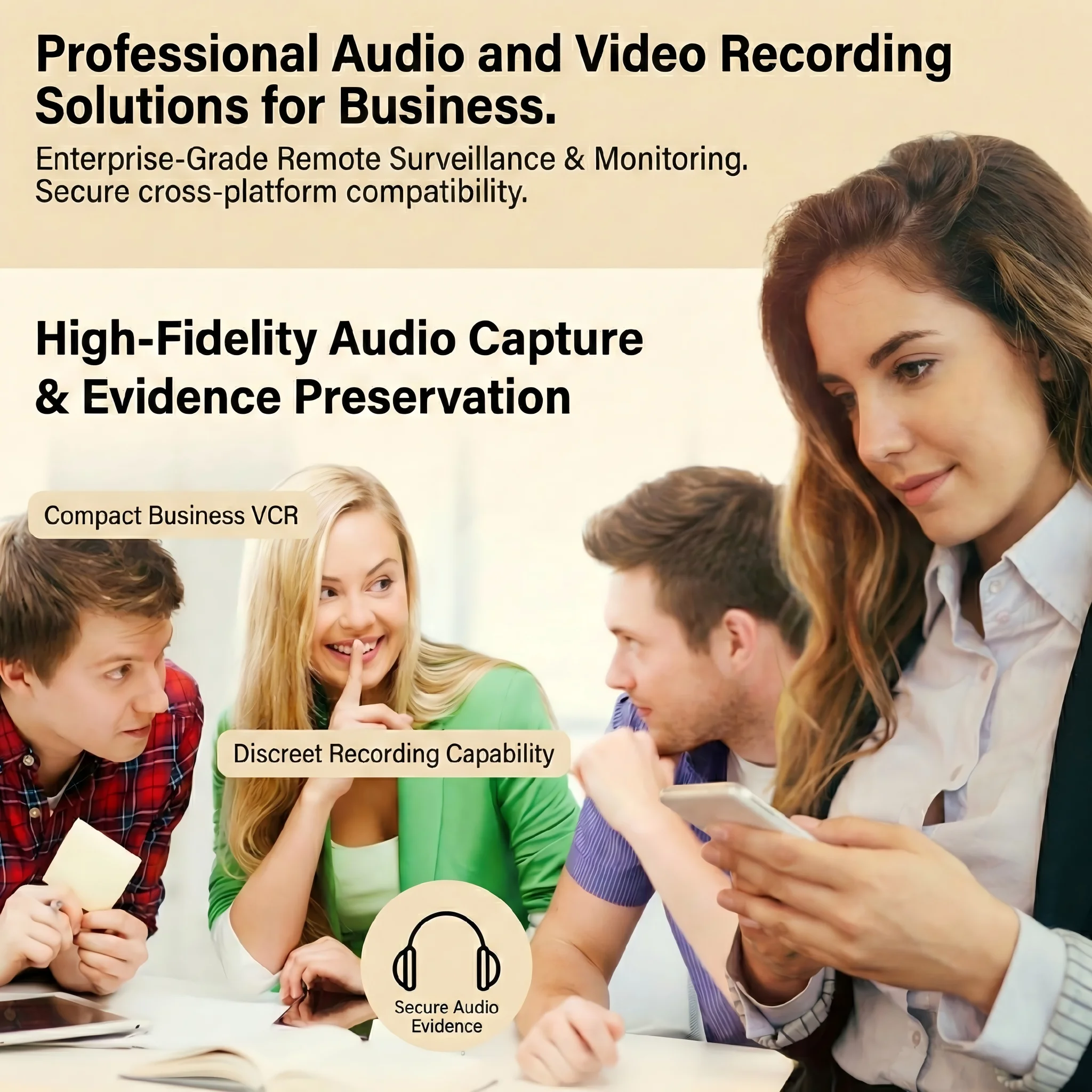
Beyond psychology, there are practical reasons pen cameras outperform phones for professional recording. A pen camera has a dedicated recording button — you do not fumble through an app to start recording. It runs independently of your phone — if your phone battery dies or you receive a call that interrupts recording, the pen keeps going. And in the event of a dispute, a dedicated recording device with its own storage is harder to tamper with than a phone file that could be claimed to have been edited.
For field professionals — investigators, property surveyors, insurance assessors — a pen camera is also considerably more discreet than a phone held up at chest or face height. It allows you to document a property inspection, a site walk, or a vehicle assessment without making the subject aware, which is often essential for capturing an accurate picture.
The UK and EU Legal Framework for Recording Conversations
Before discussing use cases, it is essential to address the legal dimension — and to be clear about something that many online guides gloss over.
The law on recording conversations differs significantly between the UK and most EU member states, and getting this wrong has real consequences.
United Kingdom: One-Party Recording in Private Settings
In the UK, a single party to a conversation can legally record it without the knowledge or consent of the other parties — provided the recording is for a legitimate purpose and the conversation is in a private setting. This is established under the Regulation of Investigatory Powers Act 2000 (RIPA) and related case law.
“Private setting” generally means a place where the parties have a reasonable expectation of privacy. A private meeting room, your office, or someone’s home qualifies. A public street does not — and recording conversations in public spaces with no expectation of privacy may still engage other legal considerations.
The legitimate purpose requirement means you cannot record a conversation with the intention of using the recording for blackmail, harassment, or other unlawful purposes. Recording a business meeting, interview, or property inspection for documentation purposes is clearly a legitimate purpose.
The ICO guidance on covert recording confirms that recording for one’s own purposes in a private setting — such as documenting a meeting or protecting oneself in a potential dispute — does not require prior notification to the other parties. However, sharing the recording with third parties (such as posting it online or distributing it widely) engages data protection obligations under UK GDPR.
Key distinction from the US: Many US states operate under “two-party consent” laws, meaning all participants in a conversation must agree to recording. The UK operates under a one-party rule, making covert recording of private conversations considerably more permissible on these shores.
European Union: Significant Variation by Country
The EU presents a more complex picture because recording laws vary by member state. Some EU countries — including Germany, under Section 201 of the Strafgesetzbuch (StGB) — impose strict restrictions on intercepting private communications, even for one’s own records. Others take a more permissive view similar to the UK.
For EU business users, particularly those operating across multiple member states, this creates an important due diligence requirement. Before deploying a recording pen in France, Germany, Italy, Spain, or any other EU country, you should confirm the specific laws of that jurisdiction.
Germany stands out as particularly restrictive. Section 201 StGB criminalises creating an unauthorised recording of someone’s unauthenticated private spoken words, even if you are one of the parties to the conversation. Violation can result in criminal penalties. Business users in Germany should obtain explicit consent before recording any conversation.
France, by contrast, generally permits one-party recording for personal purposes, though using recordings as evidence in legal proceedings requires careful procedural handling. Italy’s framework similarly permits recording in one’s own interest, but the recording must be genuine and not obtained through illegal means.
The GDPR adds a further layer across all EU member states. A recording of a conversation containing identifiable voices is personal data. This means that even when recording is legally permissible, you have obligations regarding how the recording is stored, who can access it, and how long it is retained.
Best practice for EU business users: Include a standard clause in your contracts and engagement letters confirming that meetings may be recorded for documentation purposes. This provides a clear lawful basis under GDPR Article 6(1)(b) (contractual necessity) and Article 6(1)(f) (legitimate interests) and removes ambiguity about consent across jurisdictions.
Who Benefits Most From Spy Pen Cameras in 2026
Solicitors, Paralegals, and Legal Professionals
A solicitor meeting a client to take instructions, a paralegal conducting a witness interview, or a family law mediator documenting an agreement all face the same challenge: capturing an accurate record of everything that was said without altering the dynamic of the conversation.
A QZT W8 spy pen camera records 1080p video with audio in a format that is difficult to contest. The timestamp embedded in the file provides a tamper-evident record of when the conversation occurred. For solicitors dealing with clients who later claim they were given different advice, this is direct evidence that protects both the client and the firm.
The WiFi-enabled W8 pen also allows recordings to be transferred directly to a secure device after the meeting, reducing the risk of the physical pen being lost or the storage being corrupted.
Journalists and Investigative Reporters
Journalists operate under increasing pressure to document their interactions accurately — particularly in sensitive situations where sources may be vulnerable and accuracy is paramount. A pen camera provides an additional layer of documentation beyond handwritten notes and audio recorders.
The ethical considerations for journalists are significant: recording without consent in many circumstances is a breach of press ethics guidelines and, in some countries, the law. However, in jurisdictions where it is permissible, a pen camera can serve as a tool of last resort for documenting events that would otherwise leave no record.
The key distinction is between recording for documentation (which may be permissible) and recording for publication (which triggers additional consent and privacy requirements). Journalists should consult their editor and legal team before deploying covert recording in the field.
Property Managers and Estate Agents
Property inspections, tenancy sign-ups, and rental viewings are frequent sources of disputes. A landlord who conducts a check-out inspection with a pen camera has an objective record of the property’s condition that protects against false damage claims. An estate agent documenting a property viewing with a pen camera can demonstrate exactly what was and was not disclosed to prospective buyers.
The QZT A57 WiFi voice recorder pen is particularly suited to property documentation because it emphasises audio clarity — capturing clear voice notes about property conditions, room measurements, and specific observations that are more useful than video for technical assessments.
For estate agents in England and Wales, recording tenancy negotiations serves a practical purpose beyond dispute resolution: it provides evidence in the event of a future harassment or discrimination claim.
Freelancers and Independent Contractors
Freelancers are particularly vulnerable to scope disputes, unpaid invoices, and clients who deny agreeing to specific terms. A pen camera provides documentary protection that a written email trail cannot match.
A freelancer who records a project kickoff meeting, a mid-project review, or a payment negotiation has an objective record of what was agreed. If the client later disputes the scope of work or claims that certain features were not discussed, the recording provides direct evidence.
This is especially valuable in creative industries — design, copywriting, consulting — where the deliverables are often subjective and the boundary between agreed scope and creative additions is frequently contested.
Private Investigators and Security Professionals
Private investigators are perhaps the most obvious professional users of covert recording equipment. For licensed investigators operating under SIA (Security Industry Authority) regulations in the UK, lawful surveillance is a core part of the job.
However, this is also the area where legality becomes most complex. PI surveillance in public spaces is governed by RIPA and requires authorisation in certain circumstances. Covert recording in private spaces raises additional data protection obligations. Professional investigators typically hold specific SIA licences and receive training on the legal boundaries of their work.
For non-licensed individuals who attempt to conduct their own investigations — following a suspected cheating partner, for instance — covert recording in private spaces can quickly cross into unlawful activity. If you are not a licensed investigator, the safest approach is to consult a professional rather than attempting your own surveillance.
Key Features for Professional Pen Camera Buyers
Not all spy pen cameras are suitable for professional use. Here is how to evaluate what matters.
Video Quality: 1080p Minimum
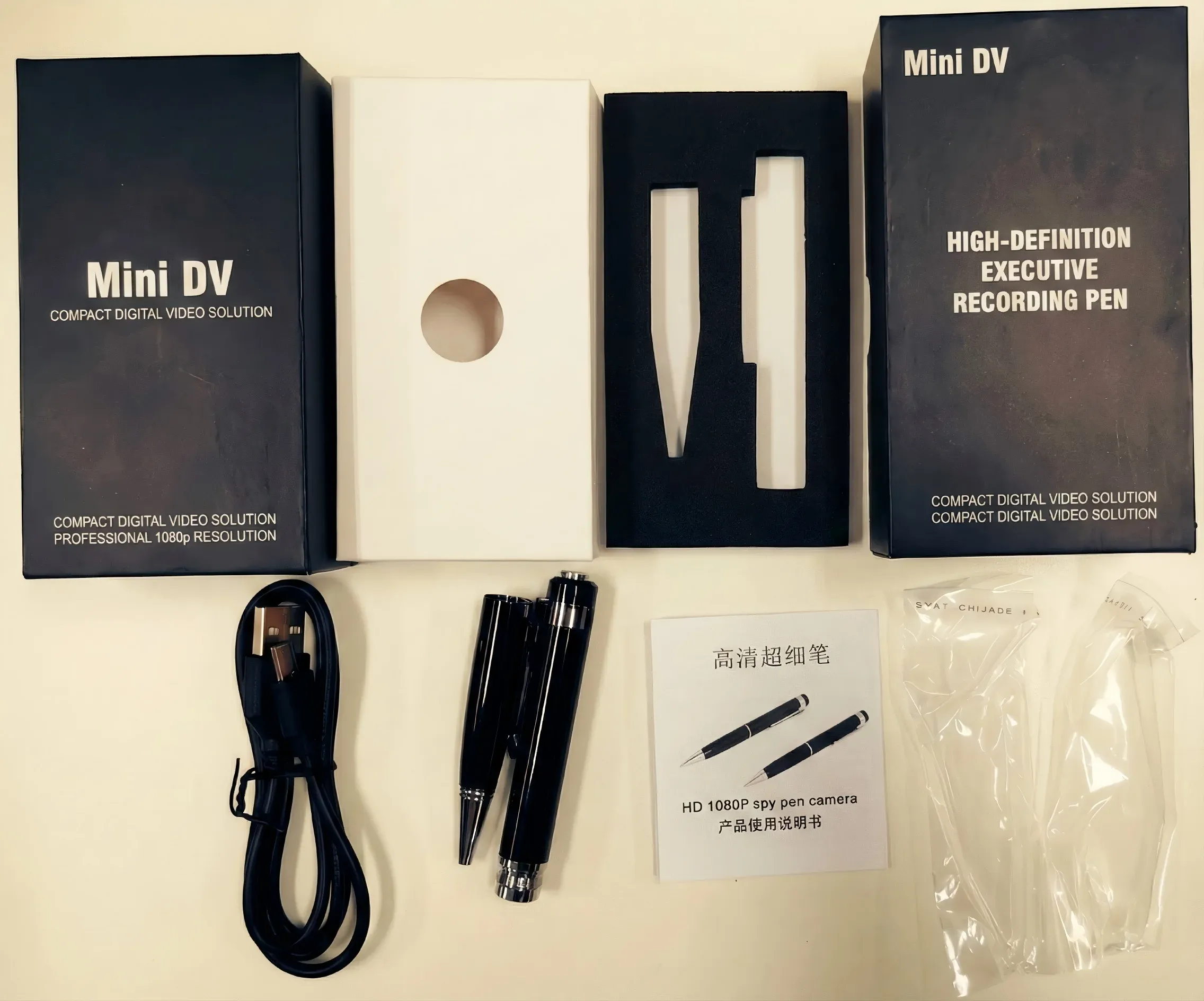
For any professional application where you might need to use the recording in a dispute or legal proceeding, 1080p is the minimum acceptable resolution. A 720p recording may capture a recognisable face in good light at close range, but will struggle to capture details — text on documents, product labels, vehicle number plates — that are often the point of the recording.
The QZT W8 pen camera records at Full HD 1080p and includes a 30-megapixel photo mode for capturing still images of documents or evidence in passing.
Look for cameras with wide apertures (lower f-numbers such as f/1.8 or f/2.0) — these admit more light and produce better quality footage in indoor and variable lighting conditions.
Audio Quality: The Most Underrated Feature
Professional users consistently underestimate the importance of audio quality. A video recording where the dialogue is muffled, distorted, or obscured by background noise is nearly useless as evidence. A clear audio recording of the same conversation is invaluable.
When evaluating pen cameras, prioritise models with:
– Directional microphones that capture voice clearly while minimising background noise
– Audio bitrates of 128kbps or higher (higher is better)
– Noise reduction processing, particularly for use in busy environments
The QZT A57 recorder pen is designed with audio clarity as its primary focus, featuring voice-activated recording mode that starts capturing the moment sound is detected — useful for capturing conversations that begin without warning.
Storage and Battery Life
For field professionals who may conduct multiple interviews or inspections in a single day, battery life and storage are critical practical considerations.
| Specification | Minimum for Professional Use | Ideal |
|---|---|---|
| Battery life | 4+ hours continuous recording | 8–12 hours |
| Storage capacity | 32GB (4–6 hours 1080p) | 64–128GB |
| Charging method | USB-C (fast charge preferred) | USB-C, power bank compatible |
| Recording format | H.264 MP4 | H.265 MP4 (smaller files) |
Some pen cameras support voice-activated recording — the device records only when sound is detected, extending battery life and storage capacity significantly. This is particularly useful for interview scenarios where the pen may be placed on a table for long periods with intermittent speech.
Connectivity: WiFi vs. Local Transfer
WiFi-enabled pen cameras allow you to transfer recordings to a secure device without physically handling the pen. This matters for two reasons: first, it allows you to back up critical recordings immediately after a meeting before the pen is lost or misplaced; second, it means the physical pen does not need to leave your possession, which is important if you are concerned about the security of recordings in transit.
However, WiFi connectivity also introduces network security considerations — the pen must connect to your phone or laptop via an app, and footage passes through a server somewhere. For professionals with heightened confidentiality requirements, a non-WiFi model that transfers via USB cable after the event may be more appropriate.
How to Use a Recording Pen Professionally
Before the Meeting
1. Confirm the legal position for your jurisdiction (see above). If operating across EU countries, have a written policy.
2. Charge the pen fully and format the storage card. Confirm it is recording correctly with a 30-second test recording.
3. Set the date and time on the device — many pen cameras embed timestamps automatically, but check this is working.
4. If using voice activation, test the sensitivity setting in your typical environment.
During the Meeting
5. Position the pen naturally. In your hand, on the table, or in a breast pocket — wherever a pen would normally be. Avoid placing it in a bag or drawer where it may pick up muffled sound.
6. Do not draw attention to it. The pen should be doing its job invisibly. If asked about it, a simple “I always carry a pen with me” is sufficient.
7. Avoid covering the microphone. Ensure the microphone port — typically a small grille on the side or top of the pen — is not blocked by your hand or paper.
After the Meeting
8. Transfer the recording promptly to a secure location — an encrypted folder on your computer or a secure cloud service.
9. Back up the original file to a second location before doing anything else with it. Once the original is backed up, create a working copy for review.
10. Do not edit the recording — editing a recording, even to remove dead air, can raise questions about its authenticity in legal proceedings. Keep it intact.
11. Label and store securely, consistent with your data retention obligations under UK GDPR. Most professionals retain meeting recordings for 6–12 months, or longer if litigation is anticipated.
GDPR Compliance for Recorded Conversations
Even when recording is legally permissible, the resulting file is personal data under UK GDPR and EU GDPR. Here is what compliance requires for business users:
Lawful basis: For B2B meetings and professional use, the most applicable lawful basis is likely Article 6(1)(b) (contractual necessity — you need the record to perform your side of the agreement) or Article 6(1)(f) (legitimate interests — documenting professional interactions is a legitimate business interest that is not overridden by the subjects’ rights).
Transparency: You are not required to announce the recording in private one-party consent settings. However, for EU users, particularly in Germany and countries with strict privacy cultures, proactively disclosing that meetings may be recorded is good practice and reduces the risk of complaints.
Storage security: The recording must be stored securely — password-protected, encrypted at rest, accessible only to authorised personnel. Leaving recordings on an unencrypted SD card in a bag or desk drawer is a data security incident waiting to happen.
Retention: You cannot retain recordings indefinitely. Define a retention period appropriate to your use case and delete recordings when that period expires. For most business meetings, 12 months is a reasonable maximum; recordings relevant to live disputes should be retained until the matter is resolved.
Subject access requests: The other party to a recorded conversation has the right to request a copy of any recording containing their voice under Article 15 of UK GDPR. You must provide this within one month. This is another reason to review your recordings and retain only those that are genuinely needed.
Top Business Use Cases by Sector
| Profession | Primary Use Case | Recommended Feature |
|---|---|---|
| Solicitor / lawyer | Meeting documentation, witness interviews | High audio clarity, WiFi transfer, timestamp |
| Journalist | Source documentation, interview records | Discreet design, photo mode |
| Property manager | Inspection documentation, tenancy records | Long battery life, voice activation |
| Freelancer / consultant | Scope protection, dispute evidence | 1080p video, local storage |
| Insurance assessor | Damage documentation, site surveys | Wide-angle lens, photo + video |
| Private investigator | Surveillance documentation | Night vision (for evening assignments), extended battery |
Addressing the Ethics: When Covert Recording Is and Is Not Justified
The practical utility of pen cameras does not mean their use is always justified. Covert recording in professional settings raises legitimate ethical questions — particularly in relationships of trust such as therapy, healthcare, or counselling, where covert recording by a client can undermine the therapeutic relationship.
For most professional business relationships — sales meetings, contract negotiations, property transactions, client briefings — recording is a defensible form of professional diligence. The ICO and UK courts have consistently recognised that individuals have the right to create records of interactions that affect their interests.
The line is crossed when recording is done with the intention of using the material for purposes beyond documentation — particularly for blackmail, unauthorised publication, or harassment. The tool itself is neutral; the intent and context determine whether its use is ethical.
If you are unsure whether recording a specific interaction is ethically defensible, consult your professional body or a solicitor before proceeding.
Need a reliable recording pen for professional use? Contact us today to explore our range of CE-certified spy pen cameras and voice recorder pens — built for professionals who need accurate, tamper-evident documentation.
Frequently Asked Questions
Is it legal to record a business meeting with a pen camera in the UK?
Yes, in most circumstances. Under the Regulation of Investigatory Powers Act 2000 and related guidance from the ICO, a single party to a private conversation can record it without the knowledge or consent of other participants, provided the recording serves a legitimate purpose (such as documenting a business meeting, protecting against disputes, or taking instructions). You should not share the recording with unauthorised third parties without considering your data protection obligations.
Do I need to tell someone I am recording with a pen camera?
In the UK, for private one-party conversations with a legitimate purpose, you are not legally required to announce the recording. However, for EU users — particularly in Germany and other countries with strict privacy laws — explicit disclosure is strongly recommended. For business use across EU member states, including a standard “meetings may be recorded” clause in your engagement terms provides both legal clarity and GDPR compliance.
Can a pen camera recording be used as evidence in court?
Yes, if it was obtained lawfully. In the UK, a recording of a private conversation made by one of the parties to that conversation, without any form of coercion or trespass, is generally admissible as evidence. The key exclusions are recordings obtained in private spaces where there was no legitimate basis, recordings of conversations where all parties had a reasonable expectation of privacy (which can vary), and recordings made with intent to commit wrongdoing. Always preserve the original, unedited file.
What is the best resolution for a professional pen camera?
1080p (Full HD) is the minimum recommended resolution for any professional use. At 1080p, you can capture recognisable faces at meeting-table distances (1–3 metres), read text on documents, and capture sufficient detail for evidence purposes. Higher resolutions such as 2K or 4K capture more detail but generate larger files and reduce recording time on a given storage card.
How long can a pen camera record on a single charge?
Battery life varies significantly by model and settings. Entry-level pen cameras may manage 2–3 hours of continuous recording. Professional-grade models with larger batteries and power-efficient processors can record for 8–12 hours on a single charge. If you need to record all-day meetings or multiple sessions, look for models that support external power via USB-C power bank — this effectively eliminates battery anxiety for professional use.
Are pen camera recordings subject to GDPR?
Yes. A recording of a conversation containing identifiable voices is personal data under both UK GDPR and EU GDPR. As the data controller, you must have a lawful basis for processing the recording (legitimate interest or contractual necessity are typically applicable for business meetings), store it securely, retain it only as long as necessary, and provide a copy to any subject who submits a subject access request. Failure to comply with GDPR obligations can result in ICO enforcement action.

 English
  Italiano
  Deutsch
  Français
  Español
  Polski