
How to Source CE-Certified Hidden Cameras for the European Market
You’ve found a supplier. The price looks right. Then you notice the listing says “CE pending.” In the European market, that phrase is a red flag that can cost you more than the goods are worth.
CE certification is not a marketing badge. In the EU, it is a legal requirement for placing electronics on the market. If you are importing surveillance devices from Asia into Europe, the compliance chain starts before the shipment leaves the port—and most buyers who skip this step learn about it from a customs seizure or a fine.
This guide walks you through what European wholesale buyers actually need to know about sourcing compliant hidden cameras and covert surveillance equipment.
Why CE Certification Is Non-Negotiable in Europe
The CE mark signals that a product conforms to all applicable EU directives. For consumer electronics broadly, that means three overlapping frameworks:
EMC (Electromagnetic Compatibility) Directive. The product does not emit interference that disrupts other devices, and it can tolerate normal electromagnetic noise in its environment. Hidden cameras with WiFi and radio-frequency components are specifically tested for this.
Low Voltage Directive (LVD) / Radio Equipment Directive (RED). As of 2017, most electronic devices operating below 1,000V AC fall under RED rather than LVD. If your camera transmits over WiFi, Bluetooth, or a cellular network, it must carry RED compliance testing and documentation.
RoHS (Restriction of Hazardous Substances). This restricts lead, mercury, cadmium, and several other substances in electrical equipment. It applies to every tier of the supply chain, including distributors who rebrand or remarket products.
The consequences of importing non-compliant goods are not theoretical. Customs authorities in Germany, France, and the Netherlands routinely hold electronics shipments pending documentation review. Under EU Regulation 2019/1020, market surveillance authorities can order a recall, impose fines, and notify trading partners across the single market.
The GDPR Layer: What Buyers Overlook
CE marking addresses product safety. GDPR addresses what happens to the data those products capture.
Any camera that records audio or video falls under GDPR when it processes personal data—which is almost always. European buyers need to understand that the compliance obligation is shared:
The importer or distributor is often considered a data controller if they determine the purpose and means of processing. Selling a hidden camera without any guidance on lawful use creates liability exposure.
The end user must have a legal basis for recording—typically legitimate interest, consent, or legal obligation. Domestic use of a covert camera in your own home generally falls outside GDPR’s scope (Recital 18), but commercial use is different.
This matters for purchasing decisions: buyers should stock products that come with clear documentation on lawful use scenarios, not just spec sheets. A datasheet that mentions GDPR compliance in passing is not the same as one that provides actual guidance for commercial users.
Reading a Supplier’s Certification Documents
Most Chinese manufacturers list “CE certified” on their Alibaba pages. Here is how to verify the claim before placing an order:
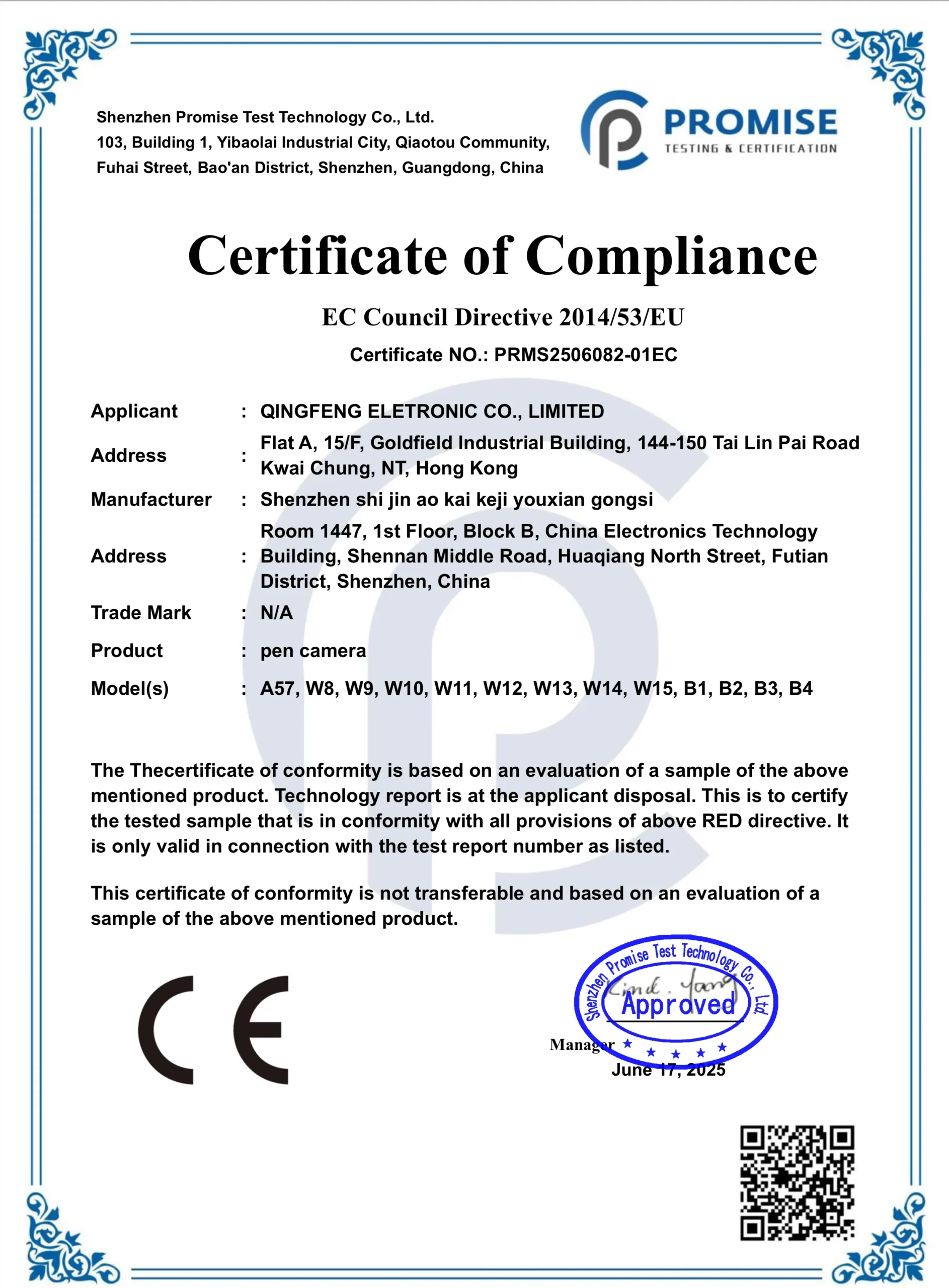
Step 1: Ask for the DoC. A Declaration of Conformity is the manufacturer’s statement that their product meets applicable directives. It should list the specific directives (e.g., RED 2014/53/EU, RoHS 2011/65/EU) and include the manufacturer’s name and address. A generic “CE certified” with no DoC attached is a red flag.
Step 2: Check the testing laboratory. Valid test reports come from accredited labs—not self-certified declarations. Look for an ILAC or MRA accreditation mark on the report. Reports without a lab identifier are typically internal test results.
Step 3: Match the model numbers. Test reports are product-specific. A report for a 1080p pen camera does not cover the 4K version, even if the supplier insists “it’s the same internals.” Every significant hardware variant needs its own documentation.
Step 4: Verify the Notified Body involvement. For RED compliance on radio equipment, some product categories require testing by an EU Notified Body. High-power WiFi transmitters and certain RF modules fall into this category. Check whether the certificate references a Notified Body number.
What the EU Market Actually Demands in 2026
European buyers are not just checking boxes. Based on procurement patterns from distributors across Germany, the UK, France, and Italy, the following requirements have become standard:
| Requirement | Notes |
|---|---|
| CE marking (RED + RoHS) | Minimum entry requirement for any distributor |
| English-language Declaration of Conformity | Must be available within 3 days of order |
| Multi-language documentation | German and French preferred for EU distribution |
| Neutral packaging available | No supplier branding visible to end customer |
| EU-based technical support contact | Increasingly required by platform marketplaces |
| GDPR-aligned privacy guidance | Product-level documentation on lawful use scenarios |
Suppliers who cannot provide neutral packaging and documentation are immediately disqualified by European distributors who sell under their own brand or on Amazon EU, where product listing compliance is enforced directly by the platform.
The Import Process: What Actually Happens at the Border
European import procedures for consumer electronics have become significantly more rigorous since 2021. Here is the practical reality for surveillance device imports:
Germany requires CE documentation at the border for electrical goods. The Zollamt (customs authority) may request test reports alongside commercial invoices. Delays of 5–10 working days are common for first-time shipments without a clean compliance record.
France operates under DGDDI (Direction Générale des Douanes) oversight. Products entering France must carry French-language instructions for use, or at minimum a multilingual document set that includes French. This is a common compliance gap for direct-from-China purchases.
The Netherlands handles a large volume of EU-bound electronics through Rotterdam Port. DHL and FedEx shipments often clear through automated systems, but random physical inspections occur. Surveillance equipment with recording capability receives closer scrutiny than standard electronics.
The UK post-Brexit requires its own UKCA marking for most products. CE remains accepted until December 2027 under existing UK government guidance, but UKCA is the forward-looking standard. Distributors importing to the UK should confirm their supplier can provide UKCA documentation.
One practical solution that has become standard among European distributors: pre-importing stock into an EU warehouse (often in the Netherlands, Poland, or the Czech Republic) before distributing to individual EU countries. This isolates customs clearance to a single point and prevents repeated documentation checks per country.

Building a Compliant Procurement Checklist
Use this checklist when evaluating any new supplier for the European market:
– [ ] DoC available with directive references and manufacturer details
– [ ] Third-party lab test report (not just self-certification)
– [ ] RoHS test report within 24 months
– [ ] RED compliance documented for WiFi/radio components
– [ ] Model numbers on test reports match the order SKU
– [ ] Neutral packaging option confirmed
– [ ] Multi-language documentation set available
– [ ] GDPR guidance document included (even if brief)
– [ ] EU-based contact or representative identified (Article 4(2) GPSR requirement)
– [ ] Payment terms protect against non-delivery (Trade Assurance, letter of credit for orders over €10,000)
What Happens When You Skip This Step
The most common scenario: a UK distributor receives a shipment of USB charger hidden cameras. Her Majesty’s Revenue and Customs (HMRC) flags the consignment. She has a commercial invoice and a generic CE certificate with no lab identifier. The shipment sits in customs for three weeks. By the time it clears, she has lost the retail selling window for the season.
The second scenario: a German retailer buys 200 units from a supplier who provided CE documentation. The products work fine. Six months later, a market surveillance authority audit finds the documentation is incomplete. The retailer faces a recall order and a fine under the General Product Safety Regulation.
Both outcomes are avoidable. The cost of proper due diligence is a fraction of the cost of a customs hold or a recall. European buyers who have been in the market for more than a year universally cite compliance documentation as their single biggest sourcing pain point—and their most valuable competitive advantage once solved.
Finding Suppliers Who Understand the European Market
Not all Chinese manufacturers are equally prepared for European compliance requirements. The suppliers who are worth working with share several characteristics:
They have a dedicated EU compliance person in their export team, not just a sales rep who handles all markets. They maintain a folder of compliance documents organized by product SKU, ready to send within hours. They have already worked with EU distributors and understand the documentation cadence. And they offer sample testing so you can verify that the product matches the documentation before placing a bulk order.
Small order quantities for initial testing—typically 3–5 units—are a standard practice in the industry. Any supplier who resists sending samples before a bulk order is not confident in their own compliance documentation.
FAQ: Common Questions from European Buyers
Can I rely on a supplier’s “CE certified” Alibaba badge?
No. The Alibaba badge is self-reported. Always request the actual Declaration of Conformity and third-party test report. If a supplier cannot produce these within 48 hours, move on.
Do I need to register with an EU entity if I dropship from China to European customers?
Under the GPSR (General Product Safety Regulation), the EU responsible person requirement applies to all consumer products sold in the EU, including dropshipped goods. If you are dropshipping surveillance equipment, you need an EU-based entity designated as the responsible person—either yourself (if you have EU operations) or a third-party compliance service.
What about GDPR liability if my customer uses the camera illegally?
As a distributor, your liability for downstream misuse is generally limited if you have provided clear guidance on lawful use and the product itself is compliant. The risk increases significantly if your marketing materials imply or encourage illegal surveillance.
How long does CE documentation take to obtain from a new supplier?
If the supplier already has valid test reports, 3–5 business days to organize and send documentation. If testing is required from scratch, allow 4–8 weeks for a new product variant.
Is UKCA marking separate from CE marking?
Yes. UKCA applies to the UK market only. CE applies to the EU market. As of 2026, CE is still accepted in the UK under transitional arrangements, but the long-term requirement is UKCA. If you distribute to both markets, you need both.
Key Takeaways
| Topic | Key Point |
|---|---|
| CE marking | Legal requirement, not optional |
| RED directive | Covers all WiFi/radio transmitting cameras |
| GDPR | Distributors share liability; provide lawful-use guidance |
| Documentation | DoC + third-party lab report + RoHS report |
| UK post-Brexit | UKCA marking is the forward standard |
| Customs | Pre-import to EU warehouse reduces border friction |
| Supplier vetting | Samples + documentation before bulk order |
If you are serious about distributing hidden cameras and covert surveillance equipment in Europe, the first conversation with any new supplier should be about documentation, not price. That conversation tells you everything you need to know.
Browse CE-certified hidden cameras and request documentation packs from our compliance team.

 English
  Italiano
  Deutsch
  Français
  Español
  Polski