
How to Hide a Mini Camera: Professional Placement Guide for 2026
Knowing how to hide a mini camera effectively is the difference between a covert security installation that works and an obvious device that gets spotted, tampered with, or destroyed. Whether you’re setting up a nanny cam in a nursery, protecting a small business from employee theft, monitoring an elderly relative’s care home visits, or deploying a network of property surveillance points, the placement decisions you make in the first five minutes determine everything about the system’s effectiveness. This guide covers placement methodology, power considerations, object-integration techniques, field-of-view geometry, and the legal framework every installer needs to understand before placing a single device.
Why Mini Camera Placement Fails: The Most Common Mistakes
Before explaining what works, it’s worth cataloguing what doesn’t — because these errors show up repeatedly across amateur and semi-professional installations.
Placing the camera too high: Shelf tops, cabinet tops, and ceiling-adjacent positions are the first places a suspicious person looks. More critically, a camera aimed downward from 2.5 meters captures the tops of heads and very little face. For identification-quality footage — faces, hands, objects — the optimal camera height is 1.5–1.8 meters, at or slightly above average eye level. Lower placements in books, boxes, or decor items at this height yield far better recognition results than high shelf positions.
Lens obstruction: A camera hidden inside an object needs a clear aperture — even a thin fabric or frosted plastic cover reduces image quality significantly and creates IR reflection halos in night vision mode. Test the actual view through any cover material before finalizing placement.
Backlit positions: Placing a camera facing a window is the most common beginner error. The ambient outdoor light overwhelms the sensor’s dynamic range, silhouetting everything in the frame. Always position cameras so their subject is better lit than the background — or use cameras with Wide Dynamic Range (WDR) sensors rated at 120 dB or higher.
Cable management: Visible power cables trailing from a supposedly “wireless” object are an immediate tell. Any wired camera installation requires routing cables inside walls, through furniture, or under carpets — or switching to a battery-powered unit that truly requires no cable management.
Single-camera dead zones: A single camera has field-of-view limitations. Relying on one camera to cover an entire room inevitably creates blind spots exploited by anyone who has a moment to observe the space. For critical monitoring zones, overlapping coverage from two cameras (even inexpensive ones) provides redundancy that a single high-end unit cannot.
Room-by-Room Placement Strategy
Different rooms have different traffic patterns, focal points, and optical constraints. Here’s the analysis for each primary space:
Living Room and Common Areas
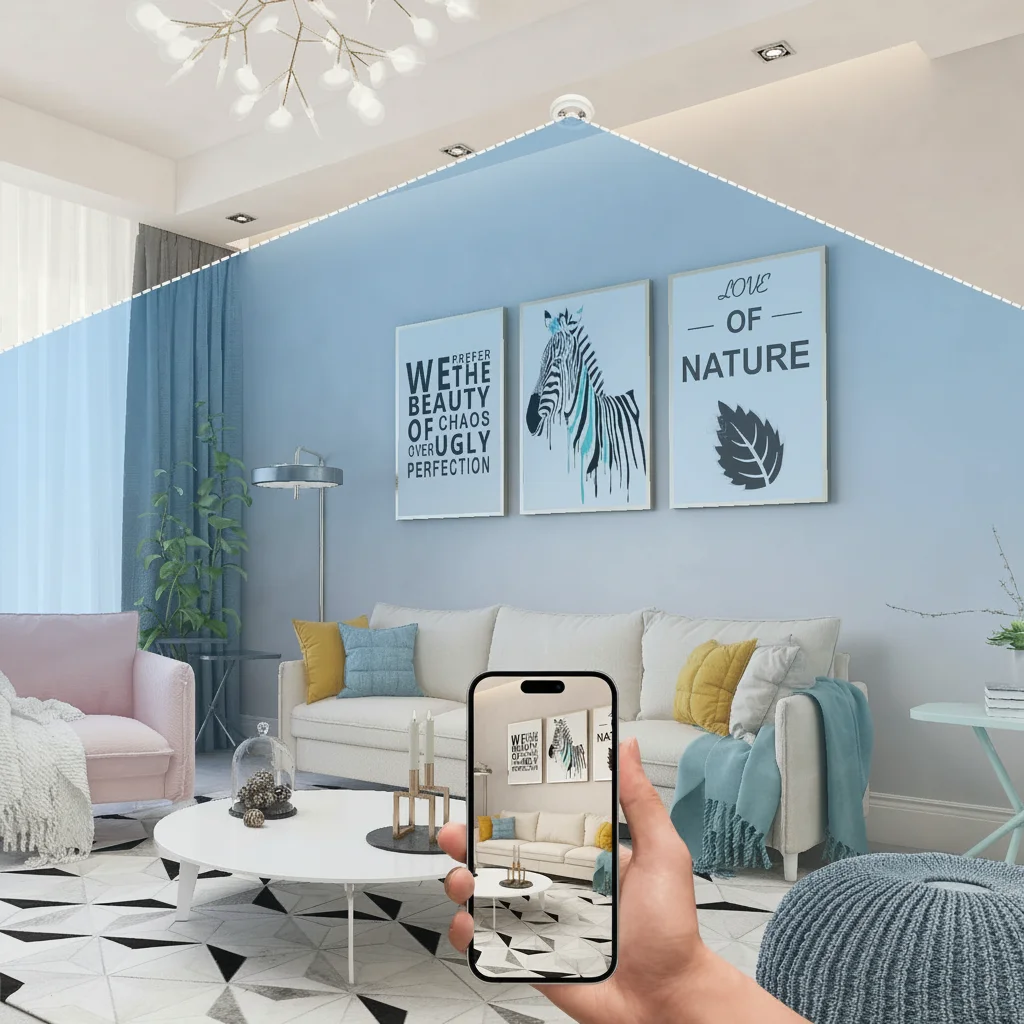
The focal points in a living room are the seating area (couch, chairs) and the room entrance. These are where interactions happen, where visitors spend time, and where a caregiver interacting with a child or elderly person will be observed. The optimal placement for a living room hidden camera is a decorative object positioned on a side table or bookshelf, at 1.5–1.7 meters height, facing the seating group from a 30–45° angle. This angle captures both faces and body language.
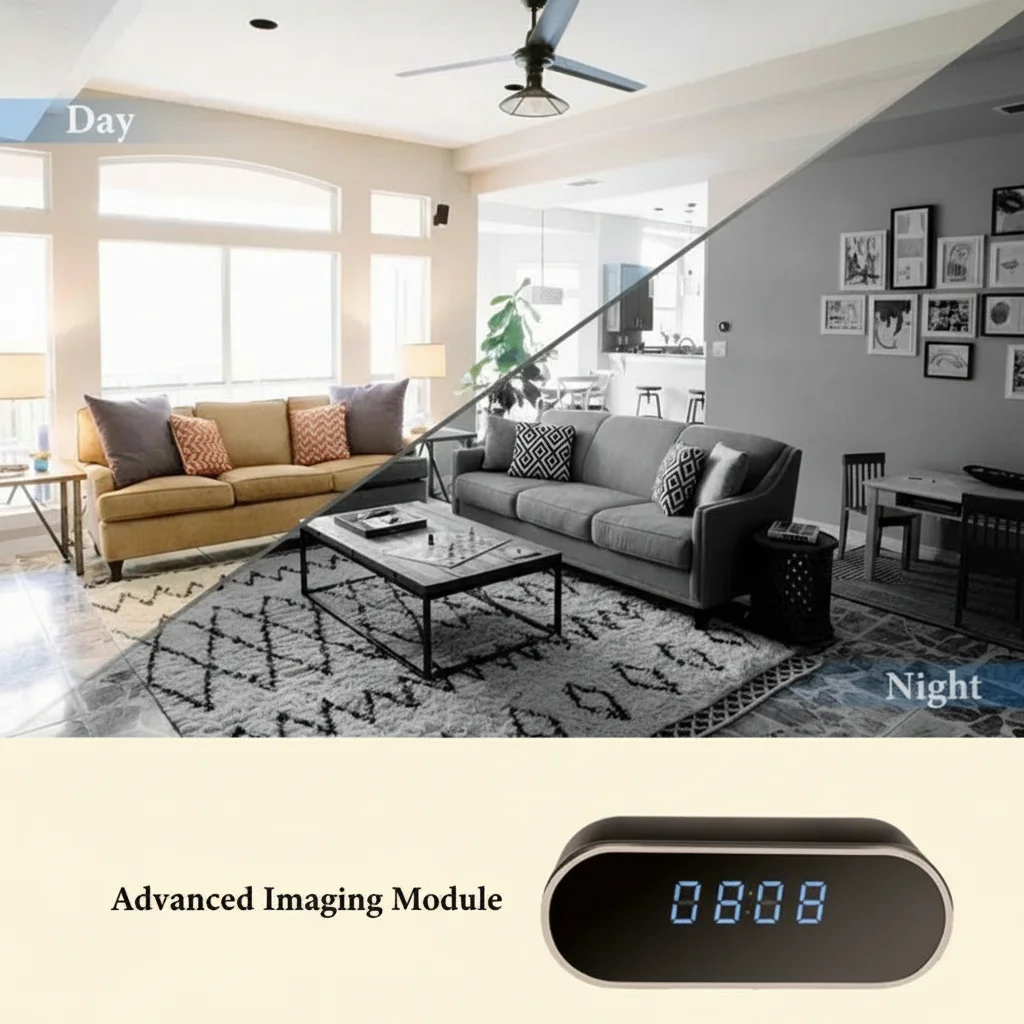
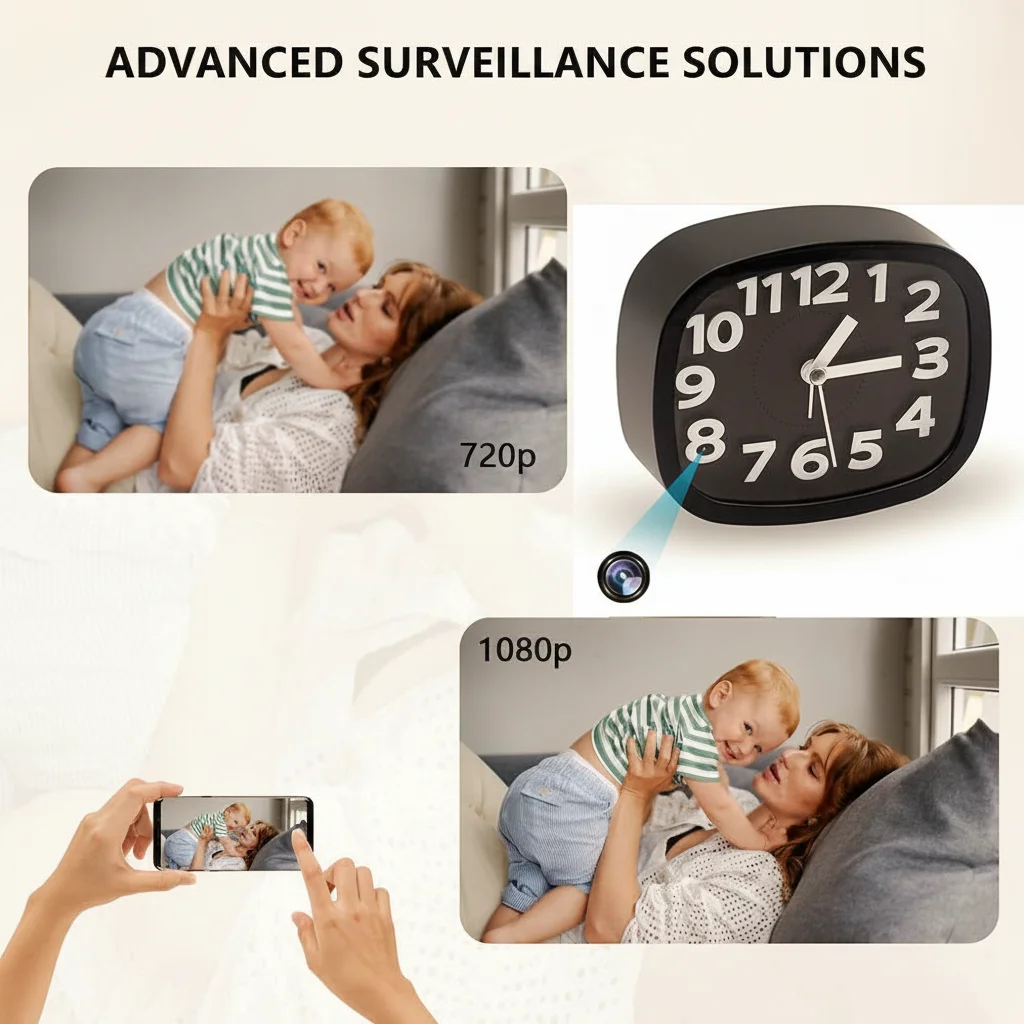
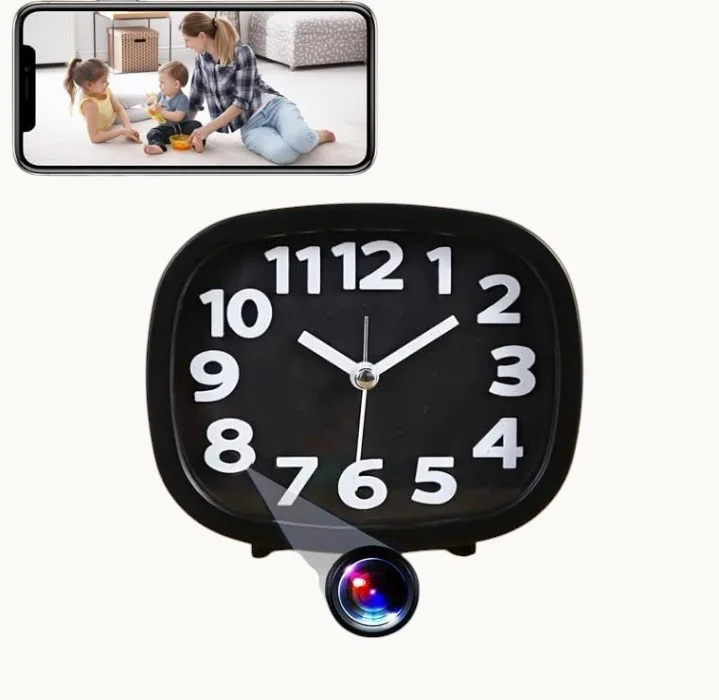
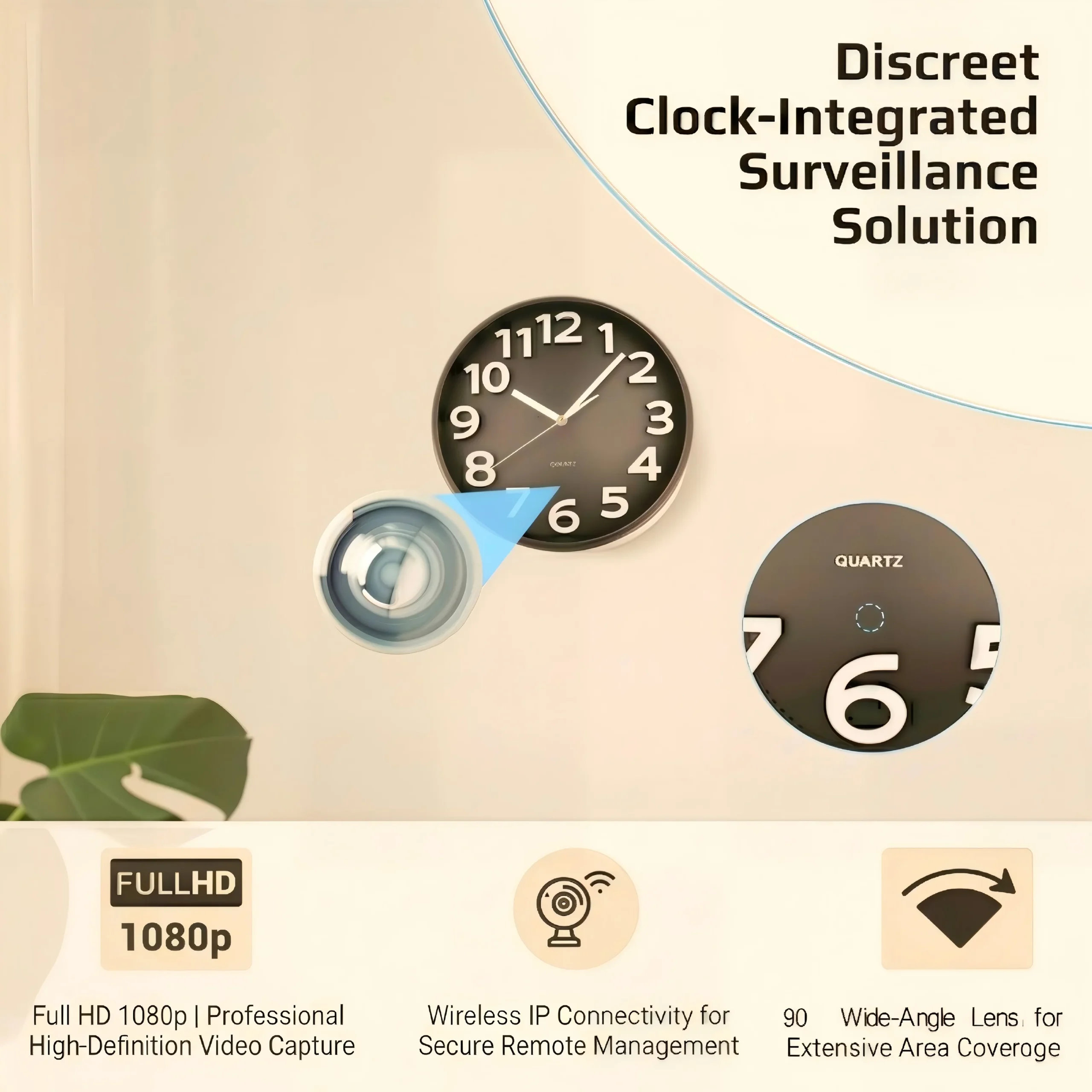
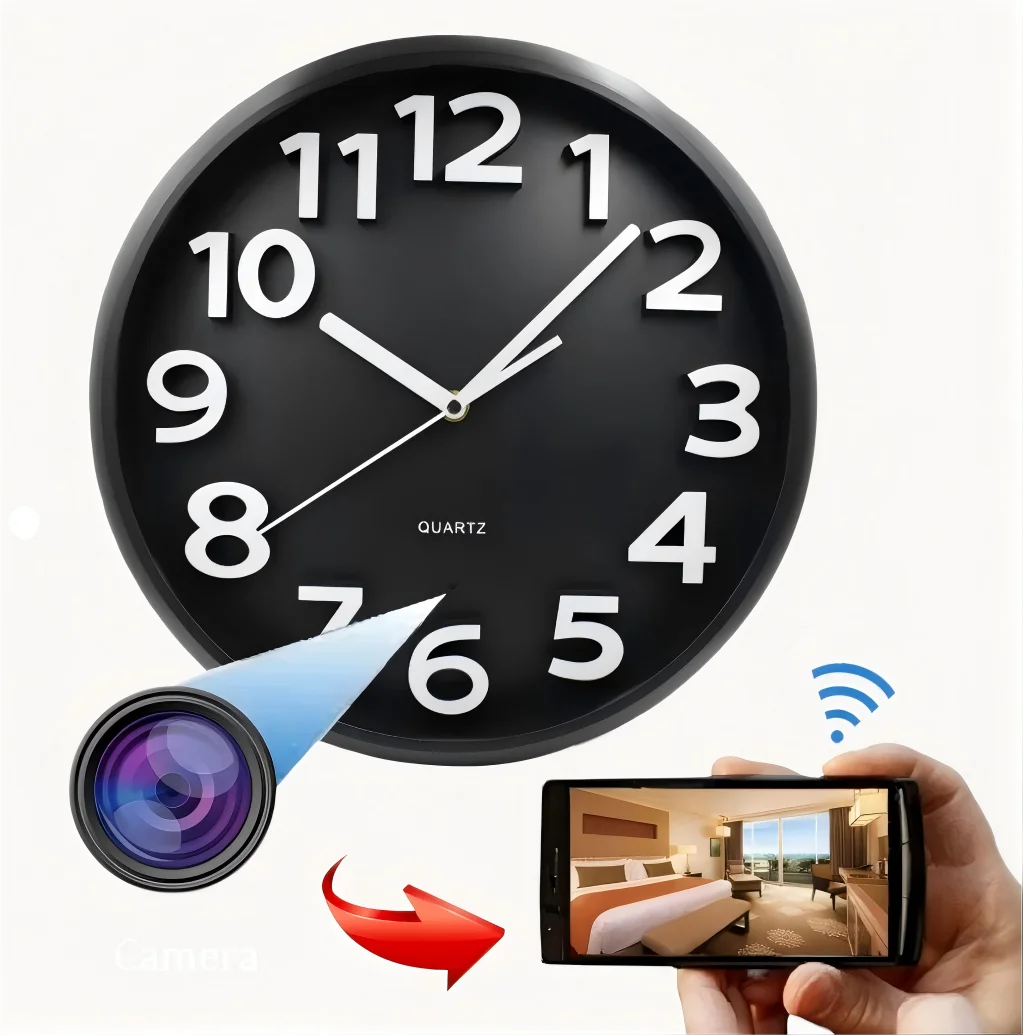
The Z10 WiFi Spy Clock Camera 1080P is specifically designed for this placement scenario. It functions as a fully operational digital clock — accurate time display, alarm function — while capturing 1080P video with a 120° wide-angle lens that covers a full living room from a single desk or shelf position. The motion detection trigger reduces storage consumption and sends mobile notifications when activity is detected.
Objects that work well as concealment: alarm clocks, desk organizers, picture frames, air purifiers, table lamps with opaque bases, decorative vases, and artificial plant arrangements. Objects that don’t work: transparent glass items, items facing windows, objects too high or too low.
Entryways and Hallways
Entry points have a specific requirement: you need to capture faces of people entering, which means the camera must face toward the entry direction, at approximately face height, with adequate lighting on the subject. A hallway camera placed at the end of the hall, facing toward the front door, captures everyone entering in profile. Instead, position it to one side of the entry, slightly back, facing toward the door — this gives a three-quarter face view of anyone coming in.
The WiFi 1080P Hidden EU Socket Camera excels in entryway deployment. It installs in a standard EU wall socket, occupying a position that is universally present and never questioned. The camera lens is hidden within the socket body, capturing footage at exact entry height. Power is drawn directly from the wall — no battery management, no charging schedule, indefinitely operational.
This is a critical point for hallway deployment: power availability and camera runtime should be decoupled. Battery cameras are appropriate for spaces without accessible power outlets, but for fixed surveillance positions where long-term reliability is required, a mains-powered device like a socket camera is the correct choice.
Nursery and Children’s Rooms
Nanny cam placement in children’s rooms must balance visibility to caregivers (you want to see the full room and crib/bed area) with visual neutrality (the camera shouldn’t be obvious to the child as they grow older, or to a caregiver who might tamper with it if they suspect monitoring). The recommended placement is a clock or decorative object on a dresser or changing table, at 1.5 meters height, angled to cover the crib, changing area, and room entrance.
Night vision capability is non-negotiable in nurseries — most of the monitoring value happens during low-light sleeping hours. Infrared night vision up to 5 meters covers a standard nursery without illuminating the room with visible light that would disturb sleep. The Z10 WiFi Spy Clock Camera 1080P includes infrared illuminators active at 850nm — invisible to the human eye, full night-vision capability.
Home Office and Study
Home office cameras primarily serve two purposes: monitoring access to sensitive documents and equipment (for property security), and recording meetings or calls (for compliance or evidence purposes). For property monitoring, a camera integrated into a bookshelf — facing the desk, filing cabinet, and room entry — covers the primary risk areas. For meeting recording, a forward-facing pen camera or desk-positioned device captures the workspace from the occupant’s perspective.
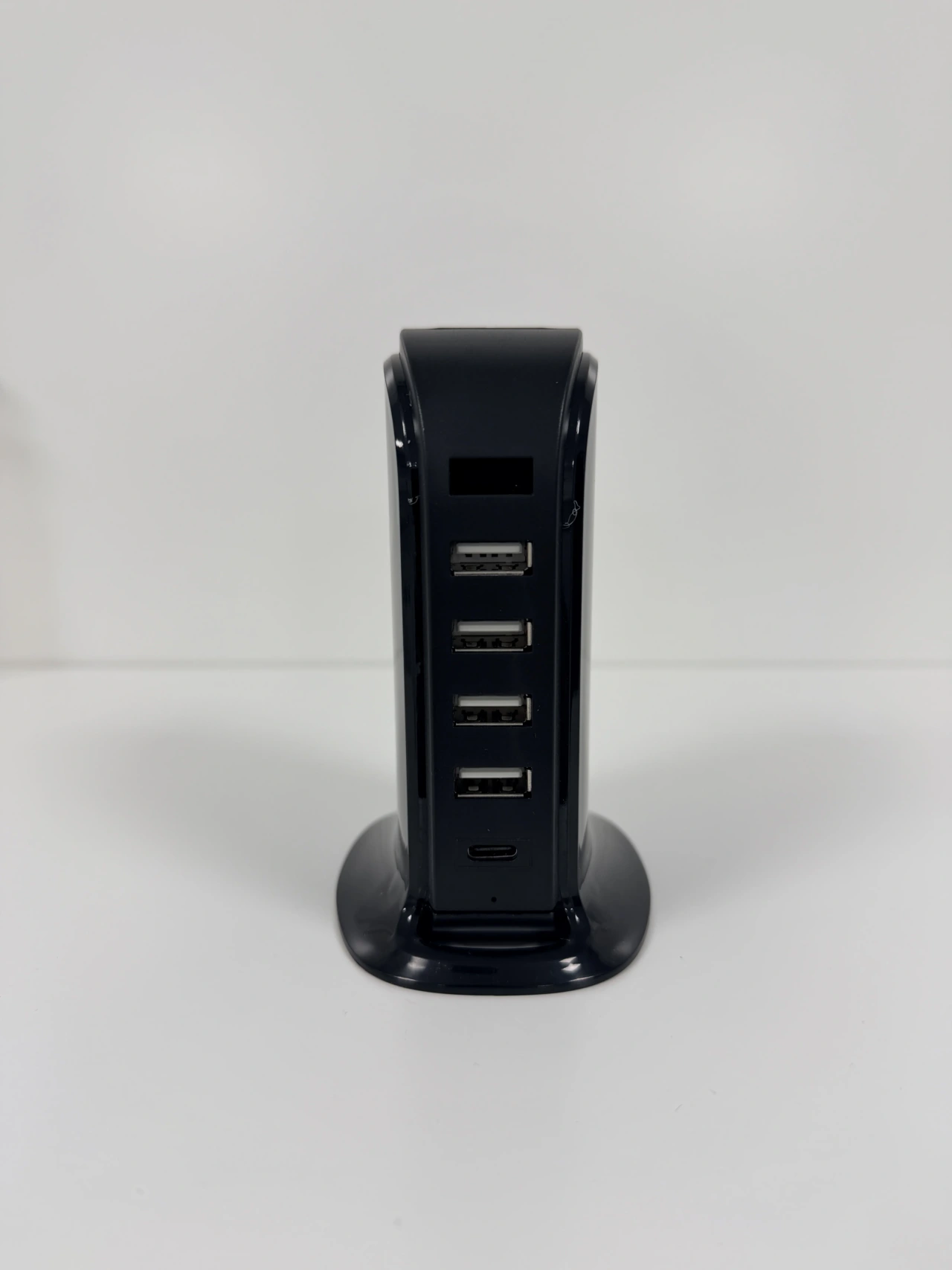
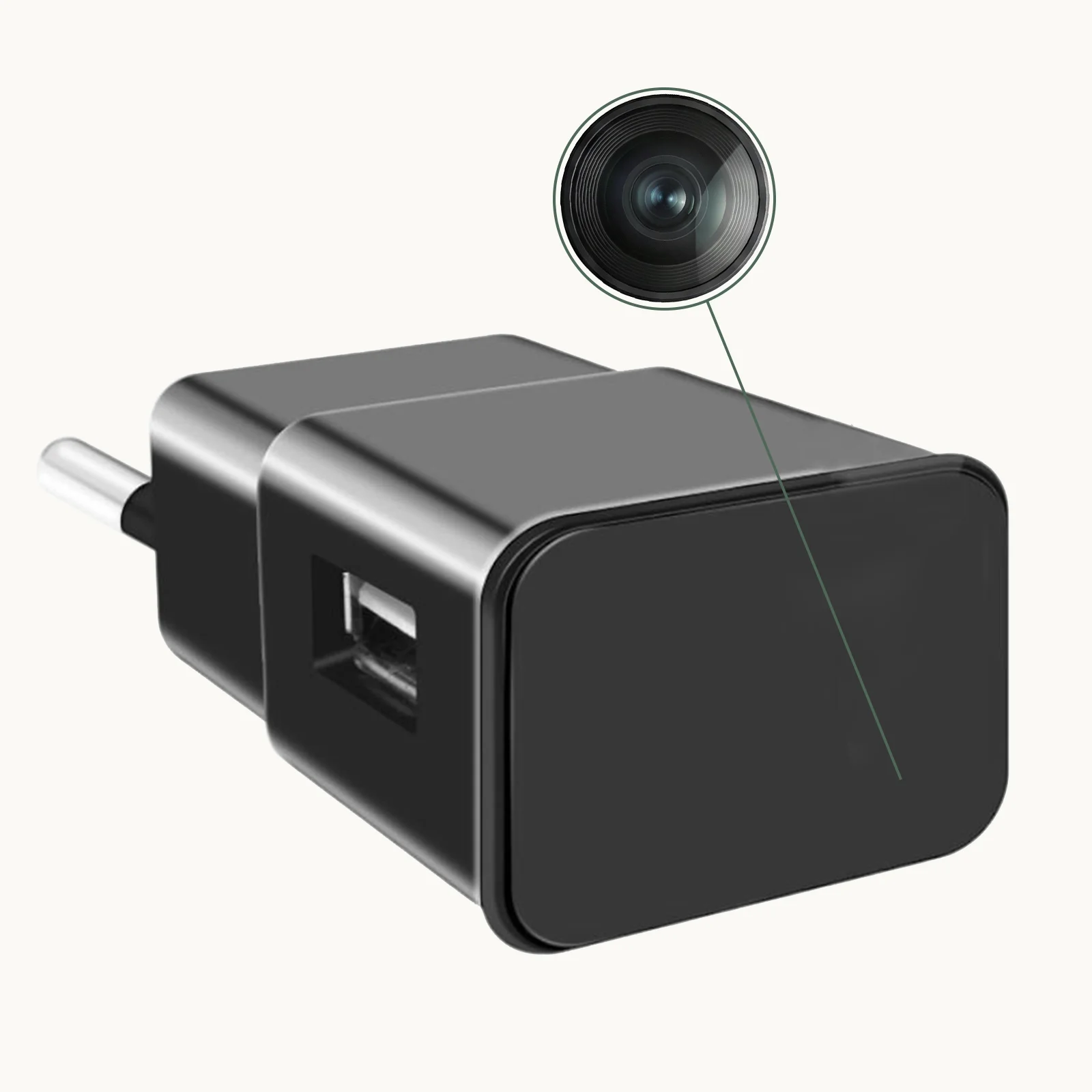
For the desk-level monitoring use case, the WiFi Spy Camera USB Charger 1080P sits in any available USB wall socket at desk height, recording the room in front of it. It draws power continuously from the wall outlet and connects via WiFi to the home network for remote monitoring. Anyone entering the office sees a USB charger — a universal, unremarkable device.
Bedroom and High-Privacy Areas
This is where legal requirements must be explicitly understood before any installation. In EU member states, GDPR Article 6(1)(f) (legitimate interests) governs private use of surveillance cameras. Recording in private spaces such as bedrooms — particularly of domestic workers, guests, or household staff without their knowledge — is likely to constitute a privacy violation regardless of who owns the property. The UK ICO guidance on home CCTV explicitly notes that cameras should not be positioned to capture private areas of the bedroom. There are legitimate exceptions: monitoring a vulnerable person who has consented, security monitoring of unoccupied properties, and recording your own activity. Consult local legal advice before placing any covert camera in a bedroom or bathroom space.
For property monitoring of unoccupied spaces (recording while you’re away), the rules are more permissive in most jurisdictions. A WiFi Smoke Detector Hidden Camera 1080P ceiling-mounted in a hallway or landing captures movement through any bedroom doorway without being positioned inside the bedroom itself — legally cleaner while providing effective coverage.
Powering Mini Cameras: Wired vs. Battery vs. Solar
Power strategy has a bigger impact on operational reliability than almost any other installation decision. The three options have fundamentally different operational profiles:
Mains-powered (socket/charger cameras): Infinite runtime, zero maintenance. The tradeoff is that you’re constrained to positions near wall sockets, and cable routing from a socket to a concealed object at distance requires planning. Socket cameras that are the socket — like the WiFi 1080P Hidden EU Socket Camera — solve this elegantly: the camera IS the socket, at socket height, with no cable to manage.
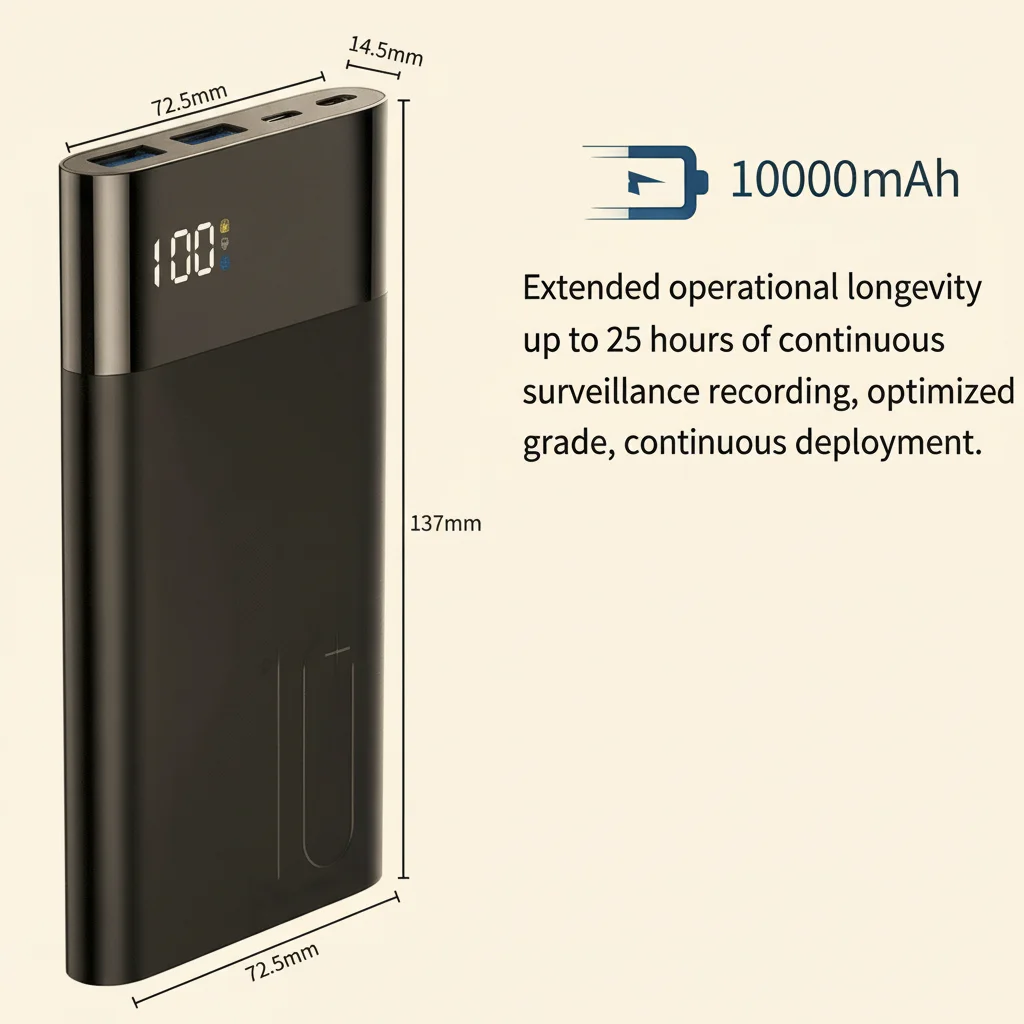
Battery-powered (power bank cameras): Flexible placement anywhere in the room, no cable management required. The constraint is battery life — most mini cameras deliver 8–24 hours of active recording, or several days in motion-detection standby mode. The WiFi 1080P Power Bank Hidden Camera Night Vision uses a 10,000 mAh power bank form factor: credible as a normal desktop device, providing 96+ hours of standby monitoring capacity with motion-triggered recording.
USB trickle-charge from existing devices: Some mini cameras support being powered via USB from an existing device (a desktop PC, a powered USB hub, a smart TV USB port) — leveraging existing infrastructure without requiring a dedicated power outlet. This works well in office environments where multiple powered devices are already present.
Field of View Geometry: Why the Lens Angle Determines Everything
A camera’s field of view (FOV) determines how much of the scene it captures at a given distance. Most mini spy cameras use wide-angle lenses in the 90°–130° range. Understanding how this projects onto a floor plan helps you select placement positions correctly:
At 120° FOV (common in socket and clock cameras):
– At 2 meters distance: covers approximately 4.6 meters wide
– At 3 meters distance: covers approximately 6.9 meters wide
– At 5 meters distance: covers approximately 11.5 meters wide
This means a 120° camera placed at the back corner of a 5×5 meter room captures the entire room width at the far wall. The same camera mounted at the room center covers a smaller arc relative to the room boundaries.
The practical implication: for rooms larger than 20 square meters, a single 120° camera positioned at a corner yields better overall coverage than a narrower camera positioned at the center. For small rooms (nurseries, bathrooms, home offices under 15 square meters), center-of-wall placement with a 90°–100° lens is sufficient and avoids the perspective distortion of extreme wide-angle at short distances.
Using Objects as Camera Hosts: What Works and What Doesn’t
The concealment challenge is matching a camera to a host object in a way that survives close inspection. The object must be:
1. Contextually appropriate for the location — a smoke detector on the ceiling is expected; a smoke detector on a bookshelf is suspicious
2. Positioned naturally — at a height and angle consistent with its stated function
3. Operationally convincing — a clock camera that doesn’t display the correct time is a red flag
Object categories that work well with embedded cameras:
| Object | Location | Concealment Quality | Notes |
|---|---|---|---|
| Digital alarm clock | Bedroom, living room, nursery | Excellent | Must display correct time |
| Smoke detector | Ceiling, hallway | Excellent | Must include flashing LED behavior |
| Wall socket/EU plug | Any wall | Excellent | Must appear functional |
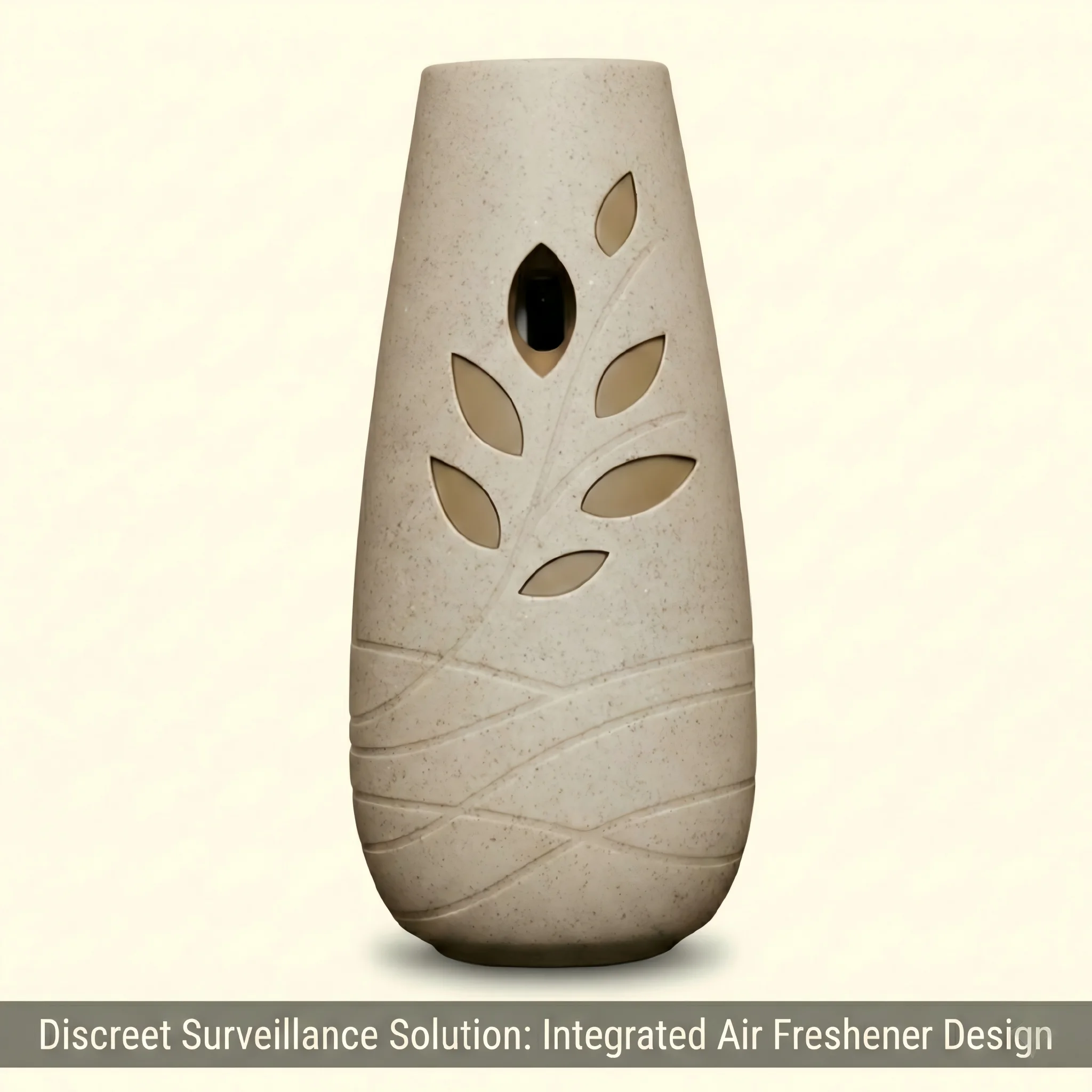
| Air freshener | Wall, bathroom | Good | Frequent inspection during refills |
| Picture frame | Wall, desk | Good | Avoid facing windows |
| Decorative vase | Shelf, desk | Good | Must position aperture at correct angle |
| USB charger | Desk, office | Excellent | Universal, unremarkable |
| Power bank | Desk, bag | Good | Large enough to house optics + battery |
| Book (hollowed) | Bookshelf | Moderate | Spine must face room, not wall |
DIY Camera Modules: Building Custom Concealment Solutions
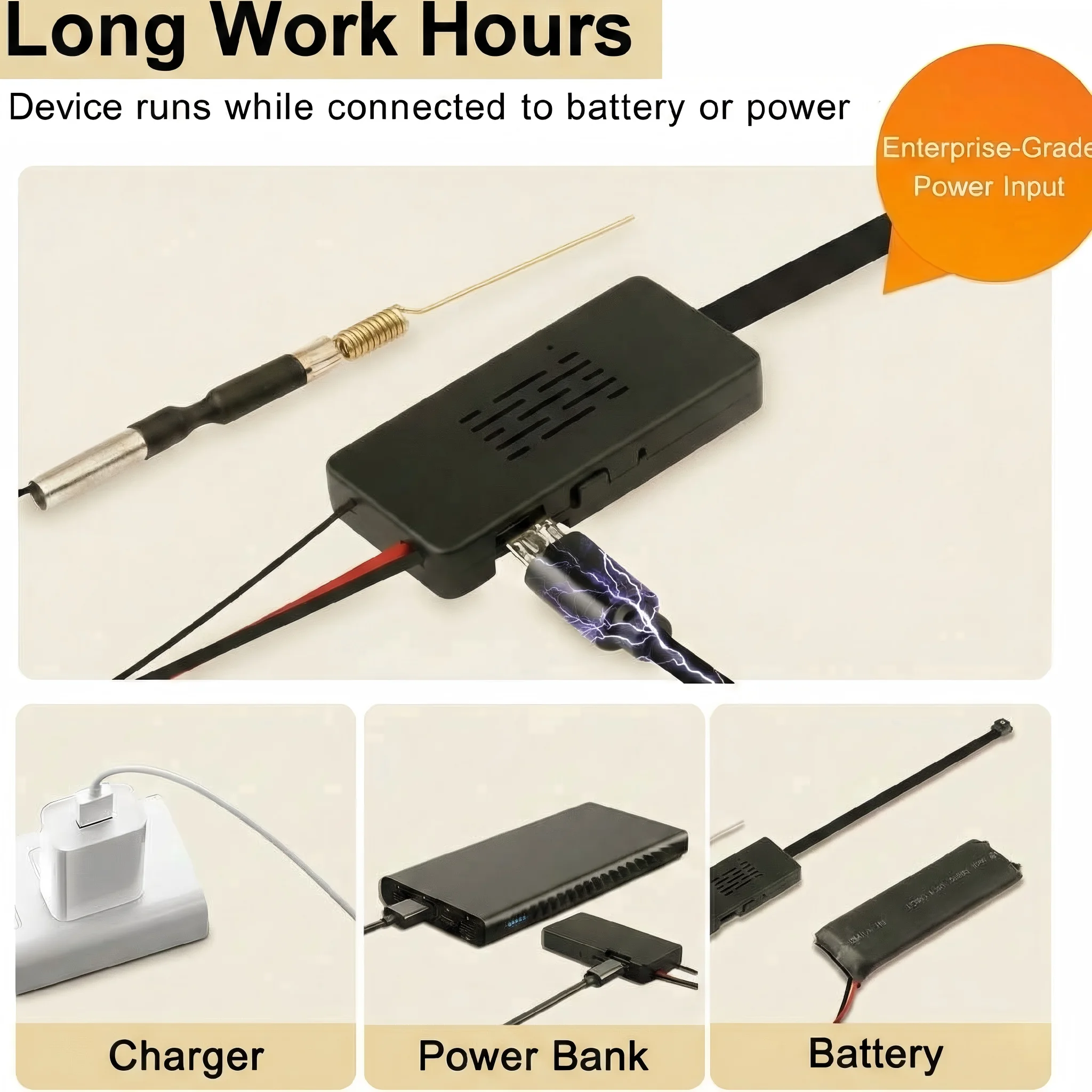
For installers who need truly custom concealment — embedding a camera inside a specific object not available as a pre-built unit, or integrating into architectural features like light fixtures or ventilation grilles — DIY camera modules offer the raw hardware without the pre-built housing.
The DIY Hidden Spy Camera Kit provides: a 1080P CMOS sensor on a miniature PCB, integrated WiFi module, motion detection processor, battery management circuit, and Tuya app connectivity — everything needed to embed in any host object. The lens module is 12mm in diameter, suitable for drilling into objects as thin as a book cover or a picture frame back. The entire electronics stack is 8mm thick at its slimmest point.
The DIY Hidden WiFi Spy Camera Module goes further, providing a pre-tested 4K capable sensor module with live stream capability and cloud storage integration. For professional installers building bespoke solutions or for B2B buyers who want to integrate camera capability into their own product lines, this is the correct starting point.
Legal Framework: What You Must Know Before Installing
The legal landscape for hidden cameras in private spaces varies significantly by jurisdiction. Key principles:
EU/GDPR: Under GDPR Recital 10, processing of personal data through surveillance cameras in private homes for purely personal activities is exempt from GDPR. However, if footage captures spaces used by employees, guests, or visitors who have a reasonable expectation of privacy, GDPR compliance applies — including lawful basis, data retention limits, and disclosure obligations. The European Data Protection Board’s guidelines on video surveillance provide the definitive reference.
UK: The ICO’s Home CCTV guidance notes that cameras covering areas beyond your own property boundary — capturing a neighbor’s garden, a public pavement, or a shared entrance — fall under data protection law and require proper handling.
US: Federal wiretapping law permits recording in any location where you have no reasonable expectation of privacy being violated as the installer. State laws vary: California requires all-party consent for audio recording. Consult state-specific resources before audio-enabled camera deployments.
The single clearest principle across all jurisdictions: cameras monitoring spaces you own, for your own legitimate security purposes, without capturing third parties’ private spaces, sit in the clearest legal territory. Cameras in bedrooms, bathrooms, or used to monitor employees without disclosure carry significant legal risk.
Pre-Installation Checklist
Before placing any camera, confirm:
– [ ] Legal authority: You own or control the property, or have explicit permission from the owner
– [ ] No audio recording in all-party-consent jurisdictions unless all parties consent
– [ ] Camera does not face a neighbor’s property, public space, or area where third parties have privacy expectations
– [ ] Power strategy decided: mains, battery, or USB — and route planned if wired
– [ ] WiFi signal strength tested at intended position (minimum -65 dBm for stable streaming)
– [ ] Camera firmware updated before placement — post-placement firmware updates require physical access
– [ ] App and remote viewing tested from outside the local network before finalizing position
– [ ] Motion detection zone configured to avoid false triggers from curtains, fans, or pet movement
– [ ] SD card formatted and loop recording mode enabled
– [ ] Night vision tested in actual room lighting conditions at target distance
FAQ: Common Questions from First-Time Installers
Q: Can a hidden camera work without WiFi?
Yes. Cameras with microSD card recording operate completely offline — they store footage locally and require physical retrieval for playback. WiFi adds live monitoring and remote alerts but isn’t required for basic recording. The DIY Hidden Spy Camera Kit supports both modes: WiFi when available, SD-only recording when not.
Q: How do I check if a camera has a clear view through its housing?
Test by connecting the camera to live view (via app or WiFi), then looking at the actual video feed while covering and uncovering the concealment material. Any material that reduces brightness by more than 20% in the feed will significantly affect night vision performance and low-light clarity.
Q: What’s the maximum SD card size most mini cameras support?
Most current mini cameras support up to 128 GB microSD (some newer units support 256 GB). At 1080P with H.265 compression, 128 GB stores approximately 150–200 hours of footage in loop recording mode, continuously overwriting the oldest material.
Q: My WiFi signal doesn’t reach the target location. What are my options?
Install a WiFi range extender (mesh node) positioned between your router and the camera. Alternatively, run a short Ethernet-to-WiFi bridge adapter. If neither is practical, use a camera with 4G LTE connectivity — several QZT models support SIM card insertion for cellular-connected operation independent of home WiFi.
Q: How do I avoid the camera being detected by RF scanners?
RF detection devices find WiFi and cellular cameras by detecting their transmission signals. During active streaming, a WiFi camera is detectable. During SD-only recording with WiFi disabled, there is no RF emission. If RF detection is a specific concern, use cameras in SD-only mode with WiFi disabled, uploading footage only during a brief designated retrieval window.
Q: How do I handle the camera lens fogging up in cold environments?
Mini cameras in sealed enclosures in cold rooms (garages, outdoor-facing interior walls) can develop condensation on the lens from temperature differentials. Solutions: use silica gel packets in the enclosure if building a DIY installation, or select cameras rated for operating temperature ranges that include your environment. Most cameras are rated 0°C–40°C operating range.

 English
  Italiano
  Deutsch
  Français
  Español
  Polski