
Cómo abastecerte de cámaras espía power bank rentables para venta al por mayor
Power bank spy cameras sit in an unusual product category. They look like ordinary consumer electronics, they sell to both end consumers and corporate buyers, and they sit at the intersection of portable power and covert surveillance — which means your regulatory compliance story is more complex than it looks.
If you are building a wholesale sourcing strategy for power bank cameras in 2026, the question is not just “which model has the best specs.” It is: which products can I import, certify, and sell in my target markets without exposing my business to regulatory action — and which ones will my customers actually reorder?
This guide covers sourcing strategy, product differentiation, certification requirements for European and UK markets, and the margin realities that most suppliers will not show you up front.
1. Product Categories — Not All Power Bank Cameras Are the Same
Walk into a sourcing fair in Shenzhen (or scroll through 30 supplier listings on a B2B platform) and you will see “power bank camera” applied to at last four genuinely different product categories.
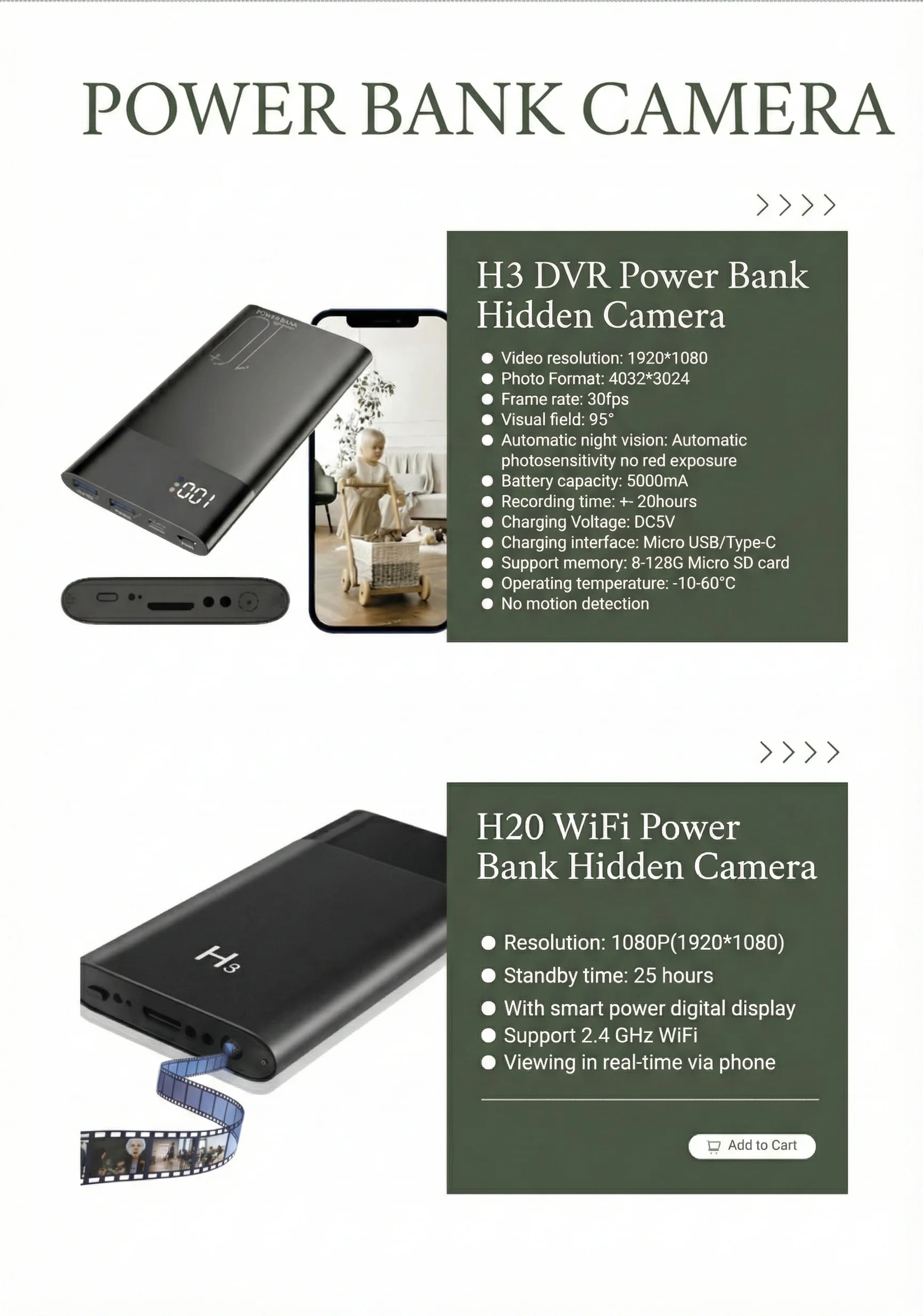
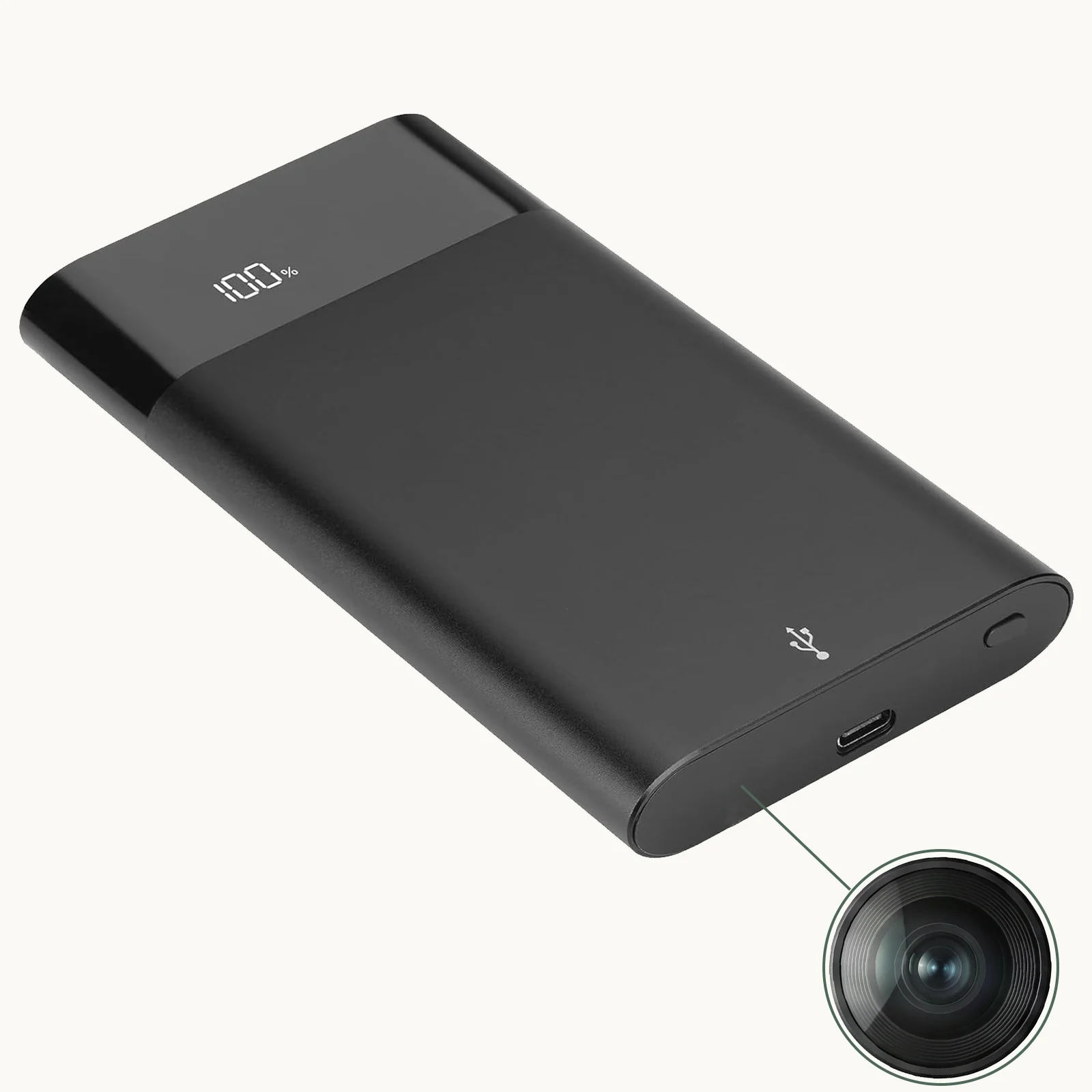
Category 1: Basic record-to-card, no WiFi. This is the H3-style product. 5000–10000mAh capacity, camera module embedded in the housing, records to microSD. No remote access, no app, no WiFi. Simplest regulatory classification (essentially a combined power bank + 1080p camera). Most reliable category for wholesale because there is no radio transmission component — which means RED (Radio Equipment Directive) does not apply.
Category 2: WiFi-enabled with remote viewing. The H20 falls here. Adds a 2.4GHz WiFi module and companion app. Now you have a radio device, which means CE RED certification is mandatory for EU sales. Also means the camera’s video feed passes through a server (for remote viewing), which brings GDPR implications for how that data is processed and where the server is located.
Category 3: TUYA/Smart Home integrated. The premium variant. The device integrates with TUYA Smart Life or Smart Plus app ecosystems. For European distributors selling into the智能家居 market, this is a strong differentiator. But TUYA integration requires additional firmware certification and server compliance — not every supplier can deliver this reliably.
Category 4: “False capacity” budget units. The grey market problem. A product listed as “10000mAh” that actually contains a 3000mAh cell, or a “4K camera” that is actually 720p upscaled. These damage your brand reputation and generate returns. Learning to identify them before you buy is a core sourcing skill.
2. Sourcing Directly From Manufacturers — What Changes in 2026
The sourcing landscape for surveillance equipment has shifted since 2023 in three structural ways that affect every distributor’s negotiating position.
The CE documentation expectation has risen. Since the EU’s General Product Safety Regulation (GPSR) came into full effect in December 2024, online marketplaces (Amazon, eBay, Temu) are under pressure to verify CE compliance before listing. This has pushed more compliance-conscious distributors toward suppliers who can provide full technical files and Declarations of Conformity (DoC). If your supplier cannot produce a genuine DoC with a notified body number (for RED-covered products), do not buy.
Component costs have stabilised after the 2021–2022 spike. CMOS sensors, lithium cells, and WiFi modules are now at or below 2019 price levels in USD terms. This means manufacturer margins have recovered, which gives you more room to negotiate on price without the supplier cutting quality to protect their margin. The distributors who locked in 12–24 month pricing contracts in 2023–2024 have an advantage over those still buying spot.
MOQ flexibility has increased for certified suppliers. Suppliers with genuine CE certification and a track record of EU exports are more willing to negotiate MOQ downward for new distributors who commit to certification compliance and documented quality control. The regulatory barrier that Temu created (non-compliant goods) has actually helped legitimate suppliers — they face less price competition from uncertified imports in the B2B channel.
3. Certification Requirements — The Minimum You Need to Import Legaly
If you are importing power bank cameras into the EU or UK, these are the certifications and documentation you must have before the first container lands.
CE Marking (EU). For power bank cameras with WiFi capability (Category 2 and 3 above), you need compliance with:
– EMC Directive 2014/30/EU (electromagnetic compatibility)
– RoHS Directive 2011/65/EU (restriction of hazardous substances)
– RED Directive 2014/53/EU (for the WiFi/radio module)
– LVD Directive 2014/35/EU (low voltage directive, for the power bank charging circuit)
– GPSR compliance (General Product Safety Regulation, for marketplace listings)
For non-WiFi units (Category 1), RED does not apply, but EMC, RoHS, and LVD still do.
UKCA Marking (United Kingdom). Since Brexit, the UK has its own conformity assessment system. CE marking is still accepted in Great Britain until December 2027 for most product categories, but UKCA marked products are preferable for long-term positioning. The regulatory framework mirrors CE in structure but has separate notified bodies.
FCC / IC (United States and Canada). If you plan to export to North America, FCC Part 15 (for the WiFi module) and appropriate SAR testing (for devices worn or used close to the body) are required. Most Shenzhen manufacturers already have FCC for their WiFi modules, but confirm before ordering.
ISO 9001 (Quality Management). Not a legal requirement, but a strong signal to B2B buyers (corporate security departments, procurement offices) that your supply chain has documented quality controls. Ask your supplier for their ISO 9001 certificate and verify it against the issuing body’s database.
4. How to Distinguish a Quality Power Bank Camera Supplier
Most suppliers will send you a spec sheet that looks professional. Many of those spec sheets contain inaccurate or directly false claims. Here is how to verify before you commit to a purchase order.
Step 1: Request a sample unit and test the capacity claim. A genuine 10000mAh lithium-polymer cell should deliver approximately 6000–7000mAh of actual usable capacity (energy conversion losses, protection circuit drain). Use a USB power meter (approximately €15 on Amazon) to measure actual discharge capacity. If a “10000mAh” unit delivers less than 5000mAh usable, it contains a false-capacity cell.
Step 2: Verify the camera resolution independently. Record a 2-minute clip. Check the file properties → video resolution. “4K” listings that show 1920×1080 in the file properties are lying. Also check the bitrate: real 1080p at 30fps has a bitrate of 3–8 Mbps. If the bitrate is 1–2 Mbps, the sensor is likely 720p upscaled.
Step 3: Check the CE documentation against the EU NANDO database. Every RED-compliant product has a four-digit notified body number printed next to the CE mark. Look up that number at europa.eu/growth/tools-databases/nando. If the notified body does not exist, or the certificate number does not match the product, walk away.
Step 4: Test the app (if applicable). For WiFi-enabled units, download the app before placing a bulk order. Can you create an account? Does the app connect reliably? Is there an English-language interface? Several distributors have told us stories of ordering 200 WiFi power bank cameras only to discover the companion app is in Chinese with no English option.
5. Pricing and Margin Structure for Wholesale Power Bank Cameras
Here is the wholesale pricing reality for power bank cameras in the European market as of early 2026.
Ex-factory pricing (FOB Shenzhen):
– Category 1 (No WiFi, 5000mAh): $12–18 per unit at 100+ MOQ
– Category 1 (No WiFi, 10000mAh): $16–24 per unit at 100+ MOQ
– Category 2 (WiFi-enabled, 10000mAh): $22–32 per unit at 100+ MOQ
– Category 3 (TUYA integrated): $28–40 per unit at 100+ MOQ
Landed cost to EU (including shipping, customs, VAT): Add approximately 25–35% to ex-factory price depending on shipping method (sea freight is cheaper per unit but slower; air freight is 3–5x the cost).
Recommended retail pricing (RRP) in key European markets:
– Reino Unido: £35–65 (Category 1); £55–85 (Category 2); £75–110 (Category 3)
– Alemania: €40–70 (Category 1); €60–90 (Category 2); €80–120 (Category 3)
– Italia: €35–60 (Category 1); €55–80 (Category 2); €70–100 (Category 3)
Distributor margin guidance: Target 30–45% gross margin. If your supplier cannot support at least 30% margin at your target retail price, either negotiate harder or find a different supplier. Margins below 25% leave no room for marketing, returns handling, or warranty replacements.
6. Common Sourcing Mistakes — And How to Avoid Them
Mistake 1: Buying on ex-factory price alone without calculating total landed cost. A supplier quotes you $15 per unit FOB Shenzhen. You calculate your margin based on that number. Then sea freight, customs duties (typically 0% for surveillance cameras under HS Code 8525.89.90, but confirm for your specific product), VAT (19–25% depending on EU member state), and last-mile logistics add 25–35%. Your actual landed cost is $20–22, not $15. Always calculate total landed cost before committing.
Mistake 2: Not verifying WiFi frequency compatibility. A power bank camera with a WiFi module that only supports China/US 2.4GHz channels may have limited range or connectivity issues in Europe where channel allocations differ slightly. This is a subtle issue — the device will “work” but with reduced range. Ask for the WiFi module’s regulatory certification for the EU specifically.
Mistake 3: Assuming “10000mAh” means you can charge a phone twice. The hidden camera module, the WiFi module (if present), and the power conversion circuit all draw from the same cell. A “10000mAh” power bank camera may only deliver 4000–5000mAh of actual phone charging capacity because the camera and WiFi modules consume a significant portion. Be honest with your customers about real-world charging performance.
Mistake 4: Not negotiating a warranty replacement SLA. Suppliers will agree to “12-month warranty” in principle but then delay or refuse replacements when defects arise. Get the replacement SLA in writing: defective units reported within 14 days of receipt are replaced at supplier’s cost; defective units reported 15–365 days are replaced at 50% cost to the distributor. Without this in writing, you are at the supplier’s discretion.
7. Power Bank Cameras in the European Market — Regulatory Outlook for 2026–2028
Three regulatory trends will shape the power bank camera market over the next 24 months.
The EU AI Act will affect camera products with on-device AI. Some high-end power bank cameras now include basic motion detection and “human shape detection” (which is a form of AI processing). The EU AI Act, phased in from 2025–2027, imposes transparency and documentation requirements on AI systems. If your power bank camera includes AI-driven features, confirm with your supplier whether they have assessed AI Act compliance.
The UK Product Safety and Telecoms Infrastructure (PSTI) regime. The UK’s PSTI regime, effective from April 2024, imposes security requirements on connectable products (which includes WiFi-enabled power bank cameras). Manufacturers must implement baseline security measures (unique passwords, software update mechanisms, vulnerability disclosure policies). Non-compliant products cannot be legally sold in the UK. Verify your supplier’s PSTI compliance before ordering.
Stricter enforcement of the EU RED Directive on combination products. Power bank cameras are “combination products” (a power bank + a camera + potentially a radio device). The RED applies to the radio portion, LVD to the power circuit, and EMC to the entire device. Notified bodies are increasing scrutiny of combination products where the manufacturer self-declares compliance without testing the integrated device. Budget for a third-party compliance audit if you are sourcing a new combination product.
8. Building a Sustainable Wholesale Business Around Power Bank Cameras
The distributors who succeed in this category do four things consistently:
1. They stock both WiFi and non-WiFi variants. Not every market wants (or can support) WiFi-enabled cameras. Germany and France have strong WiFi infrastructure and high smart home penetration — WiFi models sell well. Eastern Europe and parts of the MENA region have more price-sensitive buyers who prefer non-WiFi models. Stock both.
2. They provide compliance documentation proactively. A one-page compliance summary (CE marking details, RED certificate number, notified body contact) included with every wholesale shipment reduces buyer anxiety and builds trust. Most suppliers do not do this. You should.
3. They bundle accessories rather than discounting. A free microSD card (Class 10, 32GB, approximately €6 wholesale) or a branded carrying pouch (€0.80) has higher perceived value than a €3 price discount. Bundle, do not discount.
4. They track and act on defect rates. Si su tasa de defectos supera el {3%}, investigue inmediatamente. Puede ser un problema de calidad del lote, un patrón de daño por envío o un defecto de diseño. Detectar esto al {3%} lo salva de una crisis de devoluciones del {15%} seis meses después.
Preguntas frecuentes
¿Cuál es la cantidad mínima de pedido que debo esperar para cámaras power bank de marca?
Para marca genérica (marca del proveedor), el MOQ suele ser de 50 a 100 unidades por SKU. Para marca personalizada (su logotipo en el dispositivo y empaque), el MOQ suele ser de 500 a 1000 unidades por SKU. Si está comenzando, negocie un MOQ mixto por SKU: 50 unidades en total entre 2-3 SKU en lugar de 50 unidades de un solo SKU. La mayoría de los proveedores aceptarán esto en un primer pedido.
¿Cómo verifico que una cámara power bank “10000mAh” realmente tenga una capacidad de 10000mAh?
Pida una muestra y use un medidor de potencia USB (aprox. 15 €) para medir la capacidad de descarga real. Una celda genuina de polímero de litio de 10000mAh entrega 6000–7000mAh de capacidad utilizable después de las pérdidas por conversión. Si la capacidad medida está por debajo de 5000mAh, el proveedor está usando una celda de capacidad falsa (común en unidades de bajo costo de Temu). Los proveedores genuinos tendrán una hoja de especificaciones que muestre la capacidad real de la celda vs. la capacidad utilizable — solicítela.
¿Se requiere certificación CE RED para una cámara power bank sin WiFi?
No. Si el dispositivo no tiene capacidad de transmisión por radio (sin WiFi, sin Bluetooth, sin mando a distancia por RF), la Directiva RED no se aplica. Aún necesitará el marcado CE bajo EMC, RoHS y LVD. Pero la parte de RED — que requiere la participación de un organismo notificado — no es aplicable. Esto hace que las cámaras power bank sin WiFi sean más fáciles de certificar e importar.
¿Cuál es la mejor manera de manejar las unidades defectuosas de mi primer pedido al por mayor?
Primero, documente la tasa de defectos. Si está por debajo del {3%}, maneje los reemplazos bajo sus términos de garantía estándar. Si está por encima del {3%}, contacte al proveedor inmediatamente con evidencia fotográfica de los defectos y solicite un reembolso parcial o un reemplazo gratuito en el próximo pedido. Los proveedores legítimos trabajarán con usted para resolver problemas de calidad del lote. Si el proveedor se niega a reconocer una tasa de defectos >{3%}, no vuelva a pedir — busque un proveedor diferente.
¿Cómo afecta la Ley de IA de la UE a las cámaras power bank con detección de movimiento?
Si la detección de movimiento utiliza cualquier forma de reconocimiento de patrones (incluyendo la “detección básica de forma humana” o “detección facial”), la Ley de IA clasifica esto como un sistema de IA. Los requisitos de transparencia de la Ley (Artículo 52) exigen que se informe a los usuarios cuando están interactuando con un sistema de IA. Para cámaras de vigilancia, esto es menos relevante (el usuario sabe que está siendo grabado). Pero si el dispositivo utiliza IA para analizar las imágenes y generar alertas, el proveedor debe proporcionar documentación. Confirme con su proveedor si sus funciones de IA están dentro del alcance de la Ley.
¿Listo para abastecerse de cámaras espía power bank al por mayor? Contacte a nuestro equipo de distribuidores para precios directos de fábrica, paquetes de documentación CE y opciones de marca personalizada adaptadas a su mercado.

 English
  Italiano
  Deutsch
  Français
  Español
  Polski