
Que sont les caméras espionnes ? Types, utilisations et fonctionnement
Une caméra espion est un dispositif d'enregistrement conçu pour capturer des vidéos et de l'audio sans révéler sa présence. Contrairement aux caméras de sécurité standard qui se montent de manière visible pour dissuader les activités criminelles, les caméras espions se cachent à l'intérieur d'objets ordinaires — stylos, radio-réveils, chargeurs USB, lunettes et articles du quotidien qui se fondent dans tout environnement.
Mais voici ce que la plupart des gens comprennent mal : “caméra espion” décrit toute une catégorie, pas un seul appareil. Les facteurs de forme couvrent des technologies radicalement différentes, des cas d'utilisation et des niveaux de fiabilité. Comprendre les différences compte, que vous soyez un propriétaire britannique sécurisant sa propriété, un professionnel allemand protégeant des notes de réunion, ou un détaillant français planifiant son inventaire de produits.
Comment fonctionne réellement une caméra espion ?
Chaque caméra espion contient les mêmes composants de base, quel que soit le facteur de forme : un module d'objectif minuscule (généralement 2-4 mm), un capteur d'image CMOS, un processeur de compression (encodage H.264 pour gérer la taille des fichiers), un stockage local (microSD, généralement 8-128 Go) et une source d'alimentation (batterie rechargeable, alimentation USB ou secteur).
Le pipeline d'enregistrement est simple : le capteur capture des images brutes à généralement 30 images par seconde, le processeur compresse la vidéo en temps réel, l'audio d'un microphone omnidirectionnel se mélange à 128-192 kbps, et les morceaux de vidéo terminés sont écrits sur la carte microSD sous forme de fichiers AVI ou MP4.
Voici ce que les fiches techniques ne vous diront pas : le champ de vision de 90° de la plupart des modèles couvre clairement une à deux personnes à une distance standard de réunion de 1.5 mètre. Les optiques à mise au point fixe signifient que tout ce qui se trouve au-delà de 1-1.2 mètres semble flou, sauf si l'éclairage est excellent. Ce ne sont pas des défauts — c'est la physique. Comprendre cela influence l'endroit où vous placez la caméra.
Pour les acheteurs B2B européens, la distinction entre ces composants est importante pour le support client. Savoir si le problème d’enregistrement d’un client provient des limitations du capteur, de la gestion du stockage ou des artefacts de compression détermine si vous pouvez résoudre le problème avec des conseils — ou si un remplacement matériel est nécessaire.
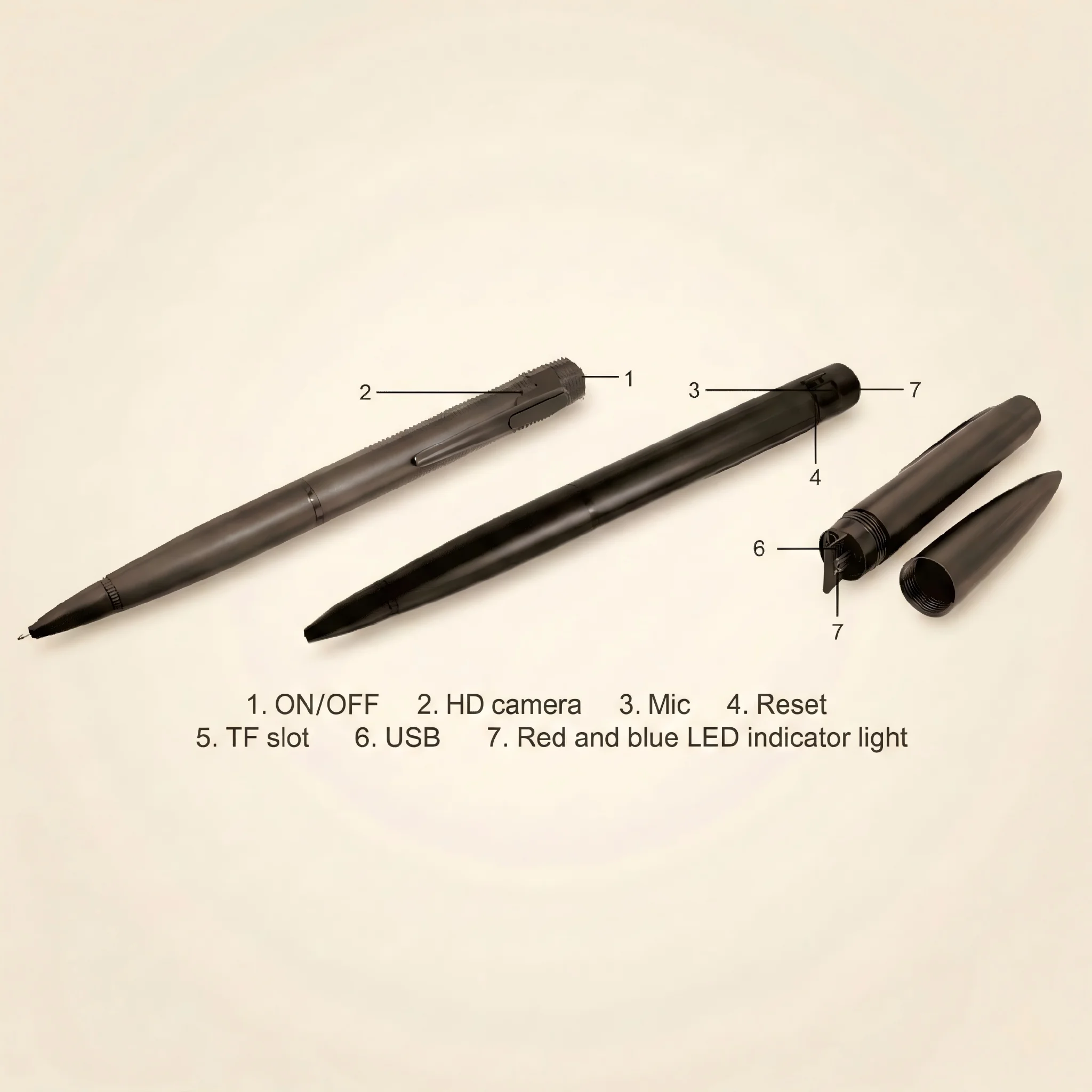
Quels sont les six principaux types de caméras espion ?
Le marché se divise en six catégories basées sur le facteur de forme et la méthode de déploiement. Chacune répond à des besoins différents.
caméras d'objets du quotidien se déguisent en objets ménagers ou de bureau courants. Réveils-radios, cadres photo électroniques, ampoules et objets décoratifs. Personne ne remet en question leur présence dans un salon ou un bureau. Ceux-ci fonctionnent le mieux pour les installations permanentes où vous avez besoin de couvrir une zone spécifique sur de longues périodes.
Caméras d'appareils électroniques sont des appareils fonctionnels qui ont des raisons légitimes d'être branchés et positionnés stratégiquement. Les chargeurs USB, les multiprises, les détecteurs de fumée, les réveils et les routeurs WiFi entrent dans cette catégorie. Caméra cachée prise EU est l'exemple le plus populaire — il se branche sur une prise murale et a l'air totalement anodin tout en enregistrant en continu depuis une position alimentée par le secteur.
Caméras cachées portables Servir les professionnels qui ont besoin d'enregistrement en perspective à la première personne en déplacement. Lunettes caméra (les Série G3000), caméras bouton portées sur le corps, caméras clé de voiture et caméras badge. Elles fonctionnent pour les journalistes, le personnel de sécurité, les cyclistes et les chercheurs opérant dans des conditions variables.
Caméras fixes pour bâtiment sont installés dans le cadre de l’infrastructure standard de sécurité ou de services publics d’un bâtiment. Détecteurs de fumée, alarmes de monoxyde de carbone, extincteurs automatiques (lens only), thermostats, prises électriques et interrupteurs. Ceux-ci nécessitent plus d’efforts d’installation mais sont pratiquement indétectables — un détecteur de fumée dans une chambre est tout à fait banal.
Caméras de gadgets domestiques sont des appareils domestiques courants avec des caméras intégrées. Haut-parleurs Bluetooth, aspirateurs robots, purificateurs d'air et appareils domestiques intelligents. Les modèles modernes utilisent souvent des signaux sans fil cryptés, ce qui les rend difficiles à détecter même avec des scanners RF.
Caméras cachées DIY et sur mesure sont imprévisibles par conception. Des objets du quotidien modifiés — livres évidés, tasses à café, lampes modifiées, smartphones réutilisés pour un enregistrement continu. Ceux-ci contournent les schémas de détection typiques mais nécessitent une ingénierie sur mesure.
Le Module de caméra espion cachée DIY sert les acheteurs B2B qui ont besoin d'options de déploiement flexibles dans divers environnements clients — des réserves de vente au détail aux installations logistiques.
| Taper | Idéal pour | Dissimulation | Source d'alimentation | Complexité |
|---|---|---|---|---|
| Objets du quotidien | Couverture fixe domicile/bureau | Excellent | Batterie ou secteur | Faible |
| Appareils électroniques | Bureaux, chambres, réception | Excellent | Secteur (toujours allumé) | Faible |
| Produits portables | Enregistrement personnel, journalisme | Porté (non caché) | Batterie | Faible |
| Équipements de bâtiment | Installations de haute sécurité | Excellent | Secteur | Haut |
| Gadgets ménagers | Smart home integration | Excellent | Secteur | Moyen |
| DIY personnalisé | Scénarios de déploiement uniques | Excellent | Variable | Haut |
Point clé à retenir : Les caméras d'appareils électroniques (horloge, chargeur USB) offrent la meilleure combinaison de dissimulation et de fiabilité pour une utilisation intérieure permanente.
Comment choisir le bon facteur de forme ?
Le bon facteur de forme dépend de trois variables : la durée de déploiement, l'accès à l'énergie et le niveau de dissimulation nécessaire.
Pour la sécurité domestique (Royaume-Uni et UE) : The Caméra horloge WiFi Z10 Il se pose sur un bureau, ressemble à un réveil ordinaire, fonctionne sur secteur pour un enregistrement illimité, et offre une surveillance en direct via application. Pour les chambres d'enfants, les bureaux à domicile et les salons, c’est le choix le plus pratique.
Pour la documentation de réunion : Le W9 caméra stylo est le choix professionnel standard. 60 à 90 minutes d'enregistrement couvrent la plupart des réunions d'affaires, et le format stylo est tout à fait discret dans un cadre professionnel.
Pour une surveillance prolongée en extérieur ou de nuit : caméra power bank H3 Avec une autonomie de 4 à 12 heures, il gère le placement toute la journée dans des sacs, des véhicules ou des pièces sans prises de courant. La capacité de vision nocturne jusqu'à 3-6 mètres couvre les scénarios de nuit.
Pour l'enregistrement extérieur personnel : Les lunettes-caméras servent les journalistes, les cyclistes et les professionnels de la sécurité qui ont besoin d'une perspective à la première personne dans des conditions météorologiques extérieures variables.
Quelles spécifications techniques comptent réellement ?
La plupart des acheteurs se concentrent sur la résolution alors qu'ils devraient se concentrer sur ce qui détermine les images utilisables.
Résolution: 1080P est le minimum pratique. Mais voici le hic — de nombreux produits commercialisés comme “1080P Full HD” capturent en résolution 1080×720. Aucune caméra espion grand public vérifiée ne livre du vrai 1920×1080 dans un format stylo ou petit. Pour des images de qualité de preuve, vérifiez la résolution réelle du capteur, pas l’allégation marketing.
Autonomie de la batterie: Varie de 60 minutes (caméras stylo) à illimité (appareils alimentés sur secteur). Caméra horloge Z10 fonctionne 24h/24 et 7j/7 sur secteur — pas d'anxiété de batterie. Les caméras stylo offrent 60 à 90 minutes en réalité, pas les 180 minutes souvent annoncées.
vision nocturne: La plupart des caméras espion de petit format annoncent “vision nocturne” mais utilisent un mode faible luminosité amélioré par logiciel plutôt que de véritables LED infrarouges. Seuls les appareils plus volumineux disposant d'un espace physique pour les réseaux de LED IR offrent une véritable vision nocturne. Le caméra power bank H3 et le stylet WiFi W10 inclut une capacité IR réelle.
Fonctionnalité WiFi/App:Le streaming en direct vers une application smartphone est disponible sur les modèles de caméras à prise W10, Z10 et S3. Le compromis est important : une latence de 1,2 à 4,7 secondes rend la surveillance en temps réel impraticable, les problèmes de compatibilité avec iOS 17+ et Android 14+ sont courants, et le support de l'application dépend de la maintenance du fabricant.
Stockage: 128GB contient environ 24-36 heures de vidéo 1080P avec compression H.264. L'enregistrement en boucle écrase les séquences les plus anciennes lorsque la carte est pleine — utile pour une surveillance continue mais signifie que toute séquence que vous souhaitez conserver doit être copiée depuis la carte avant qu'elle ne soit écrasée.
| Spécification | Valeur réaliste | Réclamation courante | Ce qu'il faut vérifier |
|---|---|---|---|
| Résolution | 720P-1080P (souvent upscalé) | 1080P Full HD | Résolution réelle du capteur |
| Pile (stylo) | 60-90 min | “180 min” | Avis utilisateurs, tests indépendants |
| Vision nocturne | Logiciel basse lumière uniquement | Vision nocturne IR | Véritable IR = LEDs rouges visibles |
| Latence WiFi | 1.2-4.7 secondes | “Surveillance en temps réel” | Compatibilité de l'application avec votre OS |
| Stockage (128GB) | 24-36 heures | 36+ heures | Codec et débit binaire réels |
Point clé à retenir : Chaque spécification est gonflée. Achetez en vous basant sur des spécifications indépendantes vérifiées, pas sur les affirmations du fabricant.
Comment les caméras espion gèrent-elles le stockage et la gestion des séquences ?
Comprendre le pipeline d'enregistrement évite les échecs courants.
Lorsque l'enregistrement en boucle est activé, la caméra enregistre en continu et écrase les séquences les plus anciennes lorsque la carte est pleine. Cela signifie que vous pouvez laisser une caméra fonctionner indéfiniment — mais toute séquence que vous souhaitez conserver doit être copiée de la carte avant que la boucle ne l'écrase. Cela prend de nombreux acheteurs novices au dépourvu.
L'enregistrement déclenché par le mouvement change considérablement ce calcul. Une caméra configurée pour n'enregistrer que lorsqu'un mouvement est détecté peut fonctionner pendant des semaines avec une seule charge et une seule carte. Mais la sensibilité de détection de mouvement varie considérablement selon les modèles : les forums rapportent que certaines caméras ignorent les sujets se déplaçant lentement tout en se déclenchant sur les ventilateurs de plafond. Testez la détection de mouvement de votre modèle spécifique dans l'environnement de déploiement réel avant de vous y fier.
Les modèles compatibles WiFi ajoutent une seconde voie de données : la diffusion en direct vers une application smartphone. Pour la conformité au RGPD de l’UE, les données personnelles (y compris les flux vidéo en direct) doivent être traitées de manière appropriée. Pour les déploiements sensibles, désactivez la connectivité cloud et fiez-vous uniquement au stockage local sur carte SD.
Pour les soumissions légales au Royaume-Uni et dans l'UE, conservez les fichiers originaux intacts après l'exportation. Utilisez le lecteur multimédia VLC pour la lecture (il gère les problèmes de codec qui perturbent Windows Media Player et QuickTime), et envisagez une conversion HandBrake avant le partage pour éliminer les problèmes de compatibilité chez le destinataire.
Comment les caméras espion sont-elles détectées — et comment éviter la détection ?
Les méthodes de détection ont évolué en parallèle avec les caméras elles-mêmes.
Inspection physique reste efficace : cherchez des objets inhabituels ou déplacés, vérifiez les détecteurs de fumée et les luminaires par rapport à une photo de référence, et examinez les objets qui semblent disproportionnés ou positionnés de manière inhabituelle.
Détecteurs RF (radiofréquence) capturer des signaux sans fil provenant de caméras qui transmettent des données. Mais les caméras modernes utilisant un stockage local sur carte SD (sans signal sans fil) ou des communications cryptées rendent les scanners RF standard totalement inefficaces. C’est pourquoi les caméras de dispositifs électroniques — qui enregistrent localement et n’émettent pas — sont parmi les plus difficiles à détecter.
Détection infrarouge Via la caméra du smartphone, cela fonctionne pour certains modèles : les LED infrarouges utilisées dans les caméras de vision nocturne émettent une lumière visible à travers l'appareil photo du téléphone mais pas à l'œil nu. Balayez la pièce lentement, en regardant à travers le viseur de l'appareil photo de votre téléphone à la recherche de sources de lumière inattendues.
Scan réseau détecte les caméras diffusant sur votre réseau WiFi. Recherchez les appareils inconnus dans la liste des appareils connectés de votre routeur. Les caméras utilisant le mode P2P peuvent apparaître sous des noms de fabricants génériques plutôt que sous des étiquettes évidentes.
Pour les acheteurs B2B conseillant des clients en matière de contre-surveillance : une approche multi-méthode est nécessaire. Aucun outil de détection unique ne permet de détecter tous les types de caméras, en particulier les caméras sans capacité sans fil qui enregistrent exclusivement sur un stockage local.
Quelles sont les limites juridiques ?
Les utilisations légales des caméras espion sont plus vastes que la plupart des acheteurs ne le réalisent — et les utilisations illégales sont tout aussi claires.
Usages légitimes: : Sécurité du domicile et de la famille (votre propre propriété), documentation de réunions professionnelles où vous êtes participant, sécurité personnelle et collecte de preuves, et installations de sécurité professionnelles pour les magasins de détail et les entrepôts avec notification appropriée aux employés.
Utilisations illicites: Enregistrement dans les salles de bain, les vestiaires ou tout espace où il existe une attente raisonnable de respect de la vie privée ; enregistrement dissimulé d'employés sans autorisation légale ; enregistrement de conversations auxquelles vous ne participez pas sans consentement ; utilisation d'enregistrements à des fins de harcèlement, de chantage ou de distribution publique.
Au Royaume-Uni, le Data Protection Act 2018 exige que les individus soient informés de l'enregistrement par CCTV dans la plupart des environnements commerciaux et publics. En Allemagne (§201 StGB), en France (lois sur la protection de la vie privée) et en Italie (D.Lgs. 196/2003), l'enregistrement clandestin sur le lieu de travail est soumis à des exigences légales spécifiques, y compris la consultation du comité d'entreprise dans certains cas.
Pour les acheteurs B2B de l'UE, fournir des indications juridiques claires avec vos produits renforce la confiance des clients et réduit les retours. Les marchés allemand et français réagissent particulièrement bien à la documentation de conformité — c'est souvent le facteur décisif pour les achats répétés.
Quelle est la meilleure approche pour les acheteurs B2B ?
Les acheteurs professionnels se procurent des caméras espion pour trois segments de clientèle distincts, chacun nécessitant des recommandations de produits différentes.
Acheteurs de sécurité domestique (Royaume-Uni, Allemagne, France) : Priorisez les appareils alimentés sur secteur avec fiabilité du secteur (caméras horloge, caméras chargeur USB), alertes de détection de mouvement et surveillance via application. L'anxiété de la batterie est la plainte numéro un des utilisateurs domestiques.
Professionnels du secteur: Caméras stylo pour la documentation de réunions, fiabilité plutôt que résolution, et fonctionnement simple sans complexité d'application. La série W9 est la recommandation standard pour ce segment.
Installateurs de sécurité: Modules DIY avec options de déploiement flexibles, considérations sur les indices de protection IP pour les environnements extérieurs, et tarification en gros pour les installations de projets. Kit de caméra espion cachée DIY répond au besoin de ce segment en matière de matériel adaptable.
Pour les trois segments : fournir des conseils juridiques clairs sur l'utilisation, vérifier les spécifications réelles avant de recommander, et adapter la source d'alimentation à la durée de déploiement requise.
Prêt à vous procurer des caméras espion pour votre commerce de détail ou de gros ? Contactez QZT Sécurité pour une tarification de volume, une personnalisation OEM/ODM, et des recommandations de produits adaptées à votre marché cible dans l'UE et le Royaume-Uni.
FAQ
Quelle est la différence entre une caméra espion et une caméra cachée ?
Les termes sont interchangeables dans la plupart des contextes. Techniquement, « caméra cachée » met l'accent sur la méthode d'installation (placement dissimulé) tandis que « caméra espion » met l'accent sur l'intention d'enregistrement discret et le facteur de forme déguisé. Les deux font référence à la même catégorie de produits.
Les caméras espion peuvent-elles enregistrer l'audio au Royaume-Uni et dans l'UE?
Oui, dans la plupart des circonstances. L'enregistrement lorsque vous êtes un participant est généralement autorisé au titre de l'intérêt légitime (article 6(1)(f) du RGPD) et des dispositions similaires relatives à la base légale au Royaume-Uni. L'enregistrement clandestin de non-participants dans des espaces privés sans divulgation est illégal dans tous les États membres de l'UE et au Royaume-Uni.
Quelle est la meilleure caméra espion pour la sécurité domestique ?
La caméra horloge Wi-Fi Z10 offre la meilleure combinaison d'alimentation secteur (enregistrement illimité), de surveillance en direct via l'application, d'alertes de mouvement et de camouflage intérieur complet. Elle est plus fiable que les alternatives à batterie pour une surveillance nocturne.
Combien de temps une caméra espion peut-elle enregistrer avant que le stockage soit plein ?
Une carte de 128 Go contient environ 24 à 36 heures de séquences en 1080P. Avec l'enregistrement en boucle activé, la caméra écrase les séquences les plus anciennes lorsqu'elle est pleine. Pour une surveillance prolongée, l'enregistrement activé par le mouvement prolonge considérablement la durée d'enregistrement effective.
Les caméras espion fonctionnent-elles la nuit ?
Les modèles dotés de véritables LED infrarouges (caméra power bank H3, stylo WiFi W10) enregistrent dans l'obscurité totale jusqu'à 3-6 mètres. La plupart des caméras de petit format commercialisées comme ayant une “vision nocturne” n'utilisent qu'un mode basse lumière amélioré par logiciel — cela produit des images granuleuses et à faible contraste dans des conditions de faible luminosité, plutôt que des images claires dans l'obscurité.

 English
  Italiano
  Deutsch
  Français
  Español
  Polski