
Caméras corporelles et caméras cachées portables : la niche de l'électronique grand public qui connaît la croissance la plus rapide en Europe
Something changed in the market for personal recording devices. Two years ago, wearable cameras were primarily the domain of police officers, security professionals, and a handful of extreme sports enthusiasts. Today, they are appearing in boardroom meeting notes, academic research, cycling clubs across the Alps, and cycling couriers on the streets of Amsterdam.
The European market for body-worn and wearable cameras grew at approximately 16% CAGR through 2024, reaching a market size that industry analysts project will exceed €1.6 billion by 2033. Germany remains the largest single market. The UK is the fastest growing. France and the Netherlands are accelerating.
This is not just law enforcement procurement. Consumer adoption is driving the volume—and the demand is coming from some unexpected places.
Why Wearable Cameras Are Going Mainstream in Europe
The price curve did most of the work. Five years ago, a body-worn camera with 1080p recording, WiFi connectivity, and a 6-hour battery cost over €300. Today, comparable devices retail at €80–150. The feature floor has risen at the same time: loop recording, audio capture, night vision, and companion smartphone apps are now standard even at entry-level price points.
Several distinct use case clusters have emerged:
The professional documentation segment. Lawyers, journalists, researchers, and auditors use wearable cameras to create first-person records of meetings, site visits, and interviews. The QZT A57 WiFi pen camera has become a standard tool in this category—its pen form factor is socially acceptable in professional settings, and the audio-video quality is sufficient for evidence documentation.
The active lifestyle segment. Cyclists, hikers, and motorsports enthusiasts use glasses cameras and compact body cameras for safety documentation. The rationale mirrors dashcam adoption: if something goes wrong, you have a record. Cycling incidents involving motor vehicles are particularly difficult to resolve without objective evidence.
The personal safety segment. Individuals who walk or commute in areas with elevated safety concerns—couriers, late-shift workers, journalists working in sensitive environments—use body cameras as a deterrent and evidence-capture tool. The psychological effect is real: most people alter their behaviour when they know they are being recorded.
The academic and training segment. Universities across Germany, the Netherlands, and the UK have begun using wearable cameras for research documentation, teaching observation, and professional training. The ability to capture first-person footage of complex procedures creates training materials that written notes cannot replicate.
The Regulatory Environment: What European Buyers Need to Know
GDPR applies to wearable cameras, but the application is context-dependent. Understanding where the legal lines sit matters more for this category than almost any other, because wearable cameras frequently capture identifiable strangers in public spaces.
In public spaces, the legal position is generally favourable for personal use. Recording in public where others have no reasonable expectation of privacy is broadly legal across EU member states and the UK. A cyclist wearing a camera on a public road is within their rights in most jurisdictions. The footage is personal data, but processing it for personal safety purposes (legitimate interest) is a defensible basis.
The GDPR nuance: third-party sharing. Where GDPR becomes relevant is if you share that footage—with a lawyer, on social media, with law enforcement, or with your employer. Before sharing footage that contains identifiable third parties, the default position should be to blur faces or obtain consent. For law enforcement purposes, different rules apply depending on your jurisdiction.
The key legal risks specific to wearable cameras:
– Audio recording without consent is more restricted than video in several EU countries. Germany, under §201 StGB, criminalises secret audio recording of private conversations even in public settings. Video recording without audio is generally fine; adding audio recording in Germany requires more caution.
– Some EU countries impose restrictions on recording police or security personnel. France and Belgium have specific provisions in this area.
– Using a wearable camera specifically to harass or intimidate someone is illegal everywhere—this is not a surveillance tool question, it is a general conduct question.
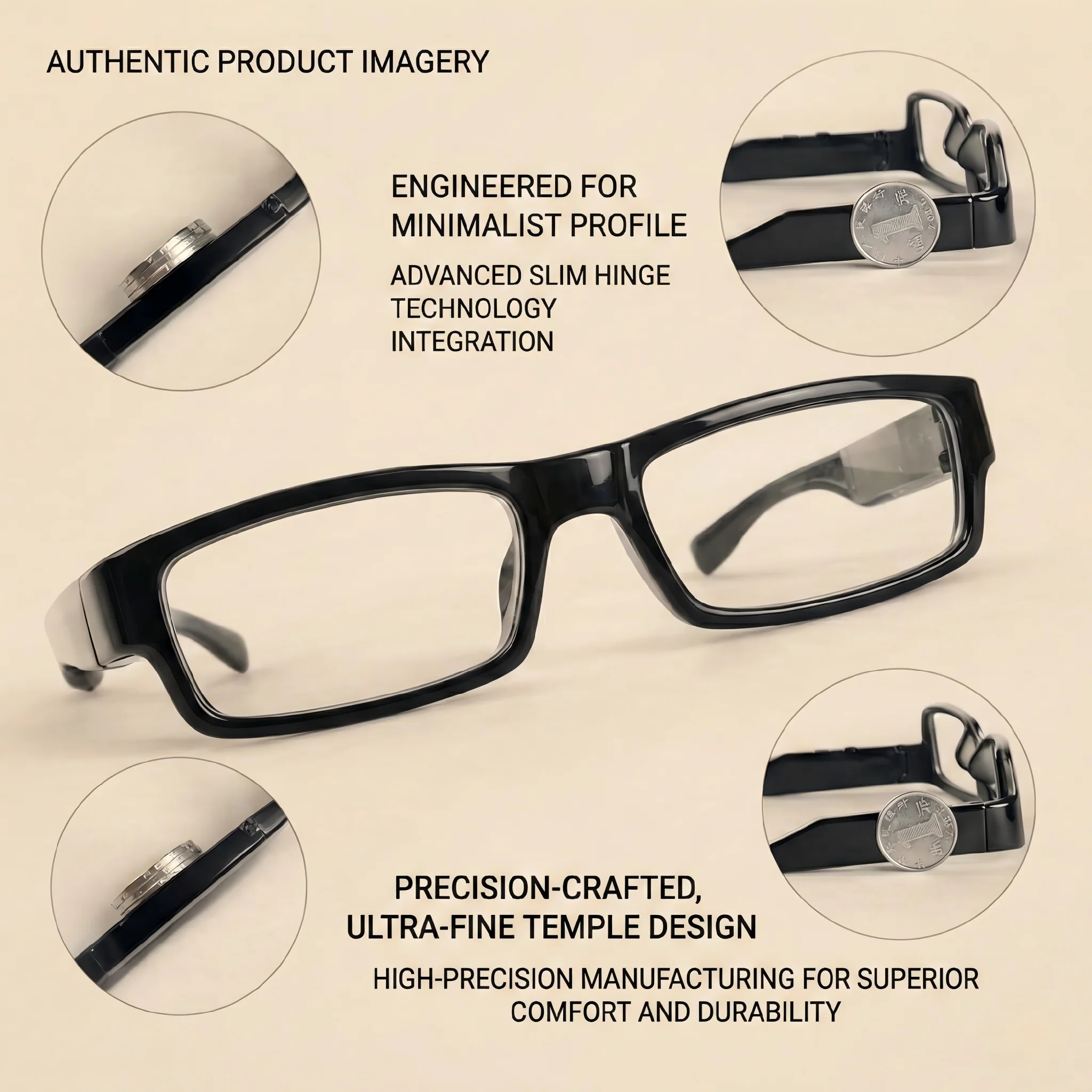
Glasses Cameras: The Product That Made Wearable Recording Invisible
No product category better illustrates the democratisation of body cameras than glasses cameras. What began as a niche product for extreme sports has evolved into a versatile professional tool with applications that extend well beyond GoPro territory.
Modern glasses cameras in the European market offer:
Full HD recording at 30fps through a wide-angle lens positioned in the frame. The field of view typically ranges from 90 to 120 degrees—wide enough to capture the peripheral environment without the fisheye distortion of early models.
Integrated audio recording in many models, capturing ambient sound and conversation. The legal constraints noted above apply, but the quality of built-in microphones has improved substantially: directional MEMS microphones reduce wind noise, and DSP-based noise reduction is standard in mid-range models.
Battery life of 60–90 minutes in continuous recording mode, with standby extending to several hours. For most professional use cases—documenting a meeting, capturing a site visit, recording a cycling route—a full charge covers the session.
Connectivité WiFi in premium models, enabling live streaming to a smartphone or direct upload to cloud storage. This is particularly valuable for journalists who need to transmit footage in real time from the field.
Frame styles that pass as normal eyewear. This is the critical design variable. Glasses cameras intended for professional use typically come in neutral, understated frames. Sport-specific models look like performance eyewear. Both are deliberately designed to be socially acceptable—using body cameras to covertly film in situations where recording would normally be refused is illegal in most EU jurisdictions regardless of the device used.
The Recording Pen: When Documentation Cannot Wait for a Meeting
The executive recording pen occupies a specific niche: professionals who need evidence-quality documentation without a visible camera. Lawyers preparing deposition notes, HR investigators conducting interviews, researchers documenting field observations, and businesspeople who want an accurate record of important meetings all find value in a device that disappears into the work environment.
Le QZT professional recording pen captures 192kbps audio alongside 1080p video—specs that exceed what most built-in phone microphones provide. The Type-C charging port reflects the current standard; micro-USB models are increasingly outdated.
What distinguishes quality professional recording pens from cheap consumer alternatives:
Microphone quality. The difference between 64kbps and 192kbps audio is significant enough to affect the usability of a recording in noisy environments. 192kbps captures enough detail to distinguish individual speakers in a multi-person meeting.
Timestamp accuracy. Professional documentation requires footage that can be tied to a specific time. Pens with accurate embedded timestamps (set at the start of each recording session) are essential for evidence use.
File format compatibility. MP4 format is the standard—compatible with every device and editing platform without conversion. AVT and proprietary formats create unnecessary friction.
Storage capacity. At 1080p / 4Mbps, a 32GB card holds approximately 18 hours of recording. This is sufficient for multiple full-day sessions, but 64GB (36 hours) or 128GB (72 hours) provides meaningful headroom for extended deployments.
The Market Data: What Growth Looks Like Across Europe
The body-worn camera market’s European trajectory reveals several patterns worth noting for anyone selling or distributing in this space:
Germany leads in absolute volume. The combination of high privacy consciousness (driving both surveillance and counter-surveillance demand), strong industrial base (professional documentation use), and an established security industry creates the largest single market. German buyers are also among the most demanding on documentation and legal compliance.
The UK is the fastest-growing market. Post-Brexit regulatory divergence has created a dynamic where UK distributors are actively seeking new product sources and UK consumers are increasingly adopting body cameras for personal safety. The Home Office’s 2026 allocation of £15 million for police body cameras has reinforced the category’s legitimacy in the public consciousness.
France shows strong latent demand. Privacy culture and counter-surveillance awareness are high in France, which creates demand from both sides of the surveillance spectrum: buyers seeking personal documentation tools and buyers seeking counter-surveillance equipment.
The Netherlands and Scandinavia represent high-average-order-value markets where buyers are willing to pay premium prices for quality, especially for professional-grade products with solid warranty and support.
Choosing a Wearable Camera: A Practical Decision Framework
Not all wearable cameras are interchangeable. Matching the device to the use case is the single most important purchasing decision:
| Cas d'utilisation | Recommended Device Type | Key Specifications |
|---|---|---|
| Cycling / outdoor sports | caméra lunettes | Wide angle 120°, water resistant, 90min+ battery |
| Professional meetings | Recording pen | 192kbps audio, 1080p, timestamp, MP4 |
| Personal safety / patrol | Body camera (wearable) | Clip-on, loop recording, night vision |
| Vehicle documentation | Caméra avec télécommande | Compact, one-button operation, night vision |
| Home / property monitoring | Clock camera or power bank camera | Always-on capability, remote alerts |
For most professionals making their first purchase, a recording pen is the lowest-risk entry point. The form factor is socially appropriate in almost any professional setting, the documentation quality is sufficient for evidence purposes, and the operational learning curve is minimal.
The Cybersecurity Angle: WiFi Cameras and Network Risks
WiFi-enabled body cameras introduce a dimension that body-worn devices did not have a decade ago: network connectivity. A camera that streams footage to a cloud server or sends push notifications over WiFi is an IoT device, and IoT devices have attack surfaces.
For European buyers, several cybersecurity considerations apply:
Default credentials are a known risk. Most cameras ship with a default admin password that a significant percentage of users never change. Before putting any WiFi-enabled camera on your network, change the default credentials and, where possible, set a strong custom password.
Firmware updates matter. Manufacturers that provide regular firmware updates are addressing known vulnerabilities. Cameras that have not received an update in over a year may have unpatched vulnerabilities.
Network isolation is worth considering. For security-sensitive deployments, placing the camera on a separate IoT VLAN—isolated from your primary network devices—limits the potential impact of a compromised device.
Cloud vs. local storage has security implications. Footage stored locally on an SD card is not accessible over the internet. Footage uploaded to a cloud service is only as secure as the provider’s infrastructure. Tuya Smart and similar platforms have undergone third-party security audits, but using cloud storage for highly sensitive footage introduces a third-party risk that some buyers prefer to avoid.
FAQ: Wearable Cameras in Europe
Can I wear a body camera while cycling in Germany?
Yes. Cycling with a forward-facing camera on a public road is legal in Germany. The resulting footage is personal data and subject to GDPR, but you are within your rights to record your own journey. Do not share footage publicly without blurring identifiable strangers, and do not audio record private conversations without consent.
Can a journalist use a hidden camera in the UK?
The press freedom framework in the UK permits journalistic use of covert recording in specific circumstances, particularly where it serves the public interest. The phone hacking scandal raised the threshold for what is considered acceptable practice. Professional journalists should consult their editor and legal counsel before using covert recording equipment.
Is it legal to wear a body camera in an EU hospital or government building?
Most public buildings prohibit recording without prior authorisation. Hospital settings involve special category health data under GDPR, making them particularly sensitive. In general: ask before recording in hospitals, government offices, or court buildings.
What’s the difference between a glasses camera and a body camera?
A glasses camera is worn on the face and captures a first-person perspective. A body camera clips to clothing or is worn on a lanyard or harness and captures a chest-level perspective. Both are body-worn cameras; the distinction is mounting position and field of view.
Do wearable cameras record audio?
La plupart le font, mais l'enregistrement audio est soumis à des contrôles légaux plus strictes que la vidéo dans plusieurs pays de l'UE—notamment en Allemagne et en Suisse. Vérifiez les lois spécifiques de votre pays avant d'activer l'enregistrement audio. Si vous avez un doute, utilisez le mode vidéo uniquement.
Quelle garantie dois-je attendre d'une caméra wearable de qualité consommateur ?
Les distributeurs les plus réputés offrent une garantie de 12 à 24 mois. Les vendeurs internationaux (directement de Chine) peuvent offrir une garantie, mais son application pratique à travers les frontières de l'UE est difficile. Pour les acheteurs B2C, il est généralement préférable d'acheter auprès d'un distributeur basé dans l'UE avec un support de garantie local.
Points clés
| Sujet | Point Clé |
|---|---|
| Croissance du marché | 16% CAGR ; UK croissance la plus rapide ; Allemagne marché le plus grand |
| Prix minimum | Caméras wearable 1080p maintenant €80–150 ; stylos professionnels €60–120 |
| RGPD dans les espaces publics | Enregistrement personnel dans les publics généralement légal ; la diffusion nécessite de la prudence |
| Enregistrement audio | Plus restrictif que la vidéo ; vérifier la loi nationale, surtout en Allemagne |
| Caméras WiFi | Modifier les identifiants par défaut ; vérifier l'historique des mises à jour du firmware |
| Risque légal en Allemagne | Enregistrement audio sans consentement criminalisé sous §201 StGB |
| Marché britannique | Croissance la plus rapide ; allocation de £15m du Home Office pour les caméras corporelles a boosté la catégorie |
| Meilleur appareil de démarrage | Stylo d'enregistrement : socialement acceptable, qualité d'évidence, faible complexité opérationnelle |
La catégorie des caméras wearable passe d'un outil professionnel à un produit de consommation plus rapidement que prévu par la plupart des observateurs. La technologie a maturé, le prix a baissé à des niveaux accessibles, et les cas d'utilisation ont multiplié. Que vous êtes un cycliste qui veut un enregistrement de votre trajet, un professionnel qui nécessite une documentation sans appareil visible, ou un propriétaire de petite entreprise qui veut une autre couche de protection d'évidence, la génération actuelle des caméras wearable offre quelque chose pratique.
Naviguer parmi les produits de caméras wearable et corporelles ou demander un catalogue wholesale pour la distribution européenne.

 English
  Italiano
  Deutsch
  Français
  Español
  Polski