
GPS Tracker Supplier Europe: How Do You Find One You Can Actually Trust?
A reliable GPS tracker supplier in Europe offers CE/RED certified 4G devices, holds local EU stock for fast shipping, provides platform access or white-label options, and — most critically — maintains the firmware and SIM infrastructure so your customers’ trackers keep reporting months after installation. The best EU-based suppliers combine Shenzhen manufacturing access with Italian, German, or Dutch warehouse and support teams, giving resellers the cost advantage of Chinese production with the responsiveness of local service.
Finding a GPS tracker supplier you can trust in Europe is harder than it looks. Search “GPS tracker supplier” and you find Alibaba traders, white-label platform companies with no hardware expertise, and Chinese factories that reply to your first enquiry in 4 hours but go silent when a batch fails. I have been on all sides of this equation — sourcing from Shenzhen factories, assembling in our Italy facility, and supporting EU distributors through firmware crises that their previous supplier ignored. Here is how to evaluate suppliers properly.

What should I check before choosing a GPS tracker supplier in Europe?
Most buyers evaluate suppliers on price and delivery time. Those are the least important factors. The two things that determine whether your GPS tracker business survives are firmware support and platform stability.
A GPS tracker supplier in Europe worth working with must demonstrate five capabilities: (1) they control or have direct access to the firmware pipeline — not just reselling someone else’s hardware, (2) they offer CE/RED certified products with test reports you can verify, (3) they hold physical stock in an EU warehouse, (4) they provide a tracking platform they either own or have a contractual SLA with, and (5) they have a technical team that can diagnose field issues — not just a sales team.

My 5-point supplier evaluation framework
| Prüfen Sie | Warum es wichtig ist | Warnsignal |
|---|---|---|
| Firmware control | They can push OTA updates when bugs appear | “We use the factory’s standard firmware” |
| CE/RED test reports | Legal EU import; customs clearance | PDF with no lab name or different model number |
| EU warehouse | 5-10 day delivery vs 35-45 day sea freight | “We ship from Shenzhen, DDP included” |
| Platform SLA | Your customers depend on uptime | Free platform with no uptime guarantee |
| Technische Unterstützung | Field diagnosis for connectivity, GPS, battery | Sales-only team, no engineers |
I lost a client in 2023 because their previous GPS tracker supplier — a Shenzhen trader — sold them 800 units running firmware version 2.1. When version 2.1 had a GPS cold-start bug that caused 5-minute location delays after power-on, the trader could not fix it because they did not write the firmware. They simply said “buy the new model.” My client had 800 installed units and no upgrade path. We replaced the entire fleet with our units and pushed a firmware fix for the cold-start issue within one week.
Kernaussage: Firmware control is the number one criterion for choosing a GPS tracker supplier in Europe. Everything else is secondary.
Why does a local EU warehouse matter for GPS tracker distribution?
Shipping GPS trackers from China to European customers creates three problems that a local EU warehouse solves completely.
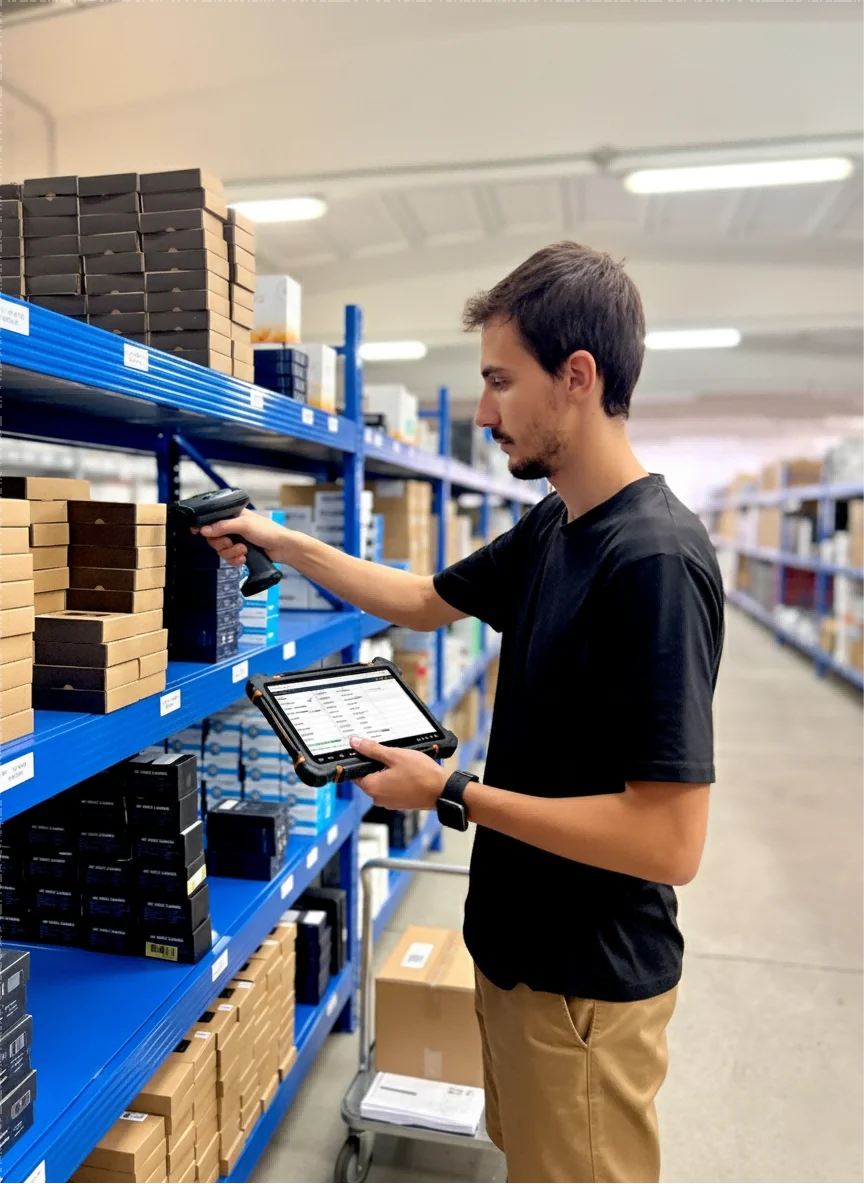
First, lead time: sea freight from Shenzhen takes 30-45 days. Your customer needs 50 trackers by next Monday for a fleet rollout. With EU stock, we ship from our Italy warehouse and deliver anywhere in Western Europe in 3-5 business days. Second, returns: when a customer returns a faulty unit, it goes to our Italy facility, not back to China. We diagnose, reflash, and reship in 3-5 days instead of 6-8 weeks. Third, customs: CE-cleared stock in an EU warehouse faces no import delays, no random customs inspections, no VAT complications for intra-EU B2B transactions.
Cost comparison: China-direct vs EU warehouse
| Faktor | Ship from China | Ship from EU warehouse |
|---|---|---|
| Delivery to customer | 30-45 days (sea) / 7-10 days (air) | 3-5 business days |
| Unit cost | Lower (5-15%) | Slightly higher |
| Mindestbestellmenge | Usually 200-500 | 50 Einheiten |
| Returns processing | 6-8 weeks round trip | 3-5 business days |
| Zollrisiko | Every shipment | None (intra-EU) |
| VAT handling | Complex import VAT | Simple intra-EU invoice |
| Emergency restock | Impossible under 2 weeks | Same-week possible |
For GPS tracker supplier relationships specifically, the EU warehouse advantage is even more pronounced than for cameras or recorders. GPS trackers are installed in vehicles and assets — when they fail, the customer needs a replacement immediately, not in 6 weeks. A fleet manager with 10 offline trackers will switch suppliers before your Chinese replacement shipment clears customs.
Kernaussage: A GPS tracker supplier in Europe must hold EU stock. The delivery speed and return handling advantages are not luxuries — they are requirements for fleet customers.
What 4G bands and certifications does a GPS tracker need for the EU market?
This is where most non-specialist GPS tracker suppliers fail. They sell “4G” trackers without verifying that the cellular module supports the specific LTE bands used by European carriers.
A GPS tracker sold in Europe must support at minimum LTE Band 3 (1800MHz), Band 7 (2600MHz), Band 8 (900MHz), and Band 20 (800MHz). Band 20 is critical — it provides rural and indoor coverage across much of Northern and Eastern Europe. A tracker that misses Band 20 will lose connectivity in rural areas, which is exactly where fleet and vehicle security customers need it most.
Band coverage by European carrier
| LTE Band | Frequenz | Key carriers | Coverage type |
|---|---|---|---|
| Band 3 | 1800MHz | Vodafone, Orange, TIM | Urban primary |
| Band 7 | 2600MHz | T-Mobile, Swisscom | Urban capacity |
| Band 8 | 900MHz | O2, Three, KPN | Rural + indoor |
| Band 20 | 800MHz | All major EU carriers | Rural primary |
| Band 28 | 700MHz | Some carriers (expanding) | Rural extension |
CE/RED certification requirements
For legal EU import and sale, a GPS tracker supplier must provide:
– [ ] CE Declaration referencing RED 2014/53/EU — mandatory for cellular devices
– [ ] Test reports covering ALL supported LTE bands (not just B3 and B7)
– [ ] IMEI TAC registration with GSMA
– [ ] Battery UN38.3 transport certification
– [ ] RoHS + WEEE compliance
– [ ] EU importer details on packaging
I had a shipment held at Rotterdam because the CE test report covered Bands 3, 7, and 20, but the device specification sheet also listed Band 28 — which was not in the test scope. The customs authority treated this as incomplete certification. The supplementary Band 28 test cost €2,500 and delayed delivery by 4 weeks. Now I verify band-by-band test coverage before every shipment.
Kernaussage: Verify that CE/RED test reports cover every LTE band listed in the device specification. One missing band can trigger a customs hold.
What tracking platform options should a GPS tracker supplier offer?
The platform is where your customer relationship lives. Choose wrong and you are locked in — or locked out.
A GPS tracker supplier in Europe should offer at least two platform options: a managed platform (hosted by the supplier, branded for you or your customer) and an open-protocol option (the tracker speaks GT06, H02, JT808 or similar, and can connect to any compatible server like Traccar or Wialon). Having both protects you from platform dependency.
Platform comparison for EU resellers
| Platform option | Monthly cost | Your control | Migration risk | Am besten geeignet für |
|---|---|---|---|---|
| Supplier-managed (their brand) | Free-€1/device | Keiner | High — locked in | Testing, small accounts |
| White-label (your brand) | €1-3/device | Hoch | Mittel | Growing resellers |
| Self-hosted Traccar | Server cost (~€20/month) | Full | Keiner | Technical resellers |
| Wialon (enterprise) | €2-5/device | Hoch | Niedrig | Fleet management companies |
I have seen three GPS tracker suppliers shut down their platforms in the last two years. One gave 30 days notice. One gave 7 days. One just disappeared. In every case, the resellers using proprietary platforms lost their customer data and had to re-install trackers. Resellers using open-protocol trackers simply pointed the devices at a new server and kept working.
Kernaussage: Never depend solely on a GPS tracker supplier’s proprietary platform. Ensure the devices support open protocols so you can migrate if needed.
What SIM card and connectivity model works best for EU fleet tracking?
SIM strategy is the hidden revenue centre of the GPS tracker business. Most new resellers do not realise they can earn recurring monthly income from SIM management.
Three SIM models exist for EU GPS trackers: (1) pre-installed multi-network IoT SIM (roams across all EU carriers — simplest for customers, best for resellers), (2) customer-sourced local SIM (cheaper per month but creates setup friction), and (3) eSIM (embedded, remotely switchable — highest hardware cost but future-proof for cross-border fleets).

SIM economics for resellers
| SIM model | Setup friction | Monthly cost to you | Monthly charge to customer | Your margin |
|---|---|---|---|---|
| Pre-installed IoT SIM | Zero — plug and play | €1.00-1.50/device | €3-5/device | €1.50-3.50/device/month |
| Customer-sourced SIM | High — APN config needed | €0 | €0 | €0 (but support costs rise) |
| eSIM | Low — remote activation | €1.50-2.00/device | €4-6/device | €2-4/device/month |
The math is compelling: 200 trackers with pre-installed IoT SIMs at €3/month margin = €600/month recurring revenue. Over 2 years, that is €14,400 in SIM margin alone — often exceeding the total hardware margin. This is why every smart GPS tracker supplier in Europe offers bundled SIM solutions.
Kernaussage: Pre-installed IoT SIMs are your biggest recurring revenue opportunity. A 200-device fleet generates €600+/month in SIM margin alone.
What after-sales support should a GPS tracker supplier provide?
GPS tracker after-sales is more complex than any other product category because problems can originate from hardware, firmware, cellular network, SIM, platform, or installation — and the customer always blames you first.
A capable GPS tracker supplier in Europe must offer: Level 1 support (basic troubleshooting scripts for your team), Level 2 support (remote diagnostics — can they ping the device, check SIM status, verify GPS fix?), and Level 3 support (firmware investigation and patch capability). If your supplier cannot provide Level 2 and 3, you are the support team — and you probably do not have the tools for remote diagnosis.

The most common GPS tracker field issues (and who should fix them)
| Issue | Frequenz | Root cause | Who fixes it |
|---|---|---|---|
| “Tracker is offline” | Very common | SIM data exhausted, APN wrong, no coverage | L1: Reseller (check SIM) |
| “Location is wrong” | Common | Urban canyon, indoor parking, cold start | L2: Supplier (remote diag) |
| “Battery dies too fast” | Common | Short reporting interval, weak signal | L1: Reseller (adjust settings) |
| “Tracker stops reporting after X days” | Occasional | Firmware bug (timer, memory leak) | L3: Supplier (firmware patch) |
| “Platform shows device but no data” | Occasional | Protocol mismatch, server config | L2: Supplier (server-side fix) |
| “Tracker works in Germany but not Poland” | Rare | Missing LTE band, SIM roaming block | L3: Supplier (hardware/SIM investigation) |
At our Italy facility, we resolve 85% of GPS tracker support tickets at Level 1 (SIM and settings). Another 10% require Level 2 remote diagnostics. Only 5% escalate to Level 3 firmware investigation. But that 5% is where supplier quality shows — a supplier who cannot fix firmware bugs loses your fleet customers permanently.
Kernaussage: Choose a GPS tracker supplier in Europe with L1-L3 support capability. The 5% of issues that need firmware fixes are the ones that make or break your fleet customer relationships.
How do I evaluate a GPS tracker supplier before committing?
A structured evaluation prevents the most common mistake: choosing on price alone and discovering quality problems after 500 units are installed in customer vehicles.
Here is the evaluation process I recommend. It takes 45-60 days but protects you from the catastrophic failures I have seen destroy GPS tracker reseller businesses.
My recommended supplier evaluation process
1. Request 5 sample units — Install in 5 different vehicles for 14 days. Check: GPS accuracy, cellular reporting reliability, battery life, and platform stability.
2. Verify CE/RED documentation — Use the compliance checklist above. Send the test reports to an independent compliance consultant if the values exceed €10K.
3. Test platform uptime — Monitor for 14 days. Any downtime over 2 hours is a red flag. Check mobile app responsiveness on iOS and Android.
4. Test support responsiveness — Submit a technical ticket on a Friday afternoon. If you do not hear back by Monday morning, this supplier will fail you during a customer emergency.
5. Order a trial batch of 50 units — Install with 3-5 pilot customers. Monitor returns and support tickets for 30 days.
6. Evaluate total cost — Hardware + SIM + platform + support. The cheapest hardware often has the most expensive total cost when returns and support are included.
7. Negotiate a 12-month supply agreement — Lock in pricing, SIM rates, platform access, and firmware update commitments.
Kernaussage: A proper GPS tracker supplier evaluation takes 45-60 days. Rushing this process is how resellers end up with 500 installed units from a supplier who disappears.
Häufig gestellte Fragen
What is the minimum order quantity from a GPS tracker supplier in Europe?
Most established GPS tracker suppliers in Europe offer MOQ 50 units from EU warehouse stock with 5-10 day delivery. Custom branding starts at 200 units. Custom firmware or housing modifications require 500+ units. Some suppliers offer initial sample packs of 5-10 units for evaluation before committing to bulk orders.
How do I verify if a GPS tracker supplier’s CE certification is genuine?
Check three things: the CE Declaration of Conformity must reference RED 2014/53/EU by directive number, the test report model number must match the product label exactly, and the testing laboratory must hold ISO 17025 accreditation verifiable on the ILAC database. If any of these checks fail, the certification may not be valid for EU customs clearance.
What recurring costs should I expect from a GPS tracker supplier in Europe?
Beyond hardware cost, expect: SIM data charges of €1-3 per device per month (IoT SIM), platform hosting of €0-3 per device per month (depending on white-label vs basic), and occasional firmware update support. Total recurring cost per device is typically €2-5 per month, which you recover by charging customers €5-10 per device per month.
Can I switch GPS tracker suppliers without replacing installed hardware?
If your current GPS tracker supplier uses open protocols (GT06, H02, JT808), you can point the devices at a new platform server without touching the hardware. If they use proprietary protocols locked to their platform, switching requires physically replacing every installed unit. This is why open-protocol support is a critical requirement when choosing your initial GPS tracker supplier in Europe.
What is the typical warranty period from a GPS tracker supplier?
Standard warranty from a GPS tracker supplier in Europe is 12-24 months covering manufacturing defects. Battery degradation beyond 30% capacity within the warranty period is typically covered. Water damage, physical damage, and SIM-related issues are usually excluded. Some suppliers offer extended 36-month warranties for fleet customers committing to 200+ unit orders.
Schlussfolgerung
Choosing a GPS tracker supplier in Europe comes down to five non-negotiable checks: firmware control, CE/RED certification covering all EU LTE bands, local EU warehouse stock, platform reliability with open-protocol fallback, and L1-L3 technical support capability. The cheapest per-unit price almost never delivers the lowest total cost when you factor in returns, support burden, and customer churn from unreliable devices. Start with 5 sample units, evaluate for 14 days in real vehicles, then scale to 50 with pilot customers before committing to volume. Still have questions? I am always happy to walk you through the specs — reach out to our team and we will get you sorted.

 English
  Italiano
  Deutsch
  Français
  Español
  Polski