
Comment choisir entre la caméra espion H3 et H20 avec batterie portable
Le choix entre la batterie externe avec caméra H3 et H20 est l'une des questions les plus fréquentes que nous posent les distributeurs et revendeurs. Les deux appareils se ressemblent presque parfaitement de l'extérieur — charge en pass-through, sortie USB-A standard, boîtier noir élégant — mais à l'intérieur, ils ciblent des segments de marché totalement différents. Stockez le mauvais modèle pour vos clients, et vous passerez les six mois suivants à gérer des retours au lieu de développer votre entreprise.
Voici la version courte : le H3 est votre cheval de bataille d'entrée de gamme, tandis que le H20 est la variante premium alimentée par TUYA avec une capacité de batterie double et des capacités de surveillance à distance. Aucun n'est universellement meilleur. La bonne réponse dépend entièrement de vos clients finaux.
Dans ce guide, nous décomposons chaque différence significative entre les deux modèles — spécifications des capteurs, expérience de l'application, autonomie de la batterie, considérations juridiques et scénarios réels de revendeur — afin que vous puissiez stocker en toute confiance et positionner le bon produit auprès du bon acheteur.
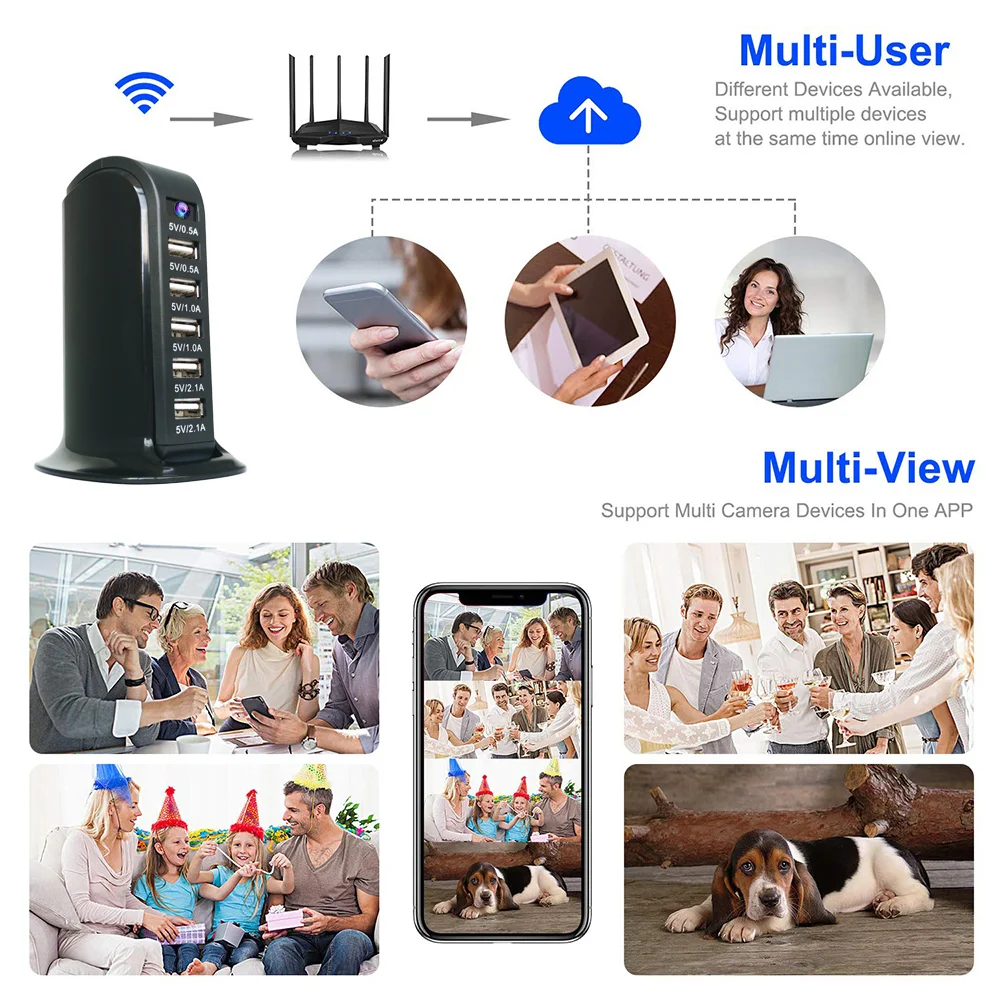
1. Qu'y a-t-il exactement à l'intérieur de la caméra-batterie H3 ?
Le H3 est construit autour d'une cellule lithium-polymère de 5000 mAh, qui offre environ 6 à 8 heures d'enregistrement continu sur une charge complète. En mode veille avec détection de mouvement active, il peut tenir plusieurs jours avant de nécessiter une recharge. Cela le rend pratique pour des scénarios de déploiement courts : vérifier le travail d'un entrepreneur lors d'une rénovation domiciliaire, surveiller un petit bureau en dehors des heures ouvrables, ou garder un œil sur une location Airbnb entre deux voyageurs.
La caméra enregistre en 1080p via un capteur CMOS — ni interpolé, ni suréchantillonné. C'est une distinction importante que nous aborderons plus tard lorsque nous discuterons des plaintes de fausse résolution de la part des clients finaux.
Ce que le H3 n'a pas, c'est la connectivité WiFi. Les séquences sont stockées sur une carte microSD (maximum 128 Go, environ 18 à 24 heures de vidéo 1080p selon les réglages de compression), et vous les récupérez en branchant la carte sur un ordinateur ou en connectant l'appareil via USB à un portable. Pour les clients qui souhaitent une visualisation à distance en direct depuis leur téléphone, le H3 n'est pas la recommandation appropriée.
2. Qu'y a-t-il exactement à l'intérieur de la caméra H20 Power Bank ?
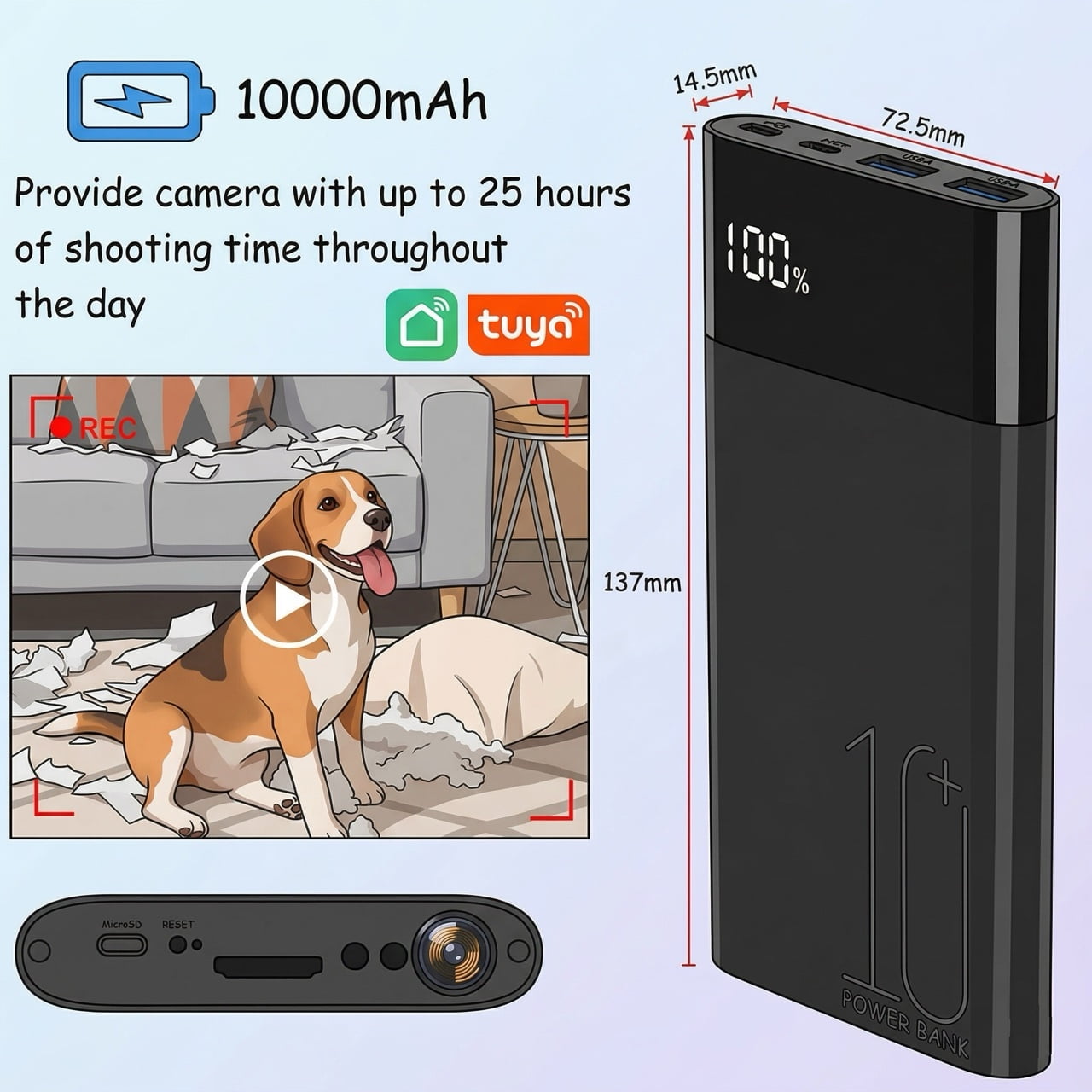
Le H20 améliore les choses de trois manières significatives. Premièrement, la capacité de la batterie est doublée à 10 000 mAh, prolongeant l'enregistrement continu à environ 12 à 15 heures, et le temps de veille à bien plus d'une semaine avec des événements déclenchés par le mouvement. Deuxièmement, il prend en charge l'intégration de la maison intelligente TUYA, ce qui signifie que les utilisateurs finaux de vos clients peuvent connecter l'appareil à l'application TUYA Smart Life ou Smart Plus, voir les images en direct à distance, recevoir des notifications push lorsqu'un mouvement est détecté et ajuster les paramètres d'enregistrement sans toucher physiquement l'appareil.
Troisièmement — et cela compte pour les marchés européens — le H20 est disponible en variantes compatibles TUYA qui s'intègrent aux écosystèmes domotiques européens les plus répandus. Si votre base de revendeurs se trouve en Allemagne, en France ou au Royaume-Uni et que leurs clients finaux utilisent les routines Alexa ou Google Home, la version TUYA ouvre des portes que le H3 ne peut tout simplement pas.
Le compromis, c'est le prix. Le H20 a un coût unitaire 20 à 35 % plus élevé selon le volume de la commande, ce qui modifie votre calcul de marge.
3. H3 vs H20 : Comparaison directe des spécifications
| Spécification | H3 Power Bank Appareil Photo | Caméra power bank H20 |
|---|---|---|
| Capacité de la batterie | covert-camera-power-bank-hidden-lens-protective-cover-case.webp | 10000mAh |
| enregistrement continu | 6–8 heures | 12–15 heures |
| Veille (détection de mouvement) | 3–5 jours | 7–10 jours |
| WiFi / Visualisation à distance | Non | Oui (TUYA app) |
| Surveillance à distance en direct | Non | Oui |
| Notifications push | Non | Oui |
| Résolution vidéo | 1080p | 1080p |
| Stockage | Up to 128GB microSD | Up to 128GB microSD |
| Charge par transit | Oui | Oui |
| Enregistrement en boucle | Oui | Oui |
| Vision nocturne | LEDs IR (variante optionnelle) | LEDs IR (standard) |
| TUYA Maison intelligente | Non | Oui |
| Sortie USB | 5V/1A standard | 5V/2A charge rapide |
La résolution est identique sur le papier. En pratique, nos tests internes montrent que le module TUYA du H20 ajoute une légère latence (1 à 3 secondes) pour la visualisation en direct par rapport à la lecture locale depuis le H3. Pour les demandes des forces de l'ordre ou la collecte de preuves où la précision à la milliseconde compte, certains clients préfèrent encore l'approche de lecture directe depuis la carte du H3.
4. Qui devrait stocker le H3 ? Profils des clients cibles
Voici ce que la plupart des gens comprennent mal à propos du H3 : ils supposent que « basique » signifie « inférieur ». Pour une part significative du marché, le H3 est exactement ce dont leurs clients ont besoin.
Collecte de preuves de courte durée. Un propriétaire britannique qui veut surprendre un voisin qui s’introduit une ou deux fois dans son jardin ne va pas payer pour un appareil de 10000mAh. Il veut quelque chose de discret, abordable et fiable. Le H3, à son prix, remplit parfaitement ce rôle.
Propriétés locatives à rotation rapide. Les gestionnaires immobiliers qui louent des logements de courte durée via Airbnb ou Booking.com dans l'UE nous interrogent fréquemment sur la surveillance des chambres conforme au RGPD. Le H3, déployé dans une zone commune avec une signalisation appropriée de mention de confidentialité, est une solution économique lorsque les clients n'ont pas besoin d'accès à distance — le modèle de récupération par tirage de carte est en fait préféré dans certains contextes sensibles au RGPD car il implique aucun stockage cloud des images des locataires.
Clients sans connaissance des smartphones. Les applications de visualisation à distance sont intuitives pour la plupart des gens, mais nous entendons constamment de la part des distributeurs sur les marchés d'Europe de l'Est et du Moyen-Orient et d'Afrique du Nord qu'une partie de leur clientèle ne peut tout simplement pas ou ne veut pas configurer les applications WiFi. Le H3 est véritablement le meilleur produit pour cet acheteur.
> Point clé à retenir : Ne sous-estimez pas le marché du H3. C'est le produit que vos clients achètent lorsqu'ils ont besoin de quelque chose qui fonctionne sans configuration, sans applications et sans abonnement cloud mensuel.
5. Qui devrait stocker le H20 ? Profils de clients cibles
Le H20 est destiné aux clients qui ont besoin de surveiller à distance et en temps réel. Considérez-le moins comme une « caméra de sécurité dans un bloc-batterie » et plus comme une « station de surveillance portable à distance ».
Professionnels en déplacement. Un propriétaire de petite entreprise à Milan qui gère un magasin de détail souhaite vérifier sa réserve depuis son téléphone pendant une pause déjeuner. La vue en direct du H20 via TUYA rend cela possible sans avoir à accéder physiquement à l'appareil. Un représentant commercial voyageant à travers l'Allemagne qui veut garder un œil sur sa voiture de location garée dans le parking de l'aéroport — le H20 le fait.
Scénarios de déploiement étendus. Les responsables de chantier, les coordonnateurs de sécurité événementielle et les superviseurs logistiques qui déploient des caméras sur plusieurs jours bénéficient de la capacité de 10000 mAh. Le fait de changer et de recharger les batteries toutes les 6 heures n'est pas pratique dans ces environnements.
Intégrateurs de maison intelligente. C'est un segment en pleine croissance en Europe du Nord : des clients qui possèdent déjà des ampoules, des prises ou des capteurs intelligents compatibles TUYA et souhaitent ajouter un composant de caméra discrète à leur installation existante. Le H20 s'intègre parfaitement dans cet écosystème.
6. Les plaintes clients les plus fréquentes — et comment y répondre
Plus de 100 tickets d'assistance client réels nous ont appris que la plupart des plaintes concernant les caméras de batterie externe se répartissent en trois catégories : problèmes de qualité d'image, autonomie ne correspondant pas aux attentes et problèmes de connectivité d'application. Voici comment les anticiper.
L'image n'est pas aussi nette que je l'attendais. Cette plainte provient presque toujours de clients qui ont acheté sur la base d'arguments marketing sur la résolution (parfois « 4K » ou « 12 MP en photos fixes ») plutôt que sur les performances vidéo réelles. Soyez explicite dans vos fiches produits : la H3 et la H20 enregistrent toutes deux en 1080p. La capture de photos fixes à plus haut nombre de mégapixels n'est pas équivalente à la résolution vidéo. Gérez cette attente dès le départ et vous réduirez considérablement les demandes de retour.
La batterie n'a duré que deux jours. Les affirmations sur l'autonomie de la batterie des fabricants économiques sont fréquemment exagérées. Nos données réelles : le H3 offre 6 à 8 heures en continu ou 3 à 5 jours en veille avec détection de mouvement. Le H20 offre 12 à 15 heures en continu ou 7 à 10 jours en veille avec détection de mouvement. Si un client s'attend à une semaine d'enregistrement continu avec un appareil de 5000 mAh, le produit a été mal vendu — pas défectueux.
L'application TUYA ne se connecte pas. Il s'agit presque toujours d'un problème de WiFi 2,4 GHz vs 5 GHz. Le module TUYA du H20 fonctionne uniquement sur le WiFi 2,4 GHz. En 2025, de nombreux foyers européens et petites entreprises utilisent des routeurs double bande avec la bande 5 GHz par défaut. La solution prend 30 secondes — passer la bande 2,4 GHz du routeur à un SSID visible — mais les clients savent rarement qu'il faut chercher cela. Mettez cela dans votre manuel produit et dans votre FAQ de liste, et votre charge après-vente diminuera sensiblement.
7. Considérations légales pour les revendeurs européens et britanniques
C'est là que votre rôle de distributeur est le plus important. Les caméras power bank se situent dans une zone juridiquement sensible dans toute l'UE et le Royaume-Uni, et vos clients finaux ont besoin de conseils qui vont au-delà de la boîte du produit.
Royaume-Uni. Les directives de l'ICO sur la vidéosurveillance domestique sont claires : si la caméra enregistre dans un espace privé que vous possédez ou auquel vous avez un accès légitime (votre domicile, vos locaux professionnels), et que vous ne capturez pas systématiquement des espaces publics ou des propriétés voisines, vous n'avez généralement pas besoin d'une analyse d'impact sur la protection des données. Cependant, si le déploiement de votre client implique des employés — même dans un petit bureau — vous entrez dans le domaine du RGPD britannique et des considérations du droit du travail. Stockez le H20 pour ces clients car sa récupération via l'application offre de meilleurs contrôles de traçabilité.
Allemagne et UE. L'article 6(1)(f) du RGPD sur les intérêts légitimes s'applique, mais les lois des États allemands (en particulier le BDSG au niveau fédéral) ajoutent des exigences de consultation du Betriebsrat (comité d'entreprise) dans les contextes professionnels. Les directives de la CNIL française exigent également une signalisation claire et des périodes de conservation définies. Pour l'usage résidentiel dans l'UE — qui représente la majorité des déploiements clients finaux — l'exemption de vie privée domestique du considérant 18 du RGPD couvre la plupart des scénarios. Documentez cela pour vos acheteurs B2B.
Italie. Nous avons reçu des demandes répétées de clients italiens concernant le déploiement dans des immeubles en copropriété (condomini). Le Garante a statué que la surveillance des parties communes nécessite un vote majoritaire en assemblée et une signalétique claire. Vos revendeurs italiens doivent le savoir.
8. Stratégie de marge et de tarification pour les distributeurs
Si vous vendez à des clients professionnels (autres revendeurs, installateurs de sécurité), votre stratégie de tarification doit refléter les différents cas d'utilisation plutôt que de rivaliser uniquement sur le prix unitaire.
Un cadre utile : positionnez le H3 comme votre volume mover et le H20 comme votre option premium.
– H3 : Prix de vente conseillé 35–55 € selon le marché. Objectif de marge de 30–45 % pour le revendeur. Seuil de remise volume : 20+ unités.
– H20 : Prix de vente conseillé 55–85 € selon le marché. Objectif de marge de 35–50 % pour le revendeur. Offrir en bundle avec des accessoires compatibles TUYA (adaptateur de voyage, microSD supplémentaire) pour justifier le prix premium.
N'essayez pas de rivaliser sur les prix avec les vendeurs du marché gris qui proposent des “ caméras power bank 4K ” à 20 €. Ces produits ne fournissent pas de 4K — ils génèrent des retours et de mauvais avis. Votre avantage concurrentiel est la connaissance du produit, le support après-vente et des fiches techniques honnêtes. Formez vos revendeurs sur ce positionnement.
9. Support après-vente : Ce que vos clients rapporteront
D'après nos registres de support distributeur, voici les cinq problèmes post-achat les plus courants avec les caméras power bank et comment les gérer :
| Problème | Cause racine | Réponse du revendeur |
|---|---|---|
| Appareil n'enregistre pas | Carte microSD non insérée / non formatée | Inclure des instructions de formatage ; recommander les cartes SanDisk ou Samsung |
| L'application se déconnecte constamment | Incompatibilité WiFi 5 GHz | Fournir un guide de dépannage WiFi ; proposer un échange contre un H3 si le 2,4 GHz n'est pas disponible |
| Batterie qui se vide pendant la nuit | Sensibilité de détection de mouvement trop élevée | Ajustez la sensibilité dans l'application TUYA (H20) ou remplacez l'unité (H3) |
| Lecture vidéo saccadée | Carte SD de mauvaise qualité ou contrefaite | Recommander des cartes Class 10 de marque ; inclure une recommandation de marque dans la boîte |
| Chargement pass-through non fonctionnel | Câble de charge ou adaptateur incompatible | Inclure un adaptateur 5V/2A avec le H20 ; avertir contre l'utilisation de câbles tiers bon marché |
Le H20 présente un mode de défaillance supplémentaire à noter : les pannes des serveurs TUYA affectent occasionnellement la fonctionnalité de visualisation en direct même lorsque l'appareil lui-même fonctionne normalement. Dirigez vos clients vers la page d'état des serveurs TUYA avant de demander un service de garantie.
10. H3 vs H20 : Lequel devriez-vous stocker ?
La réponse n'est pas H3 ou H20 — c'est les deux, avec une allocation intelligente des stocks basée sur votre mix client.
Stockez le H3 si votre acheteur typique : est sensible au prix, nécessite une surveillance à court terme, opère sur des marchés avec une infrastructure WiFi limitée, ou sert des clients qui préfèrent un fonctionnement simple sans application.
Stocker le H20 si votre acheteur type : est à l'aise avec la technologie, a besoin de capacités de surveillance à distance, opère dans des écosystèmes domotiques UE/Royaume-Uni, ou vend à des clients commerciaux prêts à payer pour les fonctionnalités premium.
La plupart des distributeurs sérieux avec lesquels nous travaillons proposent les deux modèles dans un ratio de 60/40 H3 par rapport au H20, en ajustant en fonction de leur vitesse de vente réelle. Commencez par là, suivez quelle référence se vend le plus vite sur votre marché spécifique, et laissez les données guider vos réapprovisionnements.
Et si vos clients sont encore indécis ? Guidez-les à travers les trois questions de la section 3. Ces réponses rendent presque toujours la décision évidente.
FAQ
Puis-je utiliser le H3 ou le H20 pour surveiller légalement des employés au Royaume-Uni ?
Oui, mais sous conditions. Vous devez informer les employés qu'une surveillance a lieu (politique écrite, signalisation visible), limiter la couverture aux zones sans attente raisonnable de vie privée (les salles de pause et les toilettes sont interdites) et réaliser une analyse d'impact RGPD du Royaume-Uni si vous avez plus de 10 employés. La récupération des séquences via l'application du H20 est généralement préférable dans les contextes professionnels car elle vous donne un meilleur contrôle sur qui accède aux enregistrements.
Quelle est la durée de vie réelle de la batterie de la caméra power bank H20 en pratique ?
En utilisation réelle — détection de mouvement activée, notifications TUYA actives, l'appareil se connectant toutes les quelques minutes plutôt qu'en streaming continu — le H20 fonctionnera confortablement 7 à 10 jours sur une charge complète. L'enregistrement continu avec streaming en direct réduira cela à environ 12–15 heures. Ces chiffres proviennent de tests internes ; les performances réelles dépendent de la température ambiante, de la taille de la carte microSD (les cartes plus grandes nécessitent plus d'énergie pour être gérées) et de la force du signal WiFi.
L'application TUYA sur le H20 fonctionnera-t-elle avec les réseaux WiFi 5 GHz ?
Non. Le module TUYA du H20 ne prend en charge que le WiFi 2,4 GHz. Il s'agit d'une limitation matérielle, pas d'un problème logiciel. Si le routeur de votre client utilise le 5 GHz par défaut, il devra soit activer un SSID 2,4 GHz, soit utiliser une configuration de routeur différente. La plupart des routeurs de l'UE et du Royaume-Uni à partir de 2020 sont bi-bande et ont une option 2,4 GHz, mais elle peut être masquée par défaut. C'est le ticket d'assistance le plus courant que nous traitons pour le H20 — abordez-le de manière proactive dans vos annonces.
Comment savoir si une caméra power bank prétend être “4K” mais est en réalité 1080p ?
Les caméras power bank légitimes 1080p utilisent un capteur CMOS capable d'un enregistrement natif 1920×1080. Les appareils “4K” factices suréchantillonnent à partir d'un capteur 1080p ou même 720p et commercialisent la résolution photo maximale interpolée (parfois indiquée comme “photos 12MP”) comme qualité vidéo. Demandez au fournisseur un relevé de débit binaire sur un enregistrement test : le vrai 1080p avec compression standard se situe entre 2 et 6 Mbps. Un 720p réduit puis suréchantillonné en 1080p montrera des artefacts de compression visibles sur les mouvements rapides. Demandez un échantillon et effectuez un test d'enregistrement avant de vous engager dans des commandes en gros.
Quel est le meilleur cas d'utilisation pour la caméra power bank H3 spécifiquement ?
Le H3 excelle dans deux scénarios : la collecte de preuves à court terme (24 à 72 heures d'enregistrement ciblé) et les marchés où la pénétration du WiFi est faible ou où les clients résistent à la configuration basée sur l'application. Sur les marchés MENA et dans une grande partie de l'Europe de l'Est, nous constatons systématiquement que le H3 se vend mieux que le H20 car le profil client penche vers un déploiement simple et sans fioritures. Si votre analyse de marché montre une forte proportion d'acheteurs soucieux de leur budget avec une expérience limitée de la maison connectée, misez d'abord sur le H3.
Besoin d'aide pour choisir la bonne caméra power bank pour votre marché spécifique ? Contactez notre équipe commerciale pour les tarifs distributeur et les spécifications techniques.

 English
  Italiano
  Deutsch
  Français
  Español
  Polski