
Wie verdeckte Spy-Kameras erkennen: Ein praktischer Guide für Haushalte und Unternehmen
Hidden cameras are smaller, cheaper, and easier to deploy than ever before. Whether you run a hospitality business in Milan, manage a rental property in Munich, or simply want to verify your privacy at an Airbnb, knowing how to sweep a room for covert surveillance has become a genuine practical skill — not just a paranoid one. This guide walks you through every reliable detection method, explains what actually works versus what is theatre, and gives you a concrete checklist to follow before you hand over sensitive information or let your guard down.
Inhaltsverzeichnis
1. Why Hidden Camera Detection Matters Now More Than Ever
2. Where Covert Cameras Hide in Plain Sight
3. The Physical Inspection Method: Zero Tech, High Yield
4. Using Your Smartphone to Find Hidden Cameras
5. RF Detectors and Professional-Grade Sweeping Equipment
6. Was zu tun ist, wenn Sie eine versteckte Kamera finden
7. Legal Considerations Across Europe
1. Why Hidden Camera Detection Matters Now More Than Ever
The market for compact surveillance devices has exploded. Components that once required professional installation now fit inside a USB charging brick or a standard EU power socket, retailing for under €60. This democratisation of surveillance cuts both ways: it empowers legitimate home security and childcare monitoring, but it also creates serious privacy risks in changing rooms, hotel rooms, meeting rooms, and rental properties.
> “The prevalence of covert recording devices has increased significantly, with easy access to affordable technology raising new privacy concerns.” — UK Information Commissioner’s Office (ICO), Guidance on Covert Recording
European data protection regulators have seen a corresponding rise in complaints related to unlawful hidden cameras. Under GDPR Article 83, organisations that capture individuals without proper legal basis face fines of up to €20 million or 4% of global annual turnover — whichever is higher. But regulatory action comes after the damage is done. Learning to detect hidden cameras gives you the ability to protect yourself in real time.
If you are sourcing these devices for your own security deployment, understanding detection methods also helps you appreciate the countermeasure landscape — and position your products responsibly.
2. Where Covert Cameras Hide in Plain Sight
Before reaching for any tool, it helps to know the threat landscape. The most commonly discovered hidden camera form factors include:
– Smoke detectors and alarm units — Ceiling-mounted units offer a wide downward field of view with an unobstructed vantage point. The WiFi Smoke Detector Hidden Camera from our range is a genuine security product designed for that purpose, not for covert recording of uninvolved parties.
– Wall clocks and desk clocks — A camera embedded in a clock on a mantle or bedside table can record a full room for hours. Models like the Z10 WiFi Spy Clock Camera deliver 1080p video via WiFi, making them legitimate home security tools.
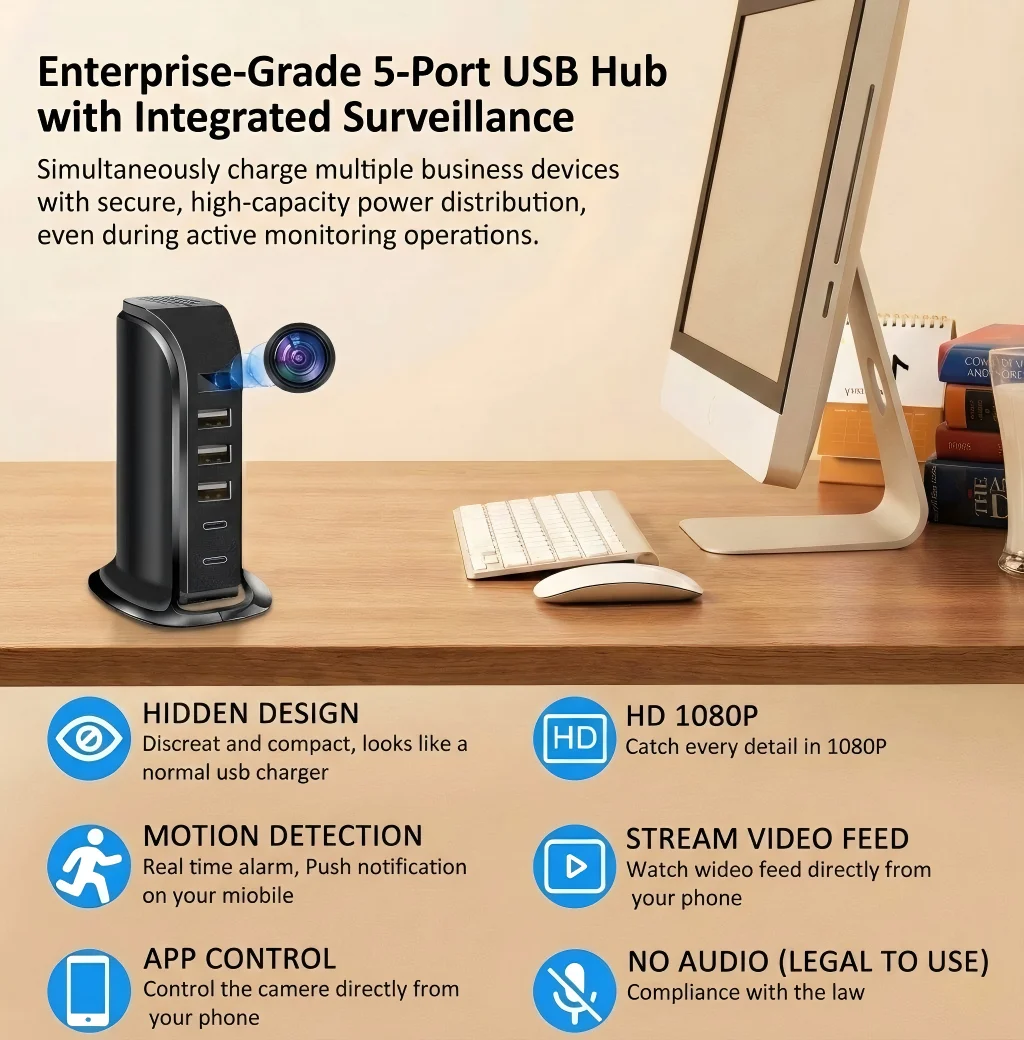
– USB chargers and power sockets — EU plug socket cameras can sit in any room socket permanently, recording to local SD card or streaming over WiFi. The WiFi 1080P Hidden EU Socket Camera is one of the most popular covert form factors in our B2B catalogue.
– Bluetooth speakers, air fresheners, and vases — Everyday household objects with camera modules inside are among the hardest to spot without close inspection.
– Pens, glasses, and key fobs — Body-worn covert cameras used for personal documentation (interviews, field notes, evidence capture) are harder to sweep for because they are not stationary.
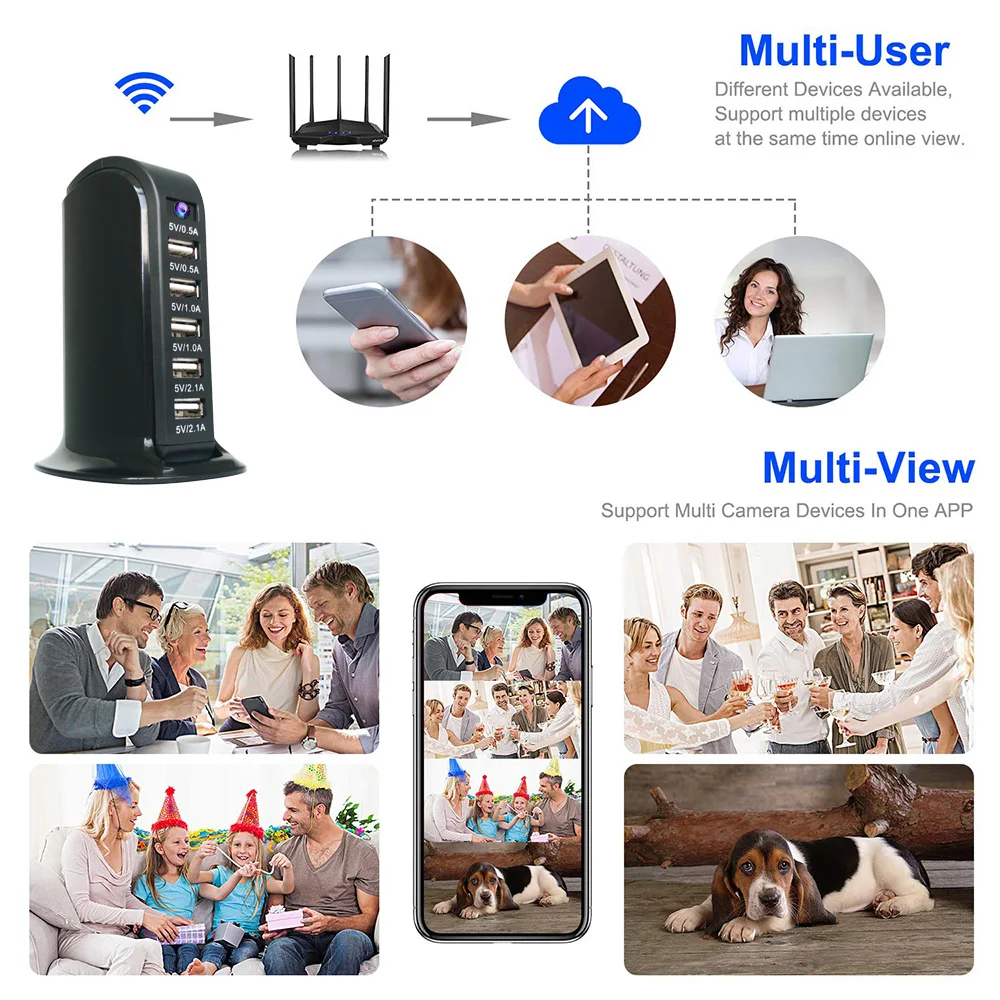
The common thread across these form factors: the lens is the one component that cannot be fully hidden. It needs an aperture. Find the aperture, find the camera.
3. The Physical Inspection Method: Zero Tech, High Yield
The single most effective detection step costs nothing and takes about five minutes. Security professionals call it a visual and physical sweep. Here is how to do it systematically.
Step-by-Step Room Sweep
1. Turn off the lights. Use your phone’s torch or a small flashlight. Shine it at a shallow angle across all surfaces — mirrors, picture frames, smoke detectors, shelves. A camera lens will reflect a blue or purple dot back at you, even through dark-tinted surfaces, because the lens glass has a distinctive refractive signature.
2. Check every device with a line of sight to sensitive areas. Scan anything that points downward from height (smoke detectors, motion sensors, light fittings) and anything placed deliberately at eye level on shelves or tables.
3. Look for unusual pinholes or asymmetry. A clock should have a display area on its face. If there is a small dark area that does not match the display, or if a smoke detector has an asymmetric vent pattern, investigate.
4. Run your hand over surfaces. Some cameras are mounted behind one-way mirror glass or behind thin panels. A subtle surface irregularity can be a tell.
5. Inspect cables and power sources. Battery-powered cameras have limited runtime. If you find a device that should have a battery indicator but has none visible — or a power socket with no connected device — that is worth examining.
6. Check WiFi device lists on your network. If you have access to the router, review connected devices. An unknown device broadcasting an SSID matching a brand name or simply labelled “camera” is a red flag. Many modern hidden cameras connect to a local WiFi network to enable remote viewing.
> Here’s what most people get wrong: They assume that if they cannot see a blinking LED, the camera is not running. Most professional covert devices have LED indicators disabled in recording mode. Absence of lights means nothing.
4. Using Your Smartphone to Find Hidden Cameras
Smartphones can assist significantly, though each method has genuine limitations.
Method A: Network Scanning Apps
Apps like Fing (available on iOS and Android) scan your local WiFi network and list all connected devices. Hidden cameras broadcasting on the same network will appear here with their manufacturer name and MAC address. Some apps try to identify device types automatically.
– Vorteile: Free, works without special hardware, fast
– Nachteile: Only detects cameras connected to your specific network; offline cameras (SD card only) are invisible
Method B: Camera Finder Apps
These apps use your phone’s camera to detect the reflective signature of a lens. You point your front camera at surfaces and the app looks for the characteristic lens glint.
– Vorteile: No additional hardware needed
– Nachteile: Very unreliable in bright environments; false positives from any glass or reflective surface; detection rate estimated at 40–60% in controlled tests
Method C: Thermal Imaging Add-Ons
Flir One and Seek Thermal compact add-ons turn your phone into a thermal camera. Active electronics inside a hidden camera generate heat. A thermal scan can reveal a warm spot inside a wall clock or behind a decorative panel.
– Vorteile: Can detect cameras that are not broadcasting anything
– Nachteile: Requires ~€200–400 hardware investment; requires experience reading thermal images
Method D: Magnetic Field Detection Apps
Some apps claim to detect the electromagnetic fields generated by electronic circuits. These are largely ineffective for modern micro cameras — the electromagnetic signature of a small board camera is below the sensitivity threshold of a smartphone magnetometer.
| Nachweismethode | Kosten | Detects Offline Cameras | Verlässlichkeit |
|---|---|---|---|
| Physical visual sweep | Free | Ja | Hoch |
| Network scanner (Fing) | Free | No (WiFi cameras only) | Medium-High |
| Camera finder app | Free | Ja | Low-Medium |
| Thermal imaging | €200–400 | Ja | Hoch |
| HF-Detektor | €30–200 | Yes (wireless) | Medium-High |
5. RF Detectors and Professional-Grade Sweeping Equipment
For business environments, rental property managers, or anyone with serious threat exposure, professional RF (radio frequency) detection equipment is worth the investment.
How RF Detectors Work
Hidden cameras that transmit video wirelessly — whether over WiFi, analogue RF, or proprietary sub-GHz protocols — emit radio energy. An RF detector senses these emissions and alerts you with an audible tone or visual indicator. As you move closer to the source, the signal strength increases.
Choosing the Right RF Detector
Entry-level detectors (€30–80) typically cover WiFi 2.4 GHz and common analogue frequencies. Professional-grade units (€150–500) add wider frequency ranges, signal strength meters, and sometimes built-in lens finders.
Look for:
– Frequency coverage: Minimum 1 GHz to 6 GHz for WiFi 2.4 GHz and 5 GHz
– Sensitivity adjustment: Allows you to differentiate between strong nearby signals and weaker distant ones
– Alert modes: Audio mute for stealth scanning, vibration for quiet environments
– Non-linear junction detection (NLJD): High-end feature that detects the semiconductor junctions in any electronic device, whether it is transmitting or not
> Caution for distributors: If you are importing or reselling detection equipment alongside covert cameras, ensure your product listings clearly distinguish legitimate surveillance (childcare monitors, home security) from devices intended for unlawful recording. GDPR and national surveillance laws in Germany, France, and Italy all impose criminal penalties for unlawful interception of communications.
6. What to Do If You Find a Hidden Camera
Discovering a covert camera on your premises or in a rented space is a serious situation. Here is the correct sequence of actions:
Immediate Steps
1. Do not touch or destroy the device. Interfering with or destroying a surveillance device may constitute a separate criminal offence depending on jurisdiction. Photograph it in situ with your phone before anything else.
2. Note the time, location, and any visible identifiers (device model, serial number, LED status).
3. If you are a guest in accommodation: Contact the host or property manager immediately via the platform you booked through. Report the incident in writing.
4. If you are on commercial premises: Contact the premises manager and request a written incident report. Ask whether the recording is covered by a legitimate security purpose (many retail and financial premises legally record).
5. File a police report. In the EU, unlawful covert recording is a criminal offence under national implementing laws of the ECHR Article 8. Police can obtain a warrant to access the device and its footage.
For Rental Property Managers
If a guest raises a concern about a hidden camera on your property:
– Take the complaint seriously immediately
– Do a joint sweep with the guest as a witness
– If a device is found, remove it and preserve it for police
– Review your onboarding procedures and ensure your property listing states your legitimate CCTV policy clearly
7. Legal Considerations Across Europe
The legal status of hidden cameras varies significantly across EU member states, and it is critical for businesses to understand the framework before deploying any surveillance device.
GDPR and the Legitimate Interest Test
Under GDPR Article 6(1)(f), recording via CCTV or covert cameras in commercial premises can be justified by legitimate interest — typically the protection of property, prevention of theft, or staff safety. However, this legitimate interest does nicht extend to:
– Recording customers without clear signage
– Monitoring employee rest areas or toilets
– Placing cameras in rental accommodation without disclosure
The European Data Protection Board (EDPB) Opinion 05/2023 clarifies that proportionality is key: the least privacy-invasive method must be used to achieve the stated purpose.
Country-Specific Rules
| Country | Covert Recording by Individuals | Business CCTV Requirements |
|---|---|---|
| Italien | Art. 615-bis c.p.: criminal offence unless all parties consent | Registration with Garante; signage mandatory |
| Germany | BVerfGE case law: self-protection recordings permitted narrowly | BDSG §26; works council co-determination for employee monitoring |
| France | CNIL: strict proportionality required; secret recording in private spaces is criminal | CNIL registration; 3-metre signage; 30-day maximum retention |
| UK | IPA 2016: limited self-help defence; secret recording in private is generally prohibited | ICO CCTV Code of Practice; signage required |
| Spain | LOPD-GDD: CCTV in public-access areas requires prior declaration | AEPD guidance; employee monitoring requires works council consultation |
> The disclosure rule across the EU: Where covert cameras are deployed for genuine security purposes, prominent signage stating that recording is taking place is universally required. Failure to display this notice converts a potentially legitimate security measure into an unlawful privacy violation — and exposes the operator to both GDPR fines and potential criminal liability.
For B2B buyers sourcing covert cameras: your obligation as a supplier is to ensure your customers understand these legal frameworks. Our product range at QZT Security is designed for legitimate applications (home security, childcare, personal evidence capture, professional investigations) — and we advise all commercial buyers to take legal guidance before large-scale deployment.
8. FAQ
Can I legally use a hidden camera detector in my own home in the EU?
Yes. Scanning your own property for surveillance devices is entirely lawful across all EU member states. You have no obligation to notify anyone before conducting a physical or network-based sweep of premises you own or legitimately occupy.
What is the most reliable method for finding a hidden camera?
A physical visual sweep with lights turned off, using a flashlight at a shallow angle to detect lens reflections, is the most consistently reliable method. It detects both active and inactive cameras and costs nothing. RF detectors add value for wireless cameras but miss SD-card-only devices.
Do hidden cameras show up on WiFi if they are not connected to my network?
No. Cameras that record only to local SD card, or that connect to a separate dedicated WiFi network, will not appear in your router’s device list. This is one reason why combining network scanning with physical inspection is essential.
How long can a hidden camera record before the battery or storage runs out?
It varies significantly by form factor and settings. Battery-powered devices like a Powerbank versteckte Kamera kann im Bewegungsmelder-Modus mit voller Ladung 6–12 Stunden aufzeichnen. Steckdosencameras, die direkt am Stromnetz betrieben werden, können unbegrenzt laufen. Die meisten 1080p-Kameras speichern 10–12 Stunden Aufnahmen pro 64 GB SD-Kartenspeicher im Standardaufnahmemodus.
Wenn ich eine versteckte Kamera in einem Airbnb finde, welche Rechte habe ich?
Sie haben das Recht, sofort die Polizei und die Hosting-Plattform zu kontaktieren. Gemäß DSGVO gelten Hosting-Plattformen als Datenverantwortliche, wenn sie von rechtswidrigen Aufnahmen auf ihrer Plattform wissen oder daran beteiligt sind. Dokumentieren Sie das Gerät fotografisch, zerstören Sie es nicht und fordern Sie eine vollständige Rückerstattung unter Berufung auf die Datenschutzverletzung. Die meisten großen Plattformen haben spezifische Richtlinien, die Hosts entfernen, die Gäste ohne Einwilligung aufzeichnen.
Benötigen Sie zuverlässige Überwachungsausrüstung für legitime Sicherheitszwecke? Wie man die beste versteckte Kamera in 2026 auswählt um Ihre Anforderungen zu besprechen – von Einzelgeräten bis zu OEM/ODM-Aufträgen für groß angelegte kommerzielle Einsätze.

 English
  Italiano
  Deutsch
  Français
  Español
  Polski