
Cómo elegir una cámara espía con batería de larga duración
La queja más común de los compradores de equipos de vigilancia encubierta es la misma en todos los mercados: la batería no dura tanto como afirmaba la lista. Cuando buscas telecámara espía batería larga duración, está mirando más allá del lenguaje de marketing para encontrar un dispositivo que realmente funcione durante un día completo de trabajo, un turno nocturno o una operación de vigilancia de varios días sin quedarse sin batería en el momento más inoportuno.
Esta guía explica cómo funciona realmente la vida de la batería en cámaras espía, cómo son los números en la realidad y cómo elegir y configurar una cámara que ofrezca la duración que necesitas.
Por qué las afirmaciones sobre la duración de la batería casi siempre son incorrectas
En cada lista de productos para una cámara espía con batería se incluye una especificación de duración de la batería. Casi ninguna refleja el rendimiento en condiciones reales. Aquí está el porqué:
La duración de la batería indicada (a menudo “hasta 20 horas” o “30 días en espera”) se mide bajo condiciones ideales de laboratorio: batería nueva, sin eventos de detección de movimiento, sin visualización remota, sin actividad de red, temperatura constante en la habitación. El uso real consume la batería significativamente más rápido.
Factores de consumo real de batería en uso real:
– Eventos de detección de movimiento — cada evento activa la grabación, el procesamiento del LED y la transmisión WiFi, consumiendo 3–5 veces más corriente que en modo de espera
– Transmisión WiFi — la visualización remota en vivo consume 2–3 veces más energía que la grabación local en SD
– Pantalla activada / aplicación abierta — cuando estás activamente viendo la transmisión en vivo, el consumo de batería aumenta significativamente
– Temperatura — las baterías de litio pierden 20–40% de la capacidad nominal a menos de 10°C y dejan de funcionar completamente a menos de -10°C
– Antigüedad de la batería — después de 300–500 ciclos de carga, las baterías de litio normalmente mantienen 70–80% de su capacidad original
– Indicadores LED — las luces indicadoras que permanecen encendidas consumen una pequeña pero medible cantidad de corriente continuamente
Una cámara catalogada como “20 horas de registro continuo” en realidad proporcionará 8–12 horas de uso real con registro mixto y en espera.
> Aquí está la regla general utilizada por los operadores de vigilancia profesionales: divida la duración de la batería indicada por el fabricante por 2.5. Ese número — no la especificación de marketing — es lo que planifica.
Comprendiendo la capacidad de la batería: explicación de los mAh
La capacidad de la batería en dispositivos electrónicos pequeños se mide en miliamperios-hora (mAh). Un número de mAh más alto significa más energía almacenada y un tiempo de funcionamiento más largo — todo lo demás siendo igual.
Aquí está el panorama práctico de la capacidad de la batería para cámaras espía:
| Capacidad de la batería | Registro Continuo (est.) | En espera (estimado) | Factor de forma |
|---|---|---|---|
| 500–1,000 mAh | 3–5 horas | 3–7 días | Cámara de bolígrafo, cámara de llavero |
| 2,000–3,000 mAh | 6–10 horas | 10–15 días | Cargador USB, detector de humo |
| 5,000–6,000 mAh | 12–18 horas | 20–30 días | Cámara con batería externa |
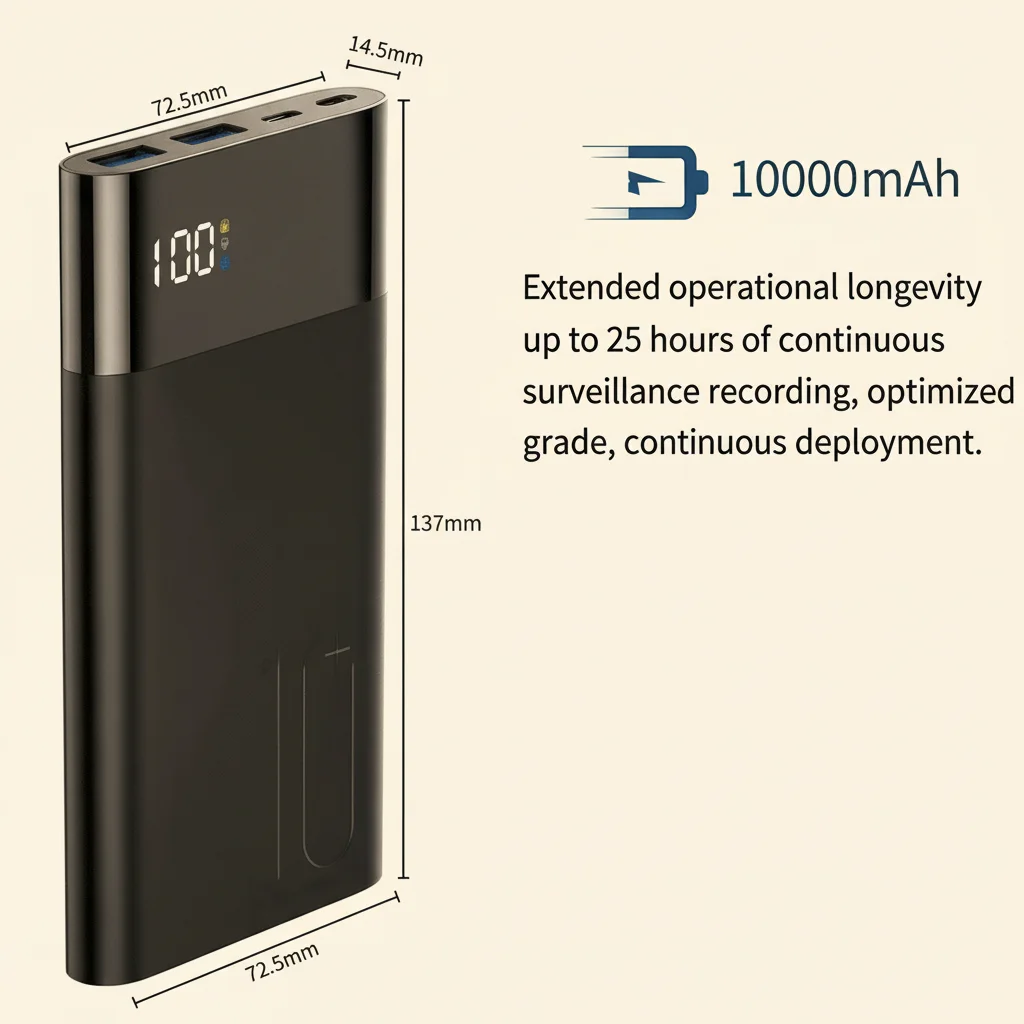
| 10,000+ mAh | 20–30 horas | 40–60 days | Large power bank, external battery pack |
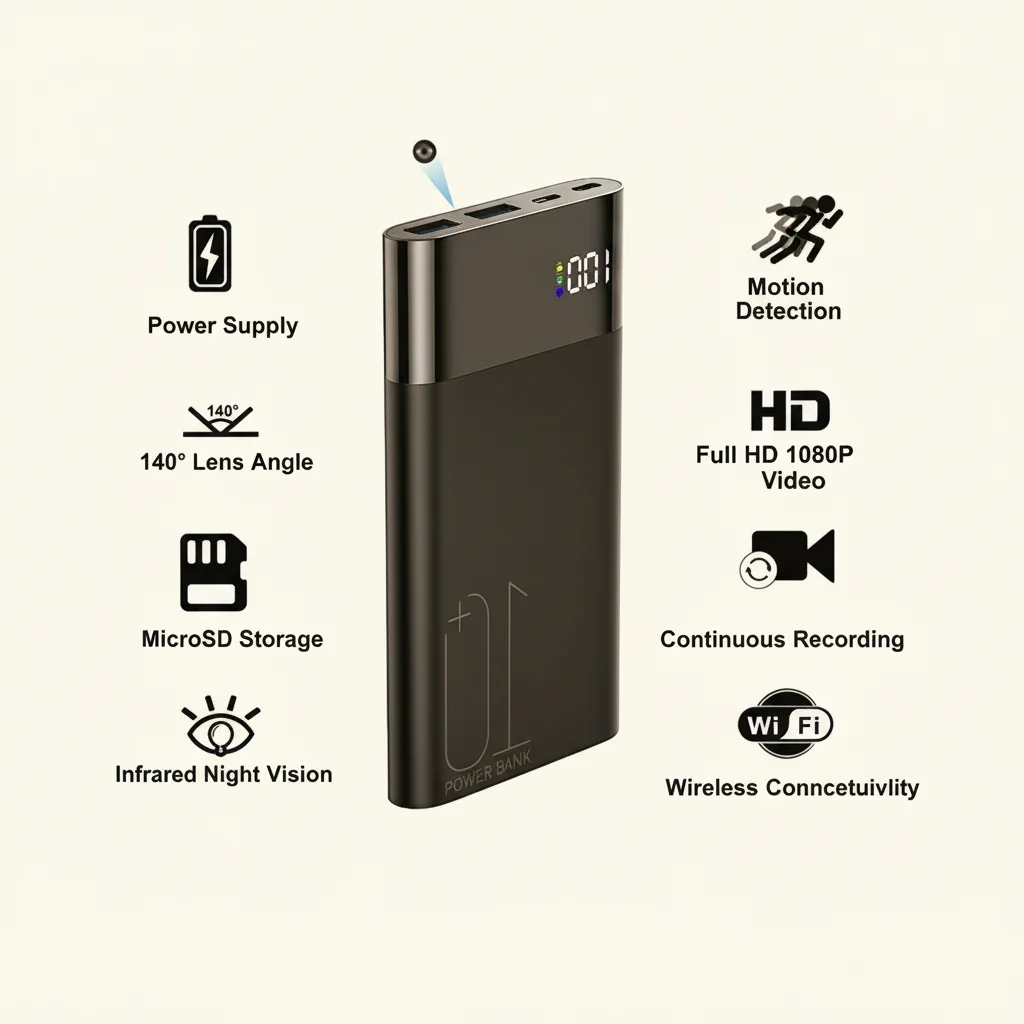
For Italian buyers planning practical deployments, the sweet spot is a 5,000–10,000 mAh capacity combined with a form factor that allows continuous USB power. A power bank camera with 10,000mAh and USB pass-through charging can operate indefinitely as long as it is connected to a power source.
Cámaras con banco de energía: la mayor duración de batería en un factor de forma portátil
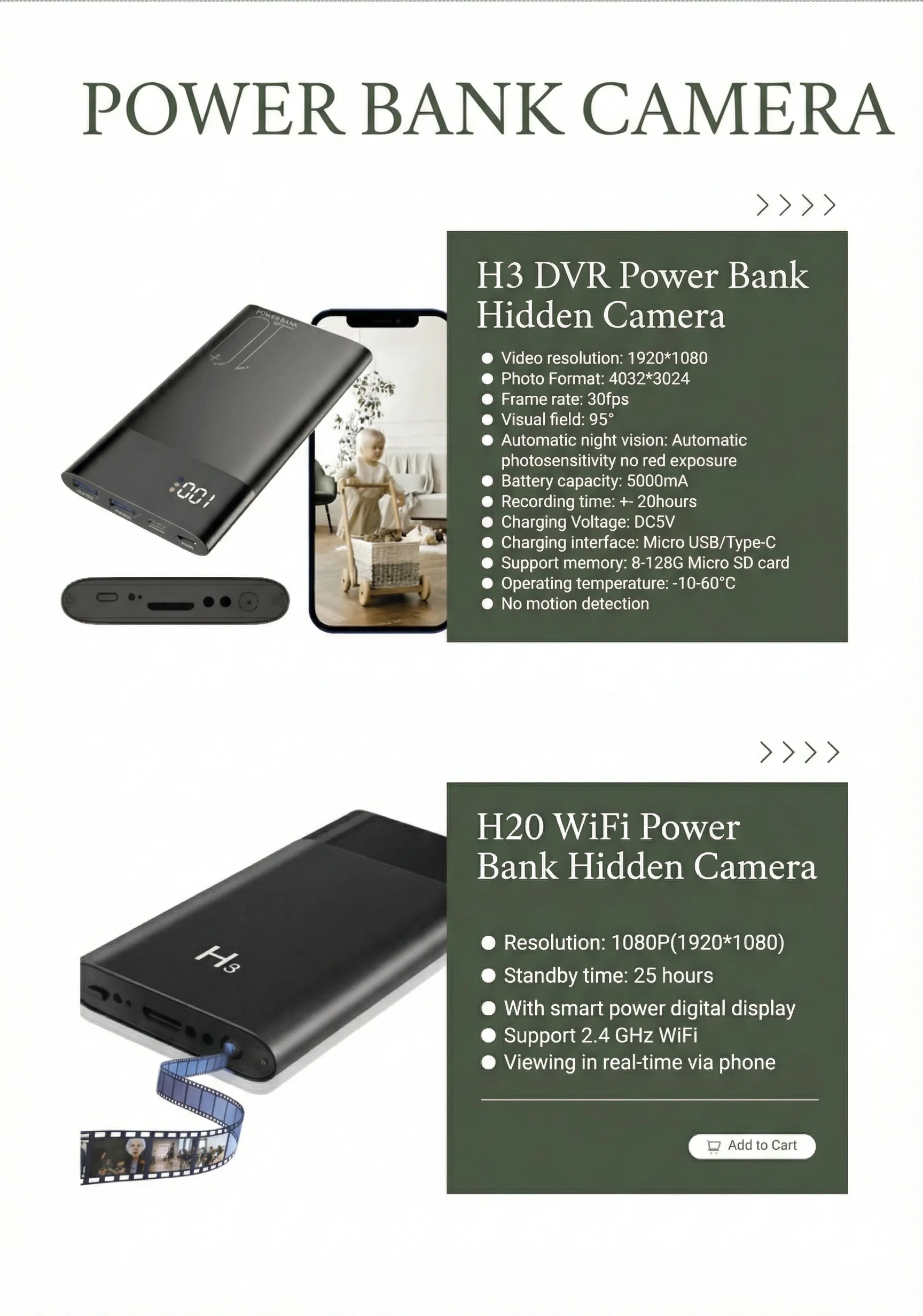
Power bank cameras — devices that look like ordinary portable battery packs but contain a hidden lens — offer the best combination of long battery life and practical portability. The Cámara power bank H3 y el Cámara H20 Power Bank are among our most requested products for exactly this reason.
With a 10,000mAh battery capacity, these cameras deliver:
– 20–30 hours of continuous recording on a single charge
– USB pass-through charging — plug in a power bank camera and it records while charging simultaneously, effectively giving it unlimited runtime when near a power outlet
– Portable deployment — take it anywhere without cables, then plug it in once you are in position
– Phone charging capability — the power bank function remains active, meaning the device serves a dual purpose and raises no suspicion
For Italian security professionals and homeowners who need a camera that lasts through a full day of surveillance or an overnight monitoring shift, the power bank form factor solves the battery problem more practically than any other approach.
Registro activado por movimiento: el multiplicador de la vida de la batería
If you are running a spy camera on battery power, motion-activated recording is not optional — it is essential. The difference in battery consumption between continuous recording and motion-triggered recording is dramatic.
Continuous recording at 1080p/30fps draws approximately 250–400mA from the battery. A 3,000mAh camera runs for 7–12 hours of continuous recording before dying.
Motion-activated recording, with the camera in standby mode between events, draws approximately 5–15mA in standby. A 3,000mAh camera can sit in standby for 8–15 days. Each motion event (a 30-second to 5-minute clip, depending on configuration) adds a few minutes of high-drain recording.
For a camera deployed in a room with moderate activity, this means:
– Motion detection ON: 5–7 days of operation from a 3,000mAh battery
– Motion detection OFF (continuous): 8–12 hours from a 3,000mAh battery
That is a 15–20x difference in practical battery life from the same hardware, achieved purely through configuration.
> Pro tip: set your motion detection to record 30–60 seconds after the last detected movement, not just a fixed clip length. This avoids cutting off the end of an event and saves recording time when the room is empty.

Detección de movimiento PIR: por qué ahorra batería y mejora las imágenes
Standard pixel-change motion detection requires the camera to analyze every frame of video in real time — a computationally intensive process that draws significant power continuously. La detección de movimiento PIR (infrarrojo pasivo) uses a dedicated infrared sensor that detects heat signatures from humans and animals without processing video frames continuously.
The power consumption difference is substantial:
– Pixel-change detection: draws 50–100mA continuously
– PIR detection: draws 5–15mA continuously
PIR sensors are standard on quality indoor cameras and outdoor cameras. They are not found on budget pen cameras and keychain cameras, where the form factor is too small to accommodate a separate PIR module.
For Italian buyers who need extended battery life from a compact pen camera or body-worn device, the practical approach is Grabación programada — set the camera to record only during specific hours rather than running continuously. A pen camera that records from 9am to 6pm (9 hours) instead of 24/7 extends its effective operational period by nearly three times on a single charge.
Opciones de energía para instalaciones permanentes o semipermanentes
For installations where the camera does not need to be portable, connecting to a permanent power source eliminates the battery problem entirely. Italian buyers should consider these options for long-term deployments:
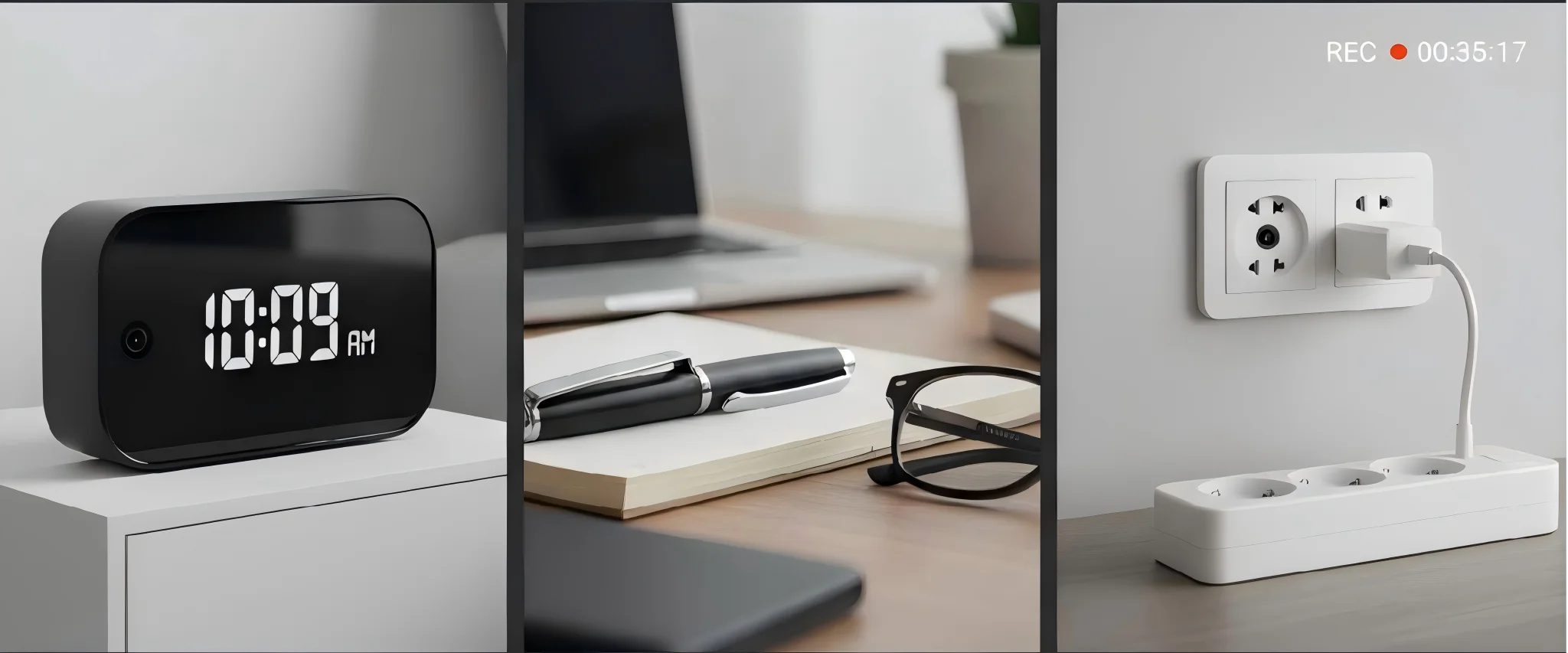
USB power adapters — plug the camera into any USB outlet or USB power strip. The Cámara oculta en enchufe EU WiFi 1080P is a wall socket with a built-in camera — it plugs into the wall, draws continuous power, and never needs battery charging. For home security and office monitoring, this is the most practical long-term solution.
USB power banks as continuous power sources — a power bank camera connected to a wall outlet via its USB pass-through port effectively becomes a wall-powered camera with built-in battery backup. If the power goes out, the internal battery takes over seamlessly.
Solar charging — for outdoor deployments where no power source is available, a small 5W solar panel can keep a compatible power bank camera running indefinitely in sunny regions of Italy. Southern Italy, coastal areas, and open rural properties get enough solar energy for year-round operation with appropriate panel sizing.
Química de la batería y longevidad: aprovechando al máximo tu cámara
Lithium-ion and lithium-polymer batteries degrade over time and with usage. Understanding this degradation helps you plan realistic battery replacement cycles and avoid unexpected failures.
Temperature is the primary enemy of battery longevity. Storing or using lithium batteries above 30°C accelerates degradation. Avoid leaving cameras in cars, direct sunlight, or near heat sources. Italian summers can be particularly challenging — a camera left in a parked car in August can lose 20–30% of its rated capacity in a single afternoon.
Partial discharges are better than full discharges for lithium battery longevity. Lithium batteries do not have a “memory effect” (that was a problem with older nickel-cadmium batteries), but deep discharging (below 10%) stresses the cells and reduces cycle life. Charge the camera when it reaches 20–30% battery rather than running it completely flat.
Storage at 40–60% charge extends battery life for cameras that are not in regular use. If you are stocking inventory or storing spare cameras, charge them to roughly half before putting them away.
For professional users who rely on cameras in critical situations — private investigators, security professionals, legal evidence gathering — carrying a spare battery or a spare camera is standard operating procedure. Battery life is never assumed to match specifications; contingency planning is essential.
Preguntas frecuentes
What is the longest battery life available in a covert spy camera?
Power bank cameras with 10,000–20,000mAh batteries offer the longest battery life in portable form factors — up to 30 hours of continuous recording. For unlimited runtime, wall-powered cameras like the WiFi Hidden EU Socket Camera eliminate the battery problem entirely by drawing constant power from the electrical grid. Solar-augmented power bank cameras can operate indefinitely outdoors in sunny regions.
Does using WiFi remote viewing drain the battery faster?
Yes — significantly. Live WiFi streaming requires the camera’s wireless module to maintain an active data connection and transmit video continuously, drawing 2–3x more power than local SD recording. For maximum battery life, disable live streaming and check footage from the SD card directly after the operation concludes. Motion detection alerts with thumbnail previews use minimal additional power and are the most battery-efficient way to stay informed remotely.
How can I extend the battery life of my spy camera during an extended operation?
Configure motion-activated recording with a 30–60 second post-motion buffer. Reduce video resolution from 4K to 1080p if available. Disable WiFi live streaming and check footage locally. Turn off LED indicators. In cold environments, keep the camera close to your body to maintain battery temperature above 15°C. For operations longer than 24 hours, a USB power bank with pass-through charging is the most reliable solution.
Do spy camera batteries wear out over time?
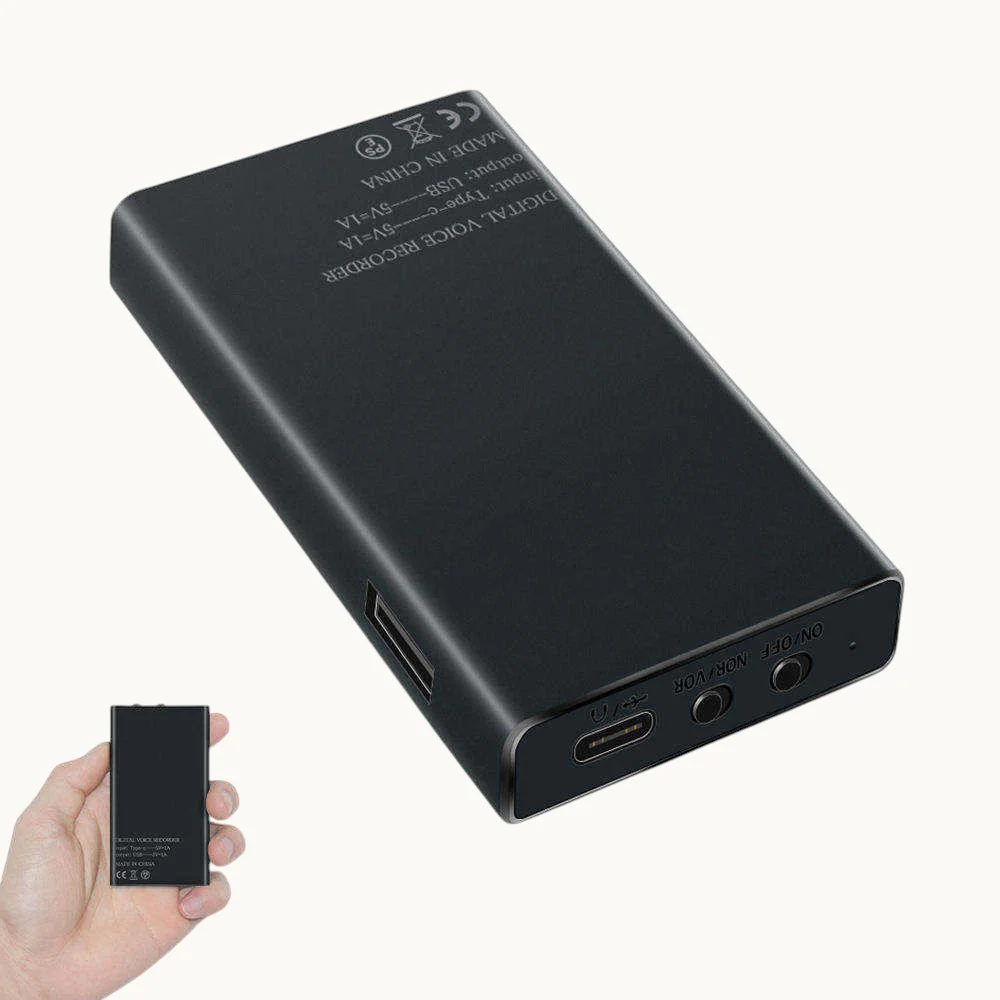
Yes. Lithium batteries typically retain 70–80% of their original capacity after 300–500 full charge cycles — roughly 1–2 years of regular use. After this point, the camera will last noticeably less long on a full charge. For cameras used daily, budget for battery replacement after 12–18 months. The Q97 Professional Voice Recorder Type C and other quality devices use replaceable batteries where available, extending operational life significantly.
Can I use a spy camera while it is charging?
Most power bank cameras and USB-powered cameras support pass-through charging — they record while connected to a power source. Verify this feature before purchasing, as some cameras disable recording while charging. For wall-powered deployments like the Cámara oculta en enchufe EU WiFi 1080P, continuous operation with no battery concerns is the standard operating mode.
Conclusión
Eligiendo una cámara espía con batería de larga duración requires looking past the marketing spec to understand real-world battery behavior. Plan on the actual battery life being 2–2.5x shorter than listed. Configure motion-activated recording on any battery-powered camera. Choose the power bank form factor for maximum portable endurance, or go wall-powered for permanent installations where battery life is irrelevant.
For Italian buyers sourcing spy cameras for professional use — private investigation, security work, or legal documentation — the investment in quality hardware with real battery endurance pays for itself the first time a camera runs out of power at a critical moment.
Browse our full range of battery-powered and wall-powered covert cameras at qztsecurity.com, or contact our team to discuss battery life specifications for specific deployment scenarios.

 English
  Italiano
  Deutsch
  Français
  Español
  Polski